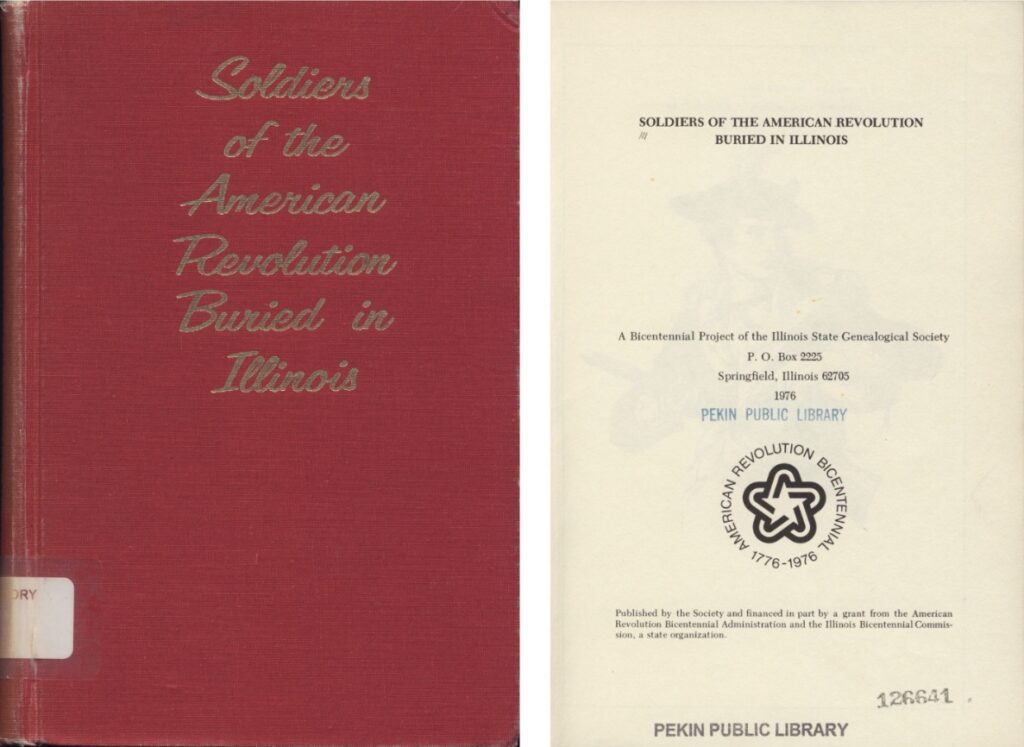
Earlier this year, in preparing the Pekin Public Library’s U.S. Semiquincentennial “Portrait of a Patriot” series, I set about researching a soldier named James Campbell, who is listed in an old reference book in the library’s Local History Collection entitled “Soldiers of the American Revolution Buried in Illinois,” prepared and published in 1976 by the Illinois State Genealogical Society for the U.S. Bicentennial.
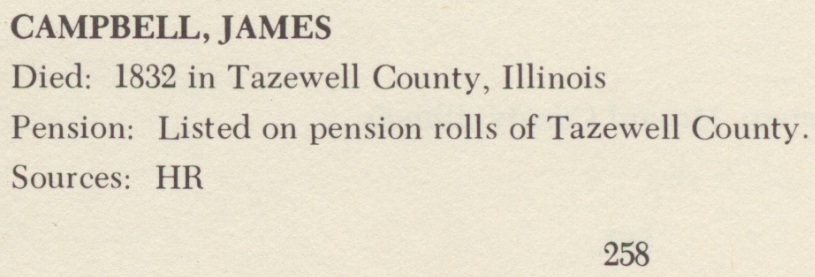
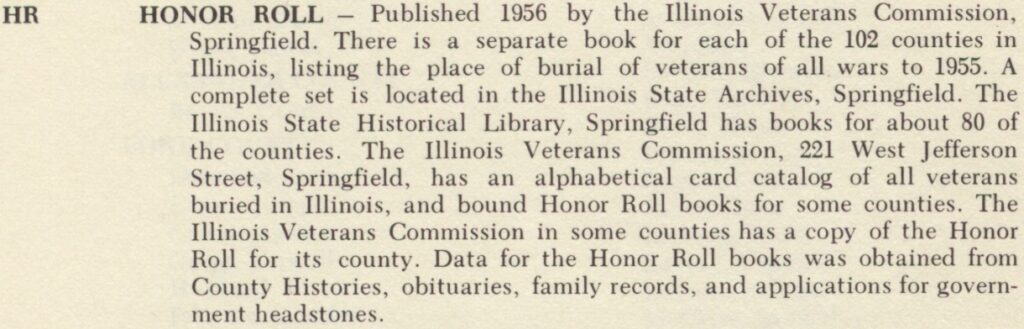
The index entry for James Campbell is quite spare, but identifies him as a Revolutionary War soldier who died in Tazewell County in 1832, and states that his name is listed on Tazewell County pension rolls. The 1976 index cites just one source for its information about James Campbell — the 1956 Honor Roll that had been compiled and published by the Illinois Veterans Commission in Springfield.
Hoping to learn more about James Campbell and his reported connection to Tazewell County, I went looking for him in the old pension rolls to verify that he was indeed a Revolutionary War soldier and to learn the details of his pension payments. As the 1976 index says, James Campbell does indeed appear on old pension rolls, as shown here below.
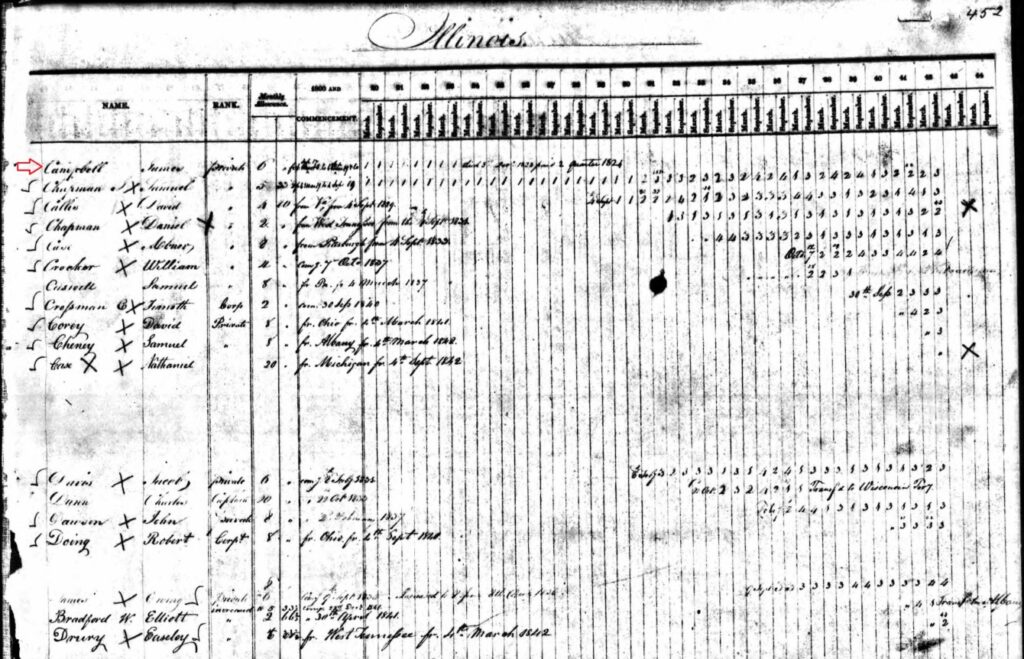

One important thing that we learn from this pension roll is that Pvt. James Campbell did NOT die in 1832 as the 1976 index says. Rather, he died 3 Dec. 1823. Obviously “1832” was a simple typographical error or misreading for “1823.” Nevertheless, from this pension roll record we can verify that James Campbell was a soldier, serving at the rank of private, and that at some point from 1820 to 1840 he received pension payments in Illinois. But this record does not tell us where in Illinois he lived. Was it Tazewell County as the 1976 index states?
Seeking to answer that question, we should next consult the 1956 Tazewell County Honor Roll:
Although there are several Campbells in the 1956 Tazewell County Honor Roll, James Campbell nowhere appears in that volume. Yet the 1976 index cites the 1956 Honor Roll as evidence for James Campbell being listed on Tazewell County pension rolls. Clearly, the James Campbell entry in the 1976 index is mistaken. Not only did James die in 1823 rather than 1832, but the source cited for James being on Tazewell County pension rolls doesn’t mention him at all.
Now, in addition to the above Illinois pension roll document, there is another 19th century pension roll that mentions James Campbell. He is listed in the “Pension Roll of 1835,” as we see here:
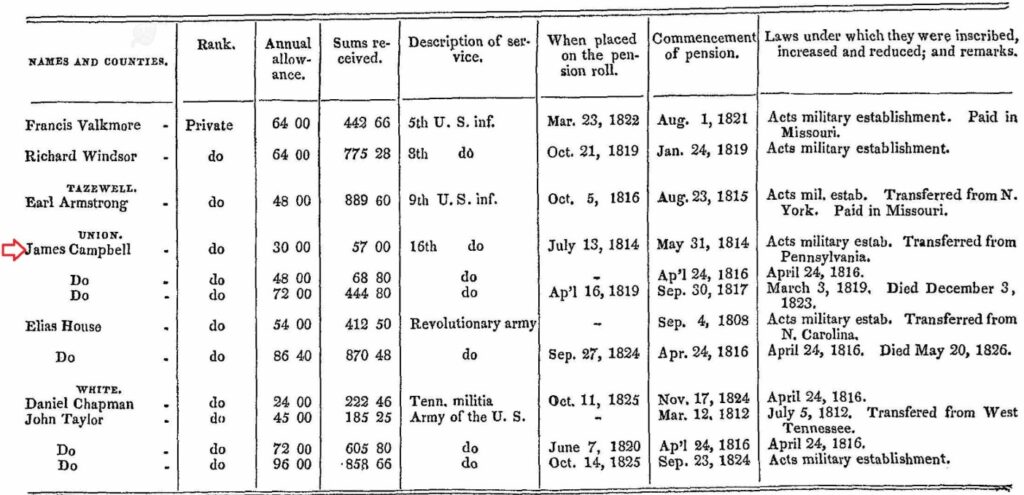
Here we find James Campbell and his pension payments and dates — but he is listed under Union County, not Tazewell County. Notice that right above James Campbell is an Earl Armstrong, listed under Tazewell County. It seems to when the 1976 index was compiled, someone probably consulted the Pension Roll of 1835 but his eyes strayed from “TAZEWELL” down to “James Campbell,” thereby misidentifying James Campbell as a resident of Tazewell County. According to the above listing, it seems we should instead look for him in Union County.
If the Pension Roll of 1835 is right, and the 1976 index really found James Campbell in the 1956 Honor Roll, then perhaps we will find him in the Union County Honor Roll book.
Nevertheless, James Campbell is not listed in the Union County Honor Roll book either. Apparently his military service attested in the 19th century pension rolls was overlooked when that book was compiled. Or perhaps the Pension Roll of 1835 mistakenly placed him in Union County when he really lived elsewhere in Illinois. Where in Illinois did James Campbell really live? Perhaps the following document might point us in the right direction.
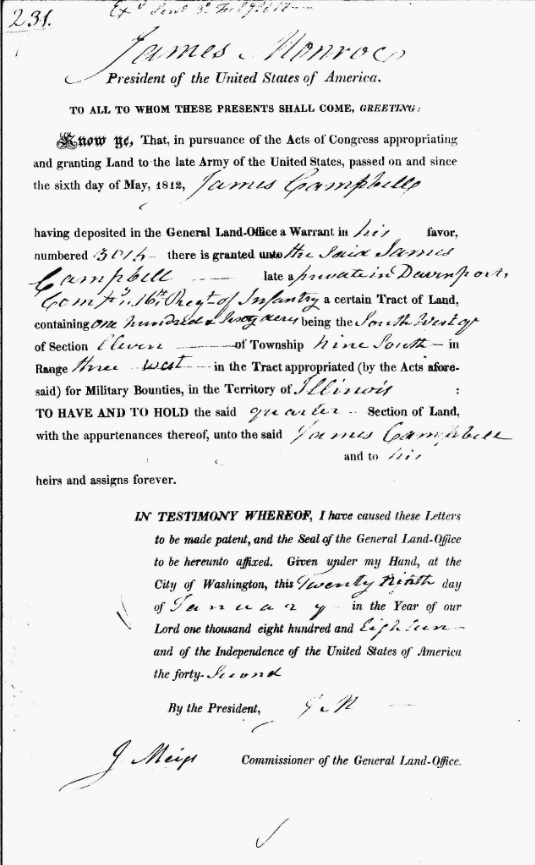
The online database “U.S. General Land Office Records 1776-2015” provides the above shown federal letters patent for James Campbell, granting him bounty land in Illinois on 29 Jan. 1818, in Section 11 of Township 9 South, Range 3 West of the 4th Principal Meridian, in reward for His faithful service in Davenport’s Company of the 16th Regiment of Infantry. At the time of this grant, Illinois was still a part of the Indiana Territory, and Campbell’s land was in Madison County, which then included about the northwest third of present Illinois. Campbell’s bounty land is now in Calhoun County — not Union County, and not Tazewell County.
We can’t be sure that Campbell ever lived on his Illinois bounty land, but he certainly came to Illinois and received pension payments here. We have no reason to believe that he ever lived in Tazewell County, though.
What else can we learn about James Campbell? For one thing, the Pension Roll of 1835 says he first began to receive his pension in Pennsylvania, then had his payments transferred to Illinois (evidently because he had left Pennsylvania and settled in Illinois). Campbell’s pension payments can be found on these Pennsylvania pension roll:
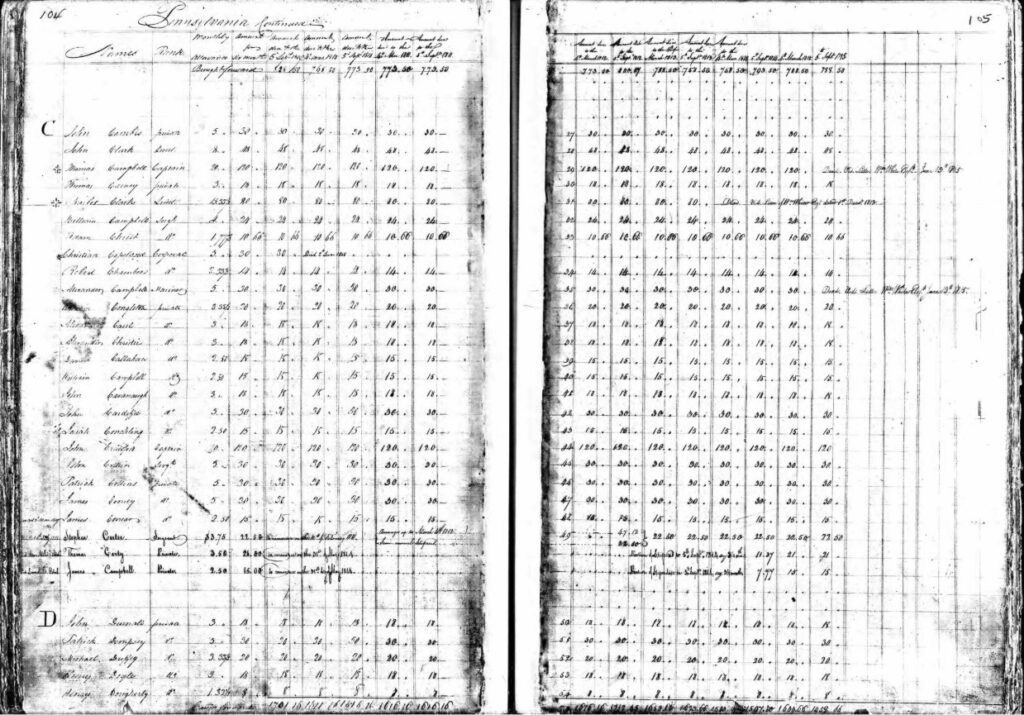
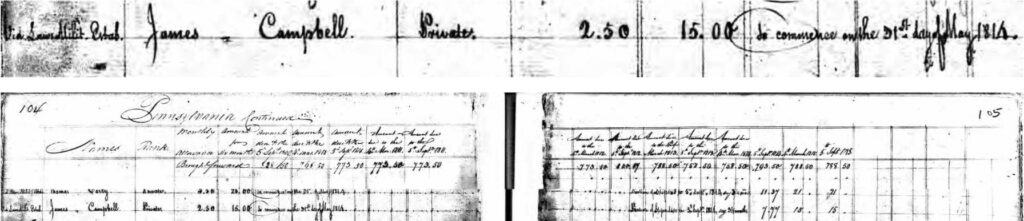
Unfortunately tracking down Pvt. James Campbell in Illinois is not at all an easy task, given how common his name is. We have also established that there is no evidence linking him to Tazewell County. He instead seems to have settled in Southern Illinois, dying in a Southern Illinois county (perhaps present day Calhoun County?) on 3 Dec. 1823. We therefore can eliminate him from the list of Revolutionary War soldiers buried in Tazewell County.
But at least he was Revolutionary War soldier, right?
No, he wasn’t even a Revolutionary War Patriot. We know that from the statements in the Pension Roll of 1835 and on the letters patent for his Illinois bounty land that he served in Davenport’s Company of the 16th Regiment of Infantry. There was no such regiment in the U.S. Continental Army during the Revolutionary War. The U.S. Army’s 16th Infantry regiment was not constituted until some years after the Revolutionary War, and it later saw action during the War of 1812.
James Campbell’s pension filing also explicitly tells us what war he served in:
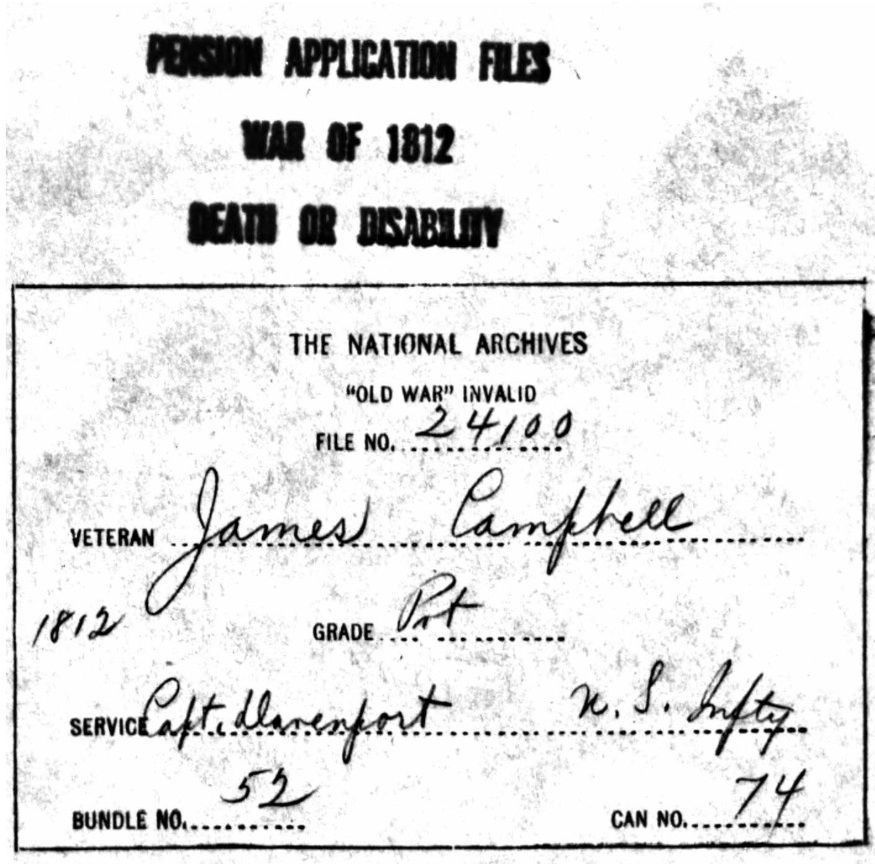
In fact, the 16th Infantry that served in the War of 1812 was specifically established on 11 Jan. 1812 and was raised in the State of Pennsylvania — where James Campbell came from. Throughout the War of 1812, the regiment was commanded by Col. Cromwell Pearce of Chester Co., Pennsylvania. The regiment’s battles during that war included York, Chrysler’s Farm, Lyon’s Creek, Chippewa, and Lundy’s Lane (Bridgewater).
Here is the 16th Infantry’s Field and Staff during the War of 1812 — note the name in boldface:
- Lieut. John Caldwell’s Co.
- Capt. William Davenport’s Co.
- Capt. Miles Greenwood’s Co.
- Capt. Thomas Lyon’s Co.
- Capt. John Machesney
- Capt. Alexander McEwen’s Co.
- Lieut. Thomas M. Powers’s Co.
- Capt. George G. Steele’s Co.
- Men at Fort George
- Men at Fort Mifflin and Province Island Barracks
Capt. Davenport and his regiment – including Pvt. James Campbell – distinguished themselves at the battles of Chippewa and Lundy’s Lane (which took place 25 July 1814) in New York at the border of British Canada. Capt. Davenport himself later served during the 1832 Black Hawk War in Illinois and Wisconsin, and we know that one of the soldiers who served under him, James Campbell, had come to Illinois about 17 years before the Black Hawk War and died about nine years before Black Hawk’s desperate rising.
So, although Campbell was not a Tazewell County resident, and he wasn’t even a Revolutionary War Patriot, he was certainly a patriot who honorably served his country during the War of 1812, the “sequel” to the Revolutionary War that ended in a stalemate but also firmly established that the United States of America was here to stay.
The important lesson to keep in mind is that researchers need to be careful with old published indexes such as “Soldiers of the American Revolution Buried in Illinois” (1976) and the 1956 Honor Roll books. Earlier publications such as those often assumed that anyone listed on a 19th century pension roll was a Revolutionary War soldier, but the pension rolls included any pensioned soldier who had served in any U.S. conflict, including the War of 1812 or Indian wars. Furthermore, as we have seen, sometimes those indexes did not rely on good sources, or they misread the good sources they had. It is always important to go back to the primary sources to verify facts about a soldier’s military service.
So then, if Campbell cannot be claimed as a Revolutionary War soldier buried in Tazewell County, what about Earl Armstrong, who is listed in the Pension Roll of 1835 as a Tazewell County resident? We will investigate the life and military service of Earl Armstrong next week.