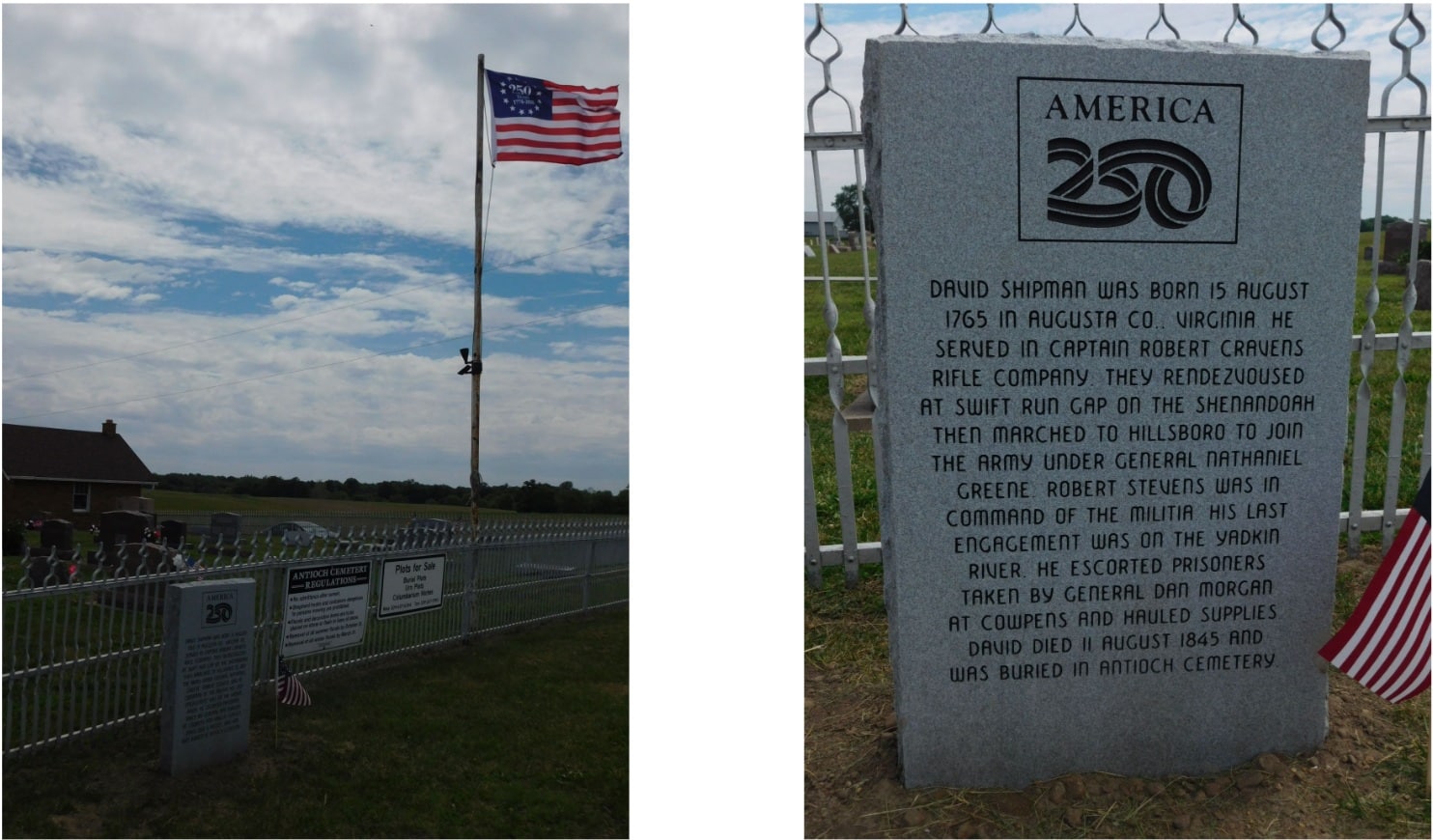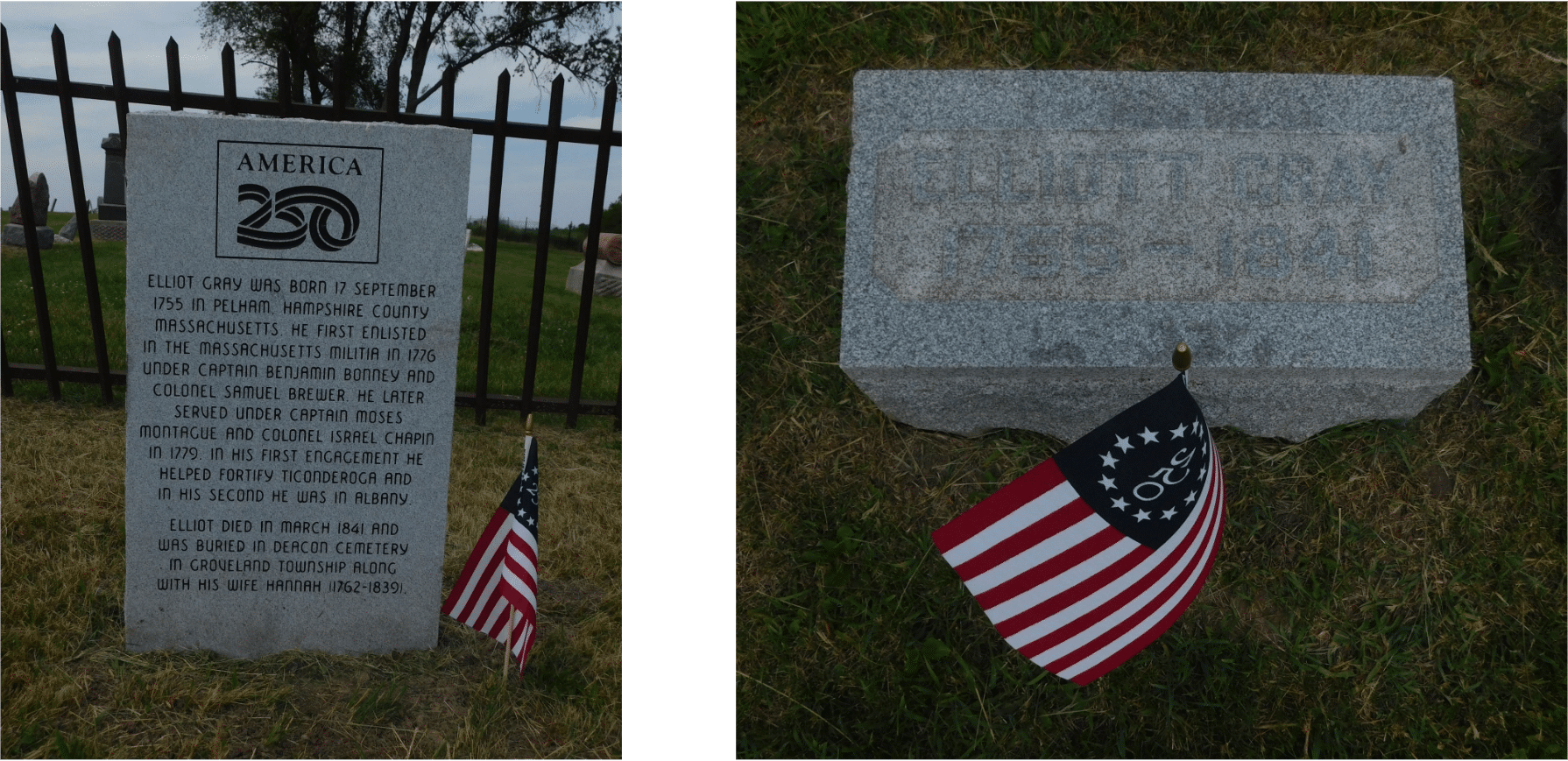

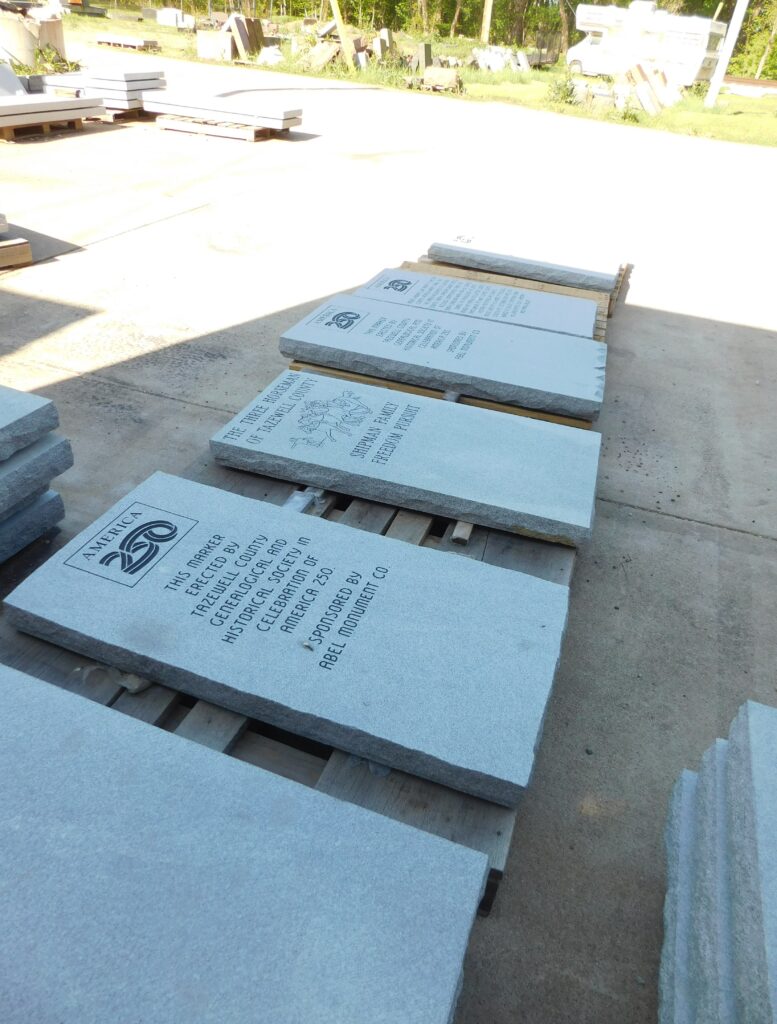
In keeping with this year’s celebration of the American Semiquicentennial, this month at “From the History Room we have turned our attention to soldiers who served in the Revolutionary War (1775-1783) and then later settled in Tazewell County, Illinois, and are buried here. This Saturday, 30 May 2026, at 10 a.m., the Tazewell County Genealogical & Historical Society will honor five of those soldiers in a public Dedication Event at Antioch Cemetery, located a few miles south of Tremont at the intersection of Antioch and Townline roads. This month, new “America 250” stone monuments created by Abel Vault & Monument have been placed to memorialize the patriotic service of James Broyhill, Elliot Gray, Moses Hoskins, Samuel McClintock (or McClintick), and David Shipman. Their memorial stones now stand near the entrances of the cemeteries that are either where these soldiers rest or are close to their probable burial sites.

The Pekin Public Library this year has also been presenting its own “America 250” in-person history programs, including an ongoing “Portrait of a Patriot” series that tells of life stories and patriotic service of Revolutionary War soldiers who are known or believed to be buried in Tazewell County. The next “Portrait of a Patriot” will be Saturday, June 6, at 10 a.m., and will tell the story of Pvt. Samuel McClintick.
This month we have begun to publish the content of those programs here at “From the History Room.” Thus, in the past two weeks we have looked into the lives and military service of two early 19th century American soldiers. One of them, Pvt. James Campbell, was erroneously listed as a Revolutionary War soldier buried in Tazewell County, while another, Pvt. Earl Armstrong, is listed on the Pension Roll of 1835 as a Tazewell County resident. We found that neither Campbell nor Armstrong were Revolutionary War soldiers, and neither of them were residents of Tazewell County — Campbell came from Pennsylvania and settled in Southern Illinois, while Armstrong came from New York and settled in Fulton County, across the river from Tazewell County.
While neither Campbell nor Armstrong were War of 1812 Patriots rather that Revolutionary War Patriots, this week at “From the History Room” we turn our attention to a man who undoubtedly served in the Revolutionary War: Pvt. Levin H. Powell (1763-1836), a Virginia native who came to Central Illinois in the last months of his life. Powell’s life and Revolutionary War service have been extensive researched by Robert Hoffer of the Peoria Historical Society and Susan Rynerson of the Tazewell County Genealogical & Historical Society. The following account of Powell’s life and service is founded upon on Hoffer’s and Rynerson’s research.
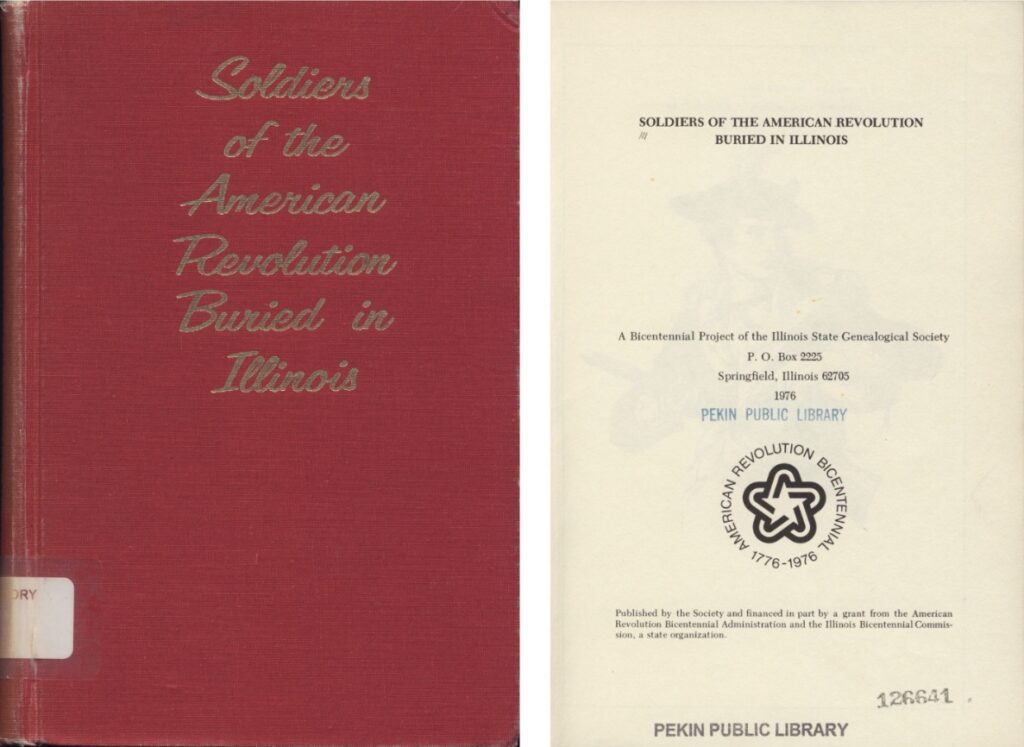
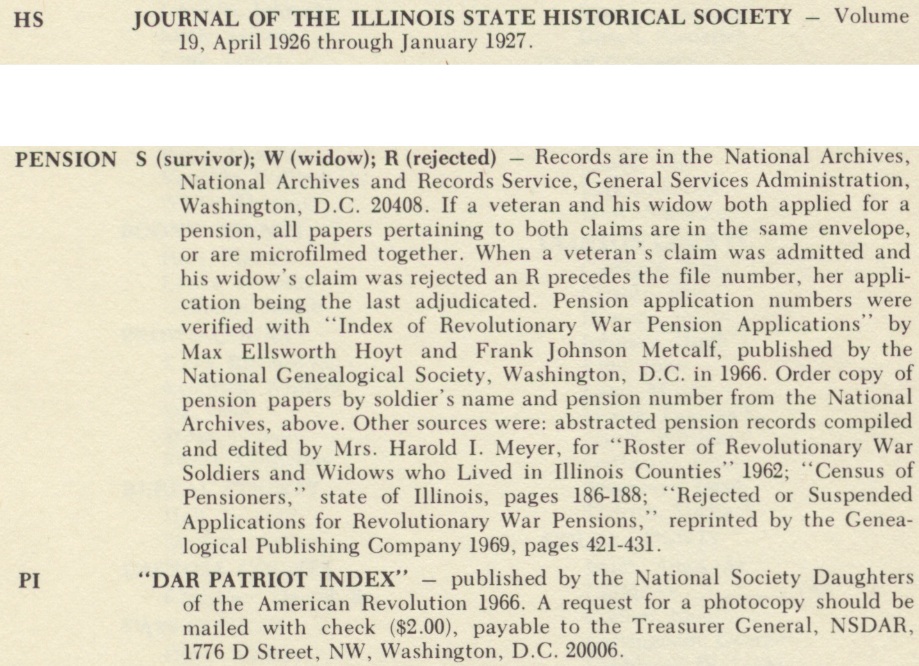
Powell is listed in “Soldiers of the American Revolution Buried in Illinois” (1976), page 189, an index prepared and published by the Illinois State Genealogical Society as a part of the U.S. Bicentennial celebrations.
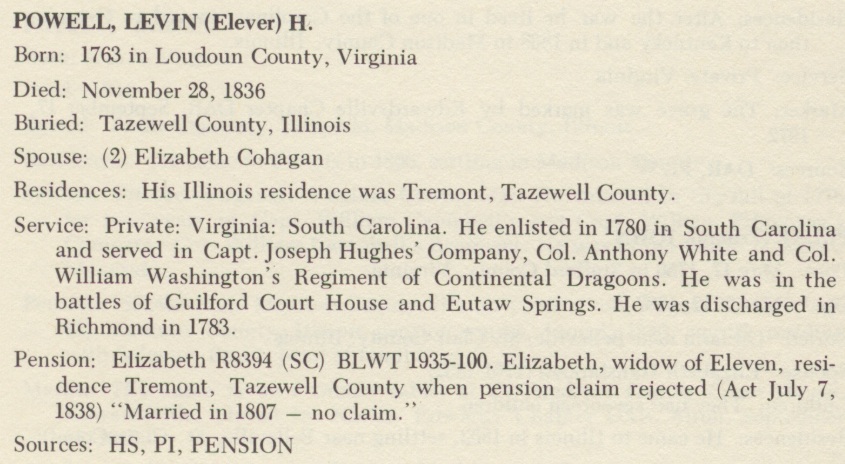
In addition to the sources cited by the 1976 index, Powell’s Revolutionary War service is further documented by Virginia pension rolls.

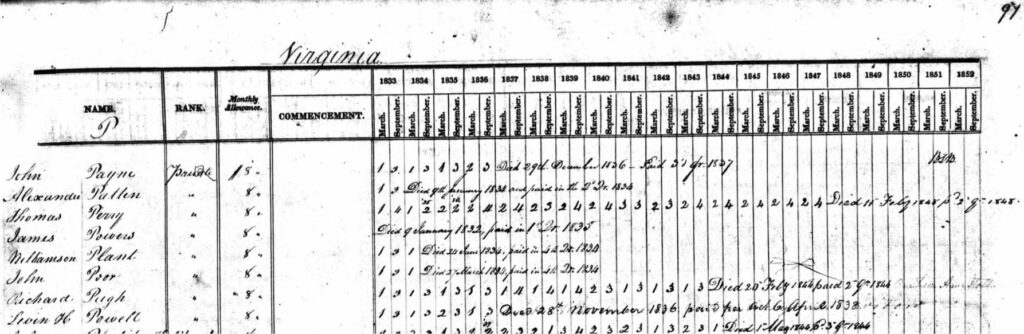
Levin Hays Powell, also known as “Eleven,” was a descendant of Welsh colonists in Virginia. His surname is of Welsh origin, deriving from the patronymic ap Hywel, “son of Howell.” Levin was born in or about 1763 in what is now Loudoun County, Virginia. To avoid confusion with other Loudoun County cousins also named Levin Powell (one of whom, Col. Levin Powell, was also a Revolutionary War Patriot), he adopted his mother’s maiden name “Hays” as a middle name. Levin was apprenticed when he was about 5 years old, and he worked as a farmer and weaver.
Levin served at the rank of private in the U.S. Continental Light Dragoons, 1st Company, from April 1780 to May 1783, seeing action in several battles, including Camden, Guilford Courthouse, and Eutaw Springs (the battles that he mentioned in his 1824 pension application). Levin was wounded in battle. Apparently unwilling to rely on charity until he and his wife became ill, he waited until he was 61 before applying for a soldier’s pension.
On 13 July 1807 near Leesburg, Loudoun County, Levin married Elizabeth Cohagan. They had seven children: Letitia, Thomas, Amy, Mahlon, Louisa, and two others who were either already adults with their own families by then (Robert Hoffer believes he has identified them), or perhaps had died young. The U.S. Censuses of 1810 and 1820 show him with his wife and children in Waterford, Loudoun County, about seven miles northwest of Leesburg and a few miles west of the Potomac River). He was residing in Fairfax County, Virginia, when he applied for his pension in 1824. By the time of the 1830 census, however, he and his family were in Hillsboro, Loudoun County, about 10 miles west of Waterford.
On 6 Oct. 1836, Levin left Virginia with his son Mahlon, daughter Letitia, and wife Elizabeth. Landing at Peoria on 5 Nov. 1836, the Powells moved up to the Peoria Narrows, where Levin fell sick and died of the palsy on 28 Nov. 1836. His widow Elizabeth and family then settled in and near Washington Township, Tazewell County, which was apparently the destination of the Powells before Levin took sick and died. Elizabeth died age 96 on 12 Jan. 1868 at Secor, Woodford County.
In his 1824 pension application, Levin provides this information about himself and his family:
“My Occupation is weaving and am not able to do that for some time past I have a wife that is of a weakly disposition and 5 children at home with me namely Leatitia a daughter aged 14 years, Thos Powell 12 years of age, Amy R Powell 10 years of age, Mahlon F Powell 8 years of age, Louiza Powell 5 years of age all at this [time] at my expense.
“Sworn to and Open Court this September 4 1824 S/ Levin H. Powell, X his mark”
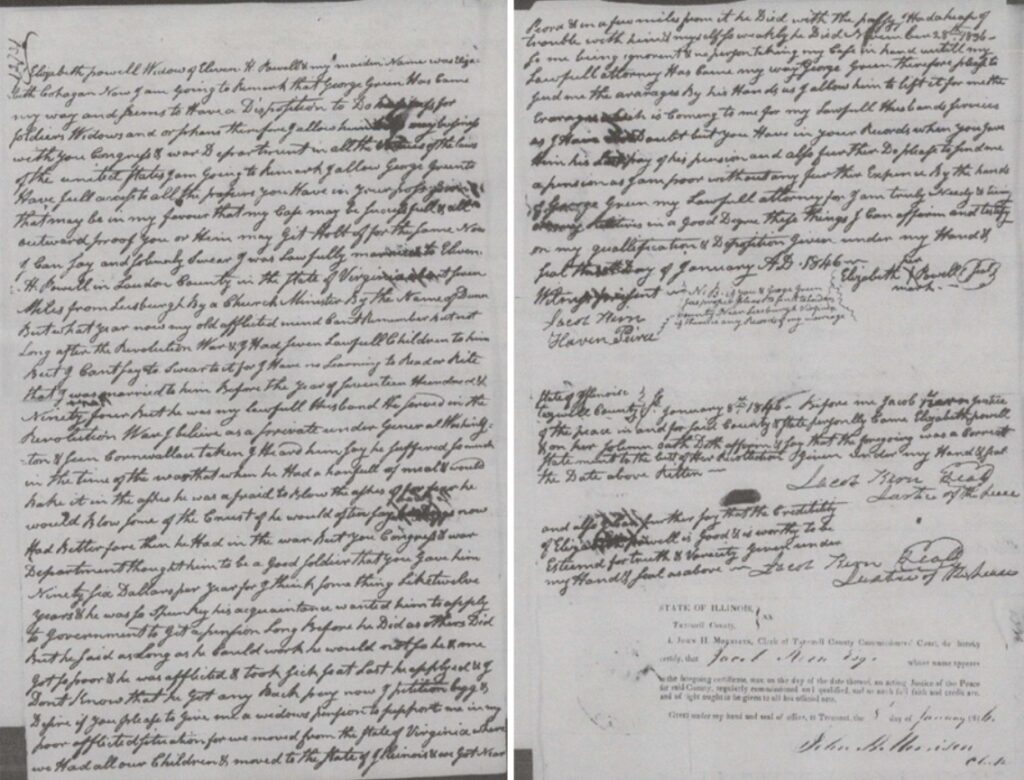
Levin’s pension file includes a marriage bond dated 13 July 1807 for the marriage of the Patriot to Elizabeth Cohagan (or Cohagen) issued in Loudoun County, Virginia. Later, in January of 1846, Elizabeth applied for a Revolutionary War widow’s pension. She was living in Washington Township, Tazewell County, Illinois, at the time, but filed her application in Tremont (then the county seat). Elizabeth said she married her husband in Loudoun County, Virginia, seven miles from Leesburg, that they were married by a “Church Minister by the name of Dunn“, and that she and her late husband had had seven children.
Elizabeth’s widow’s pension application was declined because she and Levin were not married prior to the end of the Revolutionary War.
Note that the 1976 index misinterpreted the reference to Tremont in Elizabeth’s pension file, falsely claiming that Levin and Elizabeth had settled at Tremont. Neither Levin nor Elizabeth ever lived in Tremont, and we cannot even be sure that Levin himself ever made it to Tazewell County.
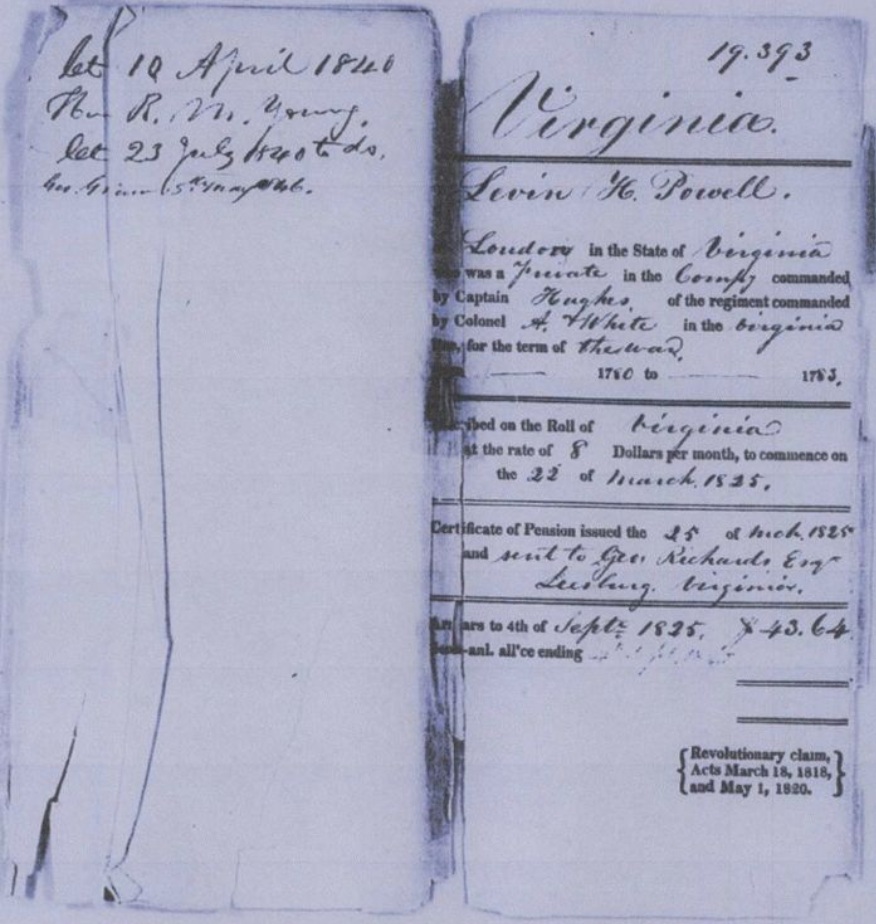
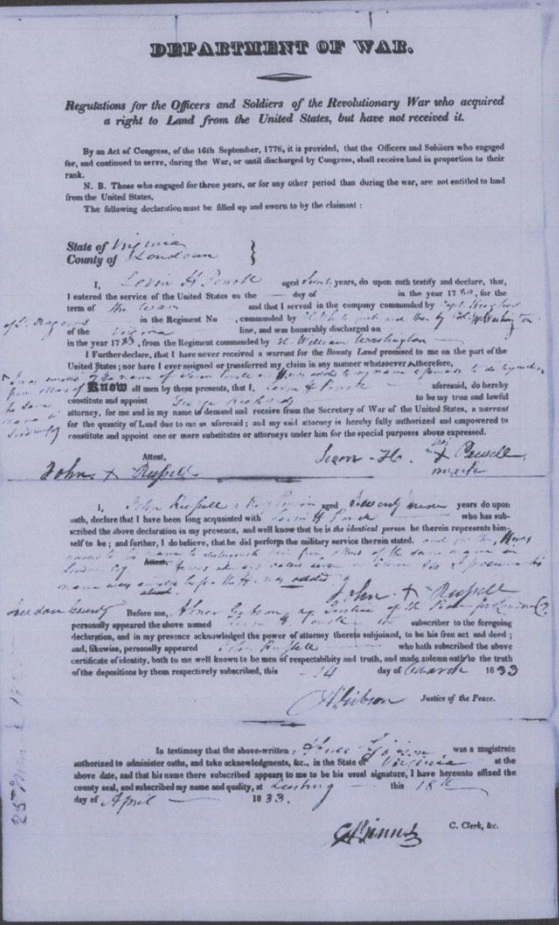
Here follows a transcription of the key paragraphs of the above pension file page:
“State of Virginia County of Loudoun
“I, Levin H. Powell aged 70 years, do upon oath testify and declare, that, I entered the service of the United States on the __ day of __ in the year 1780, for the term of the War and that I served in the company commanded by Captain Hughes [John Hughes] of Light Dragoons in the Regiment No. __ , commanded by Colonel White [Anthony Walton White] first and then by Colonel William Washington of the Virginia line, and was honorably discharged on __ in the year 1783, from the Regiment commanded by Colonel William Washington —
“I Further declare, that I have never received a warrant for the Bounty Land promised to me on the part of the United States; nor have I ever assigned or transferred my claim in any manner whatsoever therefore,
“I was enrolled by the name of Elevan Powell and H. was added to my name afterwards to distinguish me from others of the same name in Loudoun County
“Know all men by these presents, that I, Levin H. Powell aforesaid, do hereby constitute and appoint George Richards to be my true and lawful attorney, for me and in my name to demand and receive of the Secretary of War of the United States, a warrant for the quantity of Land due to me as aforesaid; and my said attorney is hereby fully authorized and empowered to constitute and appoint one or more substitutes or attorneys under him for the special purposes above expressed.
“S/ Levon H. Powell, X his mark [sic]
“[Acknowledged on 14 March 1833]”
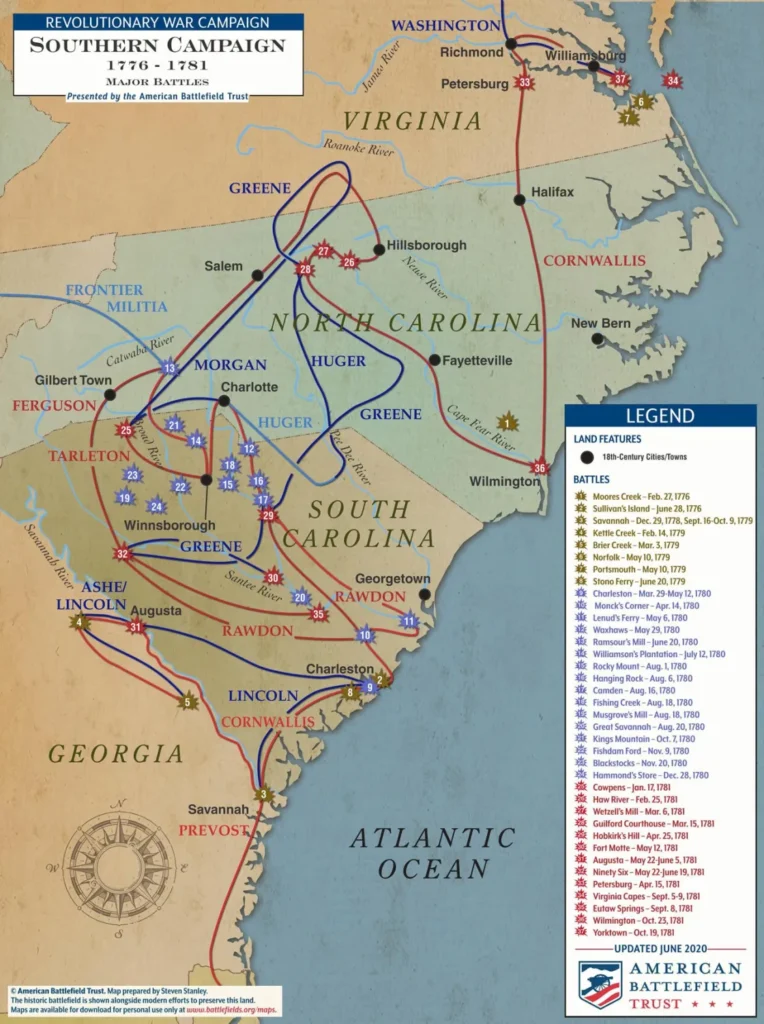
In 1780, Levin mounted his horse and rode from Northern Virginia to South Carolina, where he enlisted on 20 April 1780 in Cols. Anthony White’s and William Washington’s 1st Regiment of the Continental Light Dragoons, serving as a private in Capt. John Hughes’ Company for the duration of the war. The Continental Light Dragoons were elite, versatile mounted cavalry units in the American Revolutionary War, authorized by Congress in 1776-1777 to counter superior British horsemen. These regiments served as the “eyes and ears” of the Continental Army, conducting scouting, intelligence gathering, raiding, and screening, while also fighting on foot as infantry. They were usually armed with a pistol and a saber, and fought at close quarters.
- Battle of Camden, South Carolina (16 Aug. 1780) – a demoralizing American defeat. The Americans under Maj. Gen. Horatio Gates were defeated by Lord Cornwallis’ British troops. American Brig. Gen. Johann Baron de Kalb was mortally wounded and died three days after the battle.
- Battle of Guilford Courthouse, near Greensboro, North Carolina (15 March 1781) – another American defeat, but a pyrrhic victory for Lord Cornwallis, who lost 25% of his troops and was therefore unable to pursue American Maj. Gen. Nathanael Greene. In the battle, the Virginians put up a very stiff resistance before being forced to retreat.
- Battle of Eutaw Springs, South Carolina (8 Sept. 1781) – American forces under Gen. Greene attacked the British under Commander Alexander Stewart, who repelled repeated American attacks. Greene finally retreated after inflicting such severe casualties on British forces that Stewart had to fall back to Charleston, South Carolina.
Levin was very probably serving under Lafayette at Yorktown (19 Oct. 1781), and likely was present for Cornwallis’ surrender.
All evidence indicates that Powell fought heroically, bravely, and honorably. There is a note in his pension file, however, that suggests he may have joined a mutiny of the Light Dragoons in May of 1783:
“It appears from the Size Roll 5th Troop that Eleven Powell enlisted for the War in the first Regiment L. Dragoons April 20th ’81 [sic] and joined the mutineers May 1783
S/ W. M. Barrett, fly [formally] Capt. Baylor’s Dragoons
23 Dec. 1783”
The mutiny mentioned in this pension file note was led by Sgt. Maj. William Daingerfield and included about 100 members of Baylor’s Light Dragoons (the consolidated 1st and 3rd Light Dragoons) who, thinking they were about to be abandoned in South Carolina and deprived of their horses, appropriated their horses and rode back toward Virginia. On 22 May 1783 while in Moravian Town (now Winston-Salem), North Carolina, the mutineers petitioned Thomas Nelson (who they thought was still governor of Virginia but who had left office on 30 Nov. 1782) to address their grievances. They admitted that although their corps had received “the greatest Aplause of Any men that Belong’d to the Southering Army,” they had been obliged to desert their post on the Congaree River in South Carolina because of hunger, lack of money, and a rumor that Gen. Nathanael Greene “Intended to Dismount Us and Leave us to Shift for Our Selves.” They added that their slow march would enable the state government to have food and pay ready for them on their arrival in Richmond.
Evidently the mutineers were treated with extreme leniency and suffered few if any consequences as a result of their mutiny, though by their actions they technically forfeited their bounty land and pensions. Even so, some of them are known to have received land grants despite their actions. In a letter to the Virginia Delegates dated 31 May 1783, Virginia Gov. Benjamin Harrison said, “I wrote to the Mutineers and sharply reprimanded them for their conduct but promised in consideration of their past Services to overlook it as far as it related to me. They are really a band of heroes who have performed great & meritorious Services, and I am Satisfied would not have taken this rash Step if their Sufferings had not been very great.”
Pvt. Levin H. Powell was discharged honorably at Richmond, Virginia.
Having reviewed the evidence for the life and military service of Levin H. Powell, we have seen that his 1976 index entry is substantially correct. The chief error in that entry is that Powell and his widow never lived in Tremont. But is it accurate to say that Levin Powell is buried in Tazewell County? What can be determined about Powell’s place of burial?
One important piece of evidence is found in the short biographical sketch of Powell’s son Mahlon that is found in the History of Peoria County (1880), page 684:
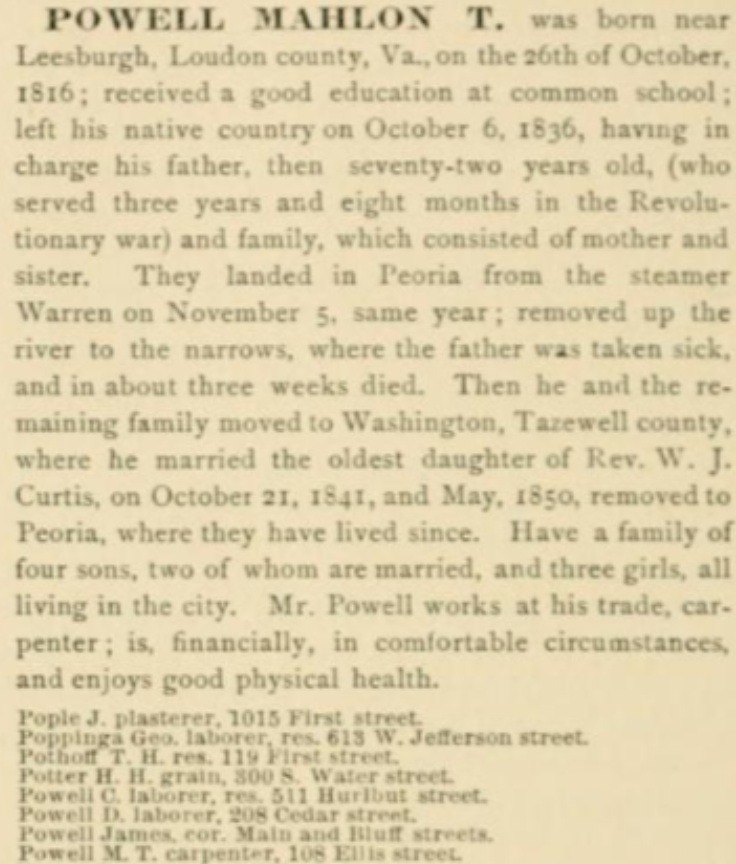
The key passage in Mahlon Powell’s 1880 biographical sketch says:
“. . . left his native country on October 6, 1836, having in charge his father, then seventy-two years old, (who served three years and eight months in the Revolutionary war) and family, which consisted of mother and sister. They landed in Peoria from the steamer Warren on November 5, same year; removed up the river to the narrows, where the father was taken sick, and in about three weeks died. Then he and the remaining family moved to Washington, Tazewell county . . . .”
That narrative substantially agrees with this following statement from the Jan. 1846 pension application of Levin’s widow Elizabeth:
“. . . for we moved from the State of Virginia where we had all our children, & moved to the State of Illinois & we got near Peoria & in a few miles from it he died with the palsy. I had a heap of trouble with him & myself so weakly he died November 28th 1836 –”
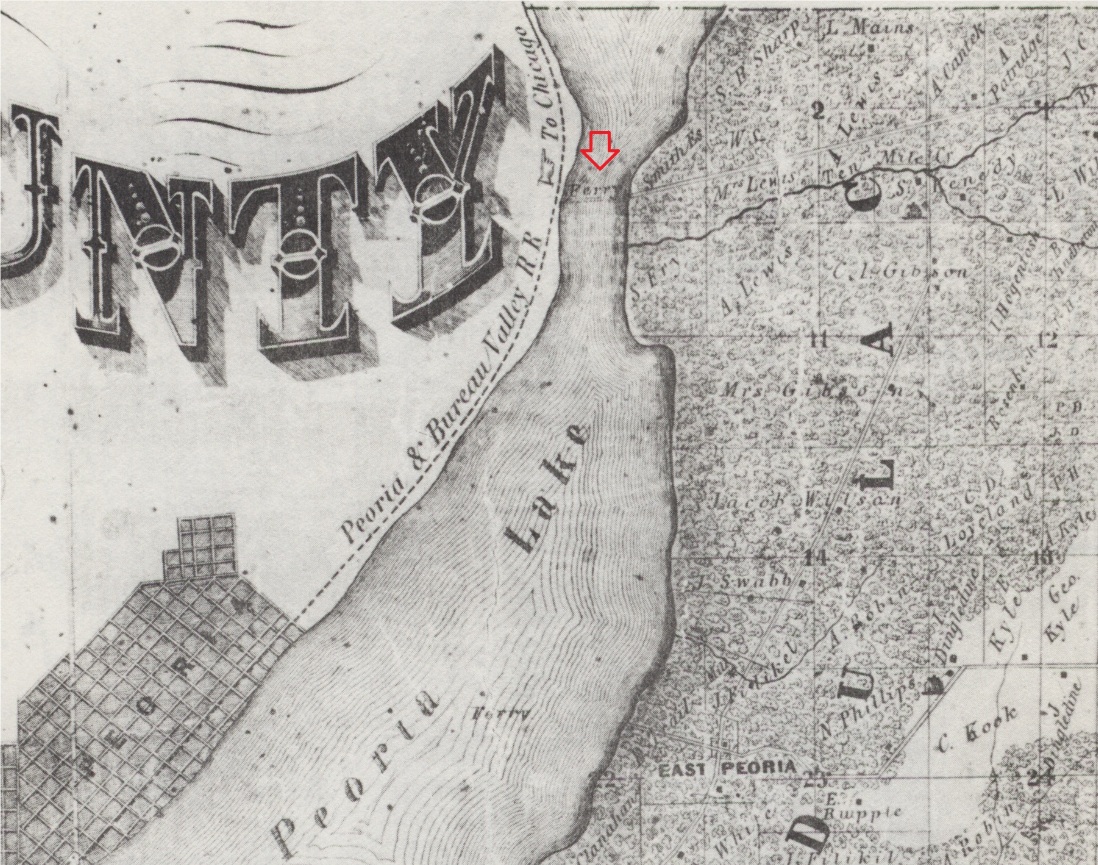
The Peoria Narrows are the narrowing of the Illinois River at a point that is today just north of the McClugage Bridge. North of the Narrows is Upper Peoria Lake, and south of the Narrows is Lower Peoria Lake (often referred to simply as Peoria Lake). In the 1830s there were no bridges across the Illinois River at or near Peoria. Instead, one had to use a ferry to cross the river.
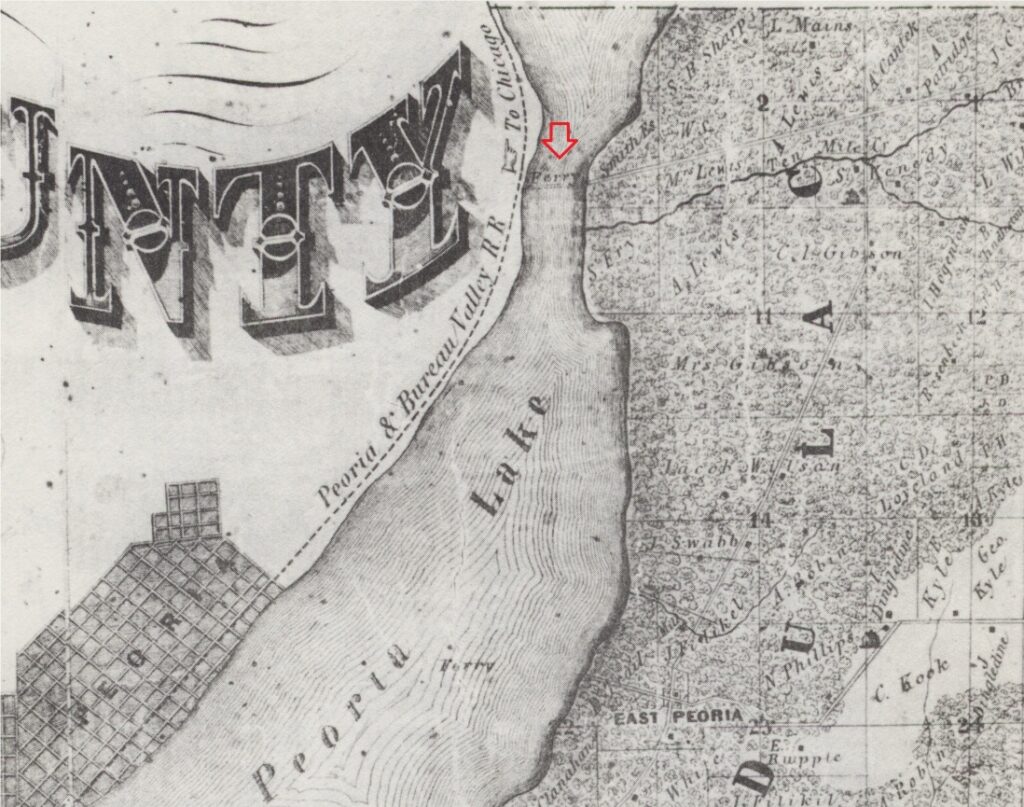
Peck’s Travelers Directory of Illinois (1839) reports that navigation of the Illinois River was usually suspended in November and December due to weather and low water. “Most of the eastern shore is low bottom and swamp.” Therefore, the Powells would have needed someone to ferry them across to Tazewell County to join their friends and relatives from Virginia who are known to have already settled in and around Washington. Past and Present in Woodford County (1878) says David Mathis, one of the earliest settlers in the area, “kept the ferry at the ‘Narrows’ near the present line between Woodford and Tazewell counties.” Mathis bought land in 1834 and 1835 in Section 2 of Fondulac Township, which was riverside property near what is now the Woodford County line. The ferry landing was near the mouth of Ten Mile Creek, and any house or inn near the ferry would have been on Mathis’ land there in Fondulac Township.
Consequently, in early November of 1836 the Powells would have had to land at Peoria and then take the road north to the Narrows where Mathis could ferry them across. It was common for ferrymen to keep tavern and inn at their landings. With Levin falling sick soon after their arrival in Central Illinois, the Powells may have remained at Mathis’ inn until Levin’s death. “I had a heap of trouble with him & myself so weakly,” Elizabeth said. Did that trouble include having to ferry his mortal remains across the Illinois?
Regarding the place of Levin’s death and burial, we have the following possibilities:
- If Levin died on the Peoria County side of the Narrows, he could have been temporarily buried there, and then perhaps reinterred near his family in Northern Tazewell County after they’d settled in. But he may rather have died at the Narrows on the Tazewell County side. The only known cemetery near the ferry was Hammett Cemetery, Section 1 of Fondulac Township, but no records survive. Others were buried at Sand Ridge Cemetery, Section 26 of Spring Bay Township, now in Woodford County.
- One source says Levin’s family resided “near the Narrows” in Tazewell County (i.e., Fondulac Township), but most other sources show that Levin’s children settled in Washington Township, so it is possible he was buried in Baker, Union, or Old City cemeteries, but again, no records survive.
- But, as Peoria DAR historian Electa Spangler (1880-1967) believed, Levin’s bones could even be in an unknown and forgotten grave on the Peoria County side of the Narrows.
In the end, we can only guess where Levin H. Powell is buried. Susan Rynerson favors of Tazewell County, but Robert Hoffer favors Peoria County.
In a summer of 2025, Robert Hoffer, along with the Peoria chapter of the Sons of the American Revolution, and Peoria’s Springdale Cemetery began a project to create a Revolutionary War Patriot Plaza at Springdale Cemetery (which is to the southwest of the Peoria Narrows, not very far from where Levin Powell died). As a fitting tribute for the U.S. Semiquincentennial, a joint SAR and DAR dedication of Patriot Plaza is planned for National Flag Day, 14 June 2026.
The plaza will initially commemorate three Revolutionary War soldiers, Capt. Zeally Moss, Pvt. William Crow, and Pvt. Levin H. Powell. Two of them are buried in Peoria County and one, Levin Powell, might be. All three were born in Loudoun County, Virginia; all were at Yorktown where two were under Lafayette; two certainly (and Powell possibly) died in Peoria County; all have descendants in Peoria; and all have descendants buried at Springdale. A storyboard is planned to recognize partners, sponsors, and major associates and direct visitors to more information. Later phases may include bricks and pavers to recognize other Patriots in the area as well.