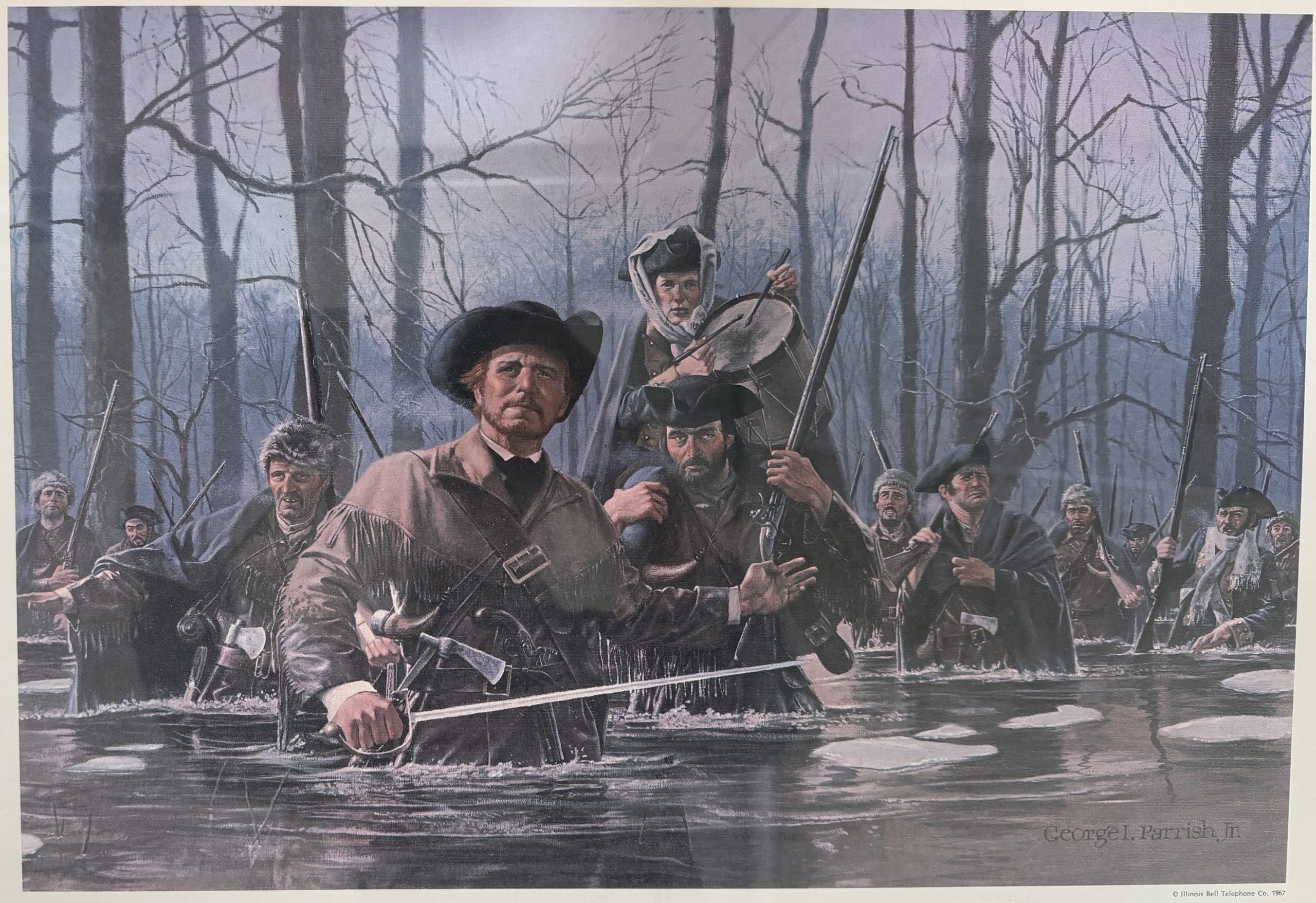

Following up on our nation’s celebration of its 250th birthday this Independence Day, the Pekin Public Library will continue its “America 250” history series on Saturday, 1 Aug. 2026, at 2 p.m., in the second-floor Community Room with a program that will tell of the life and exploits of Revolutionary War Brig. Gen. George Rogers Clark, “conqueror” of the Old Northwest in his famed Illinois Campaign. The public is invited to attend.

Most of our “America 250” programs this year have been dubbed a “Portrait of a Patriot.” This week’s “From the History Room” article is adapted from last month’s “Portrait of a Patriot” program. On Saturday, 6 June 2026, the Pekin Public Library presented a local history program on the life and career of Samuel McClintick (1764-1846) who — like his friend and fellow Tazewell County pioneer James Broyhill Sr. (1761-1842) — was a Virginia militiaman who served in the all-important Southern Campaign during the Revolutionary War. While Broyhill settled in Tremont Township in Tazewell County, McClintick settled in the area of Circleville in Sand Prairie Township.
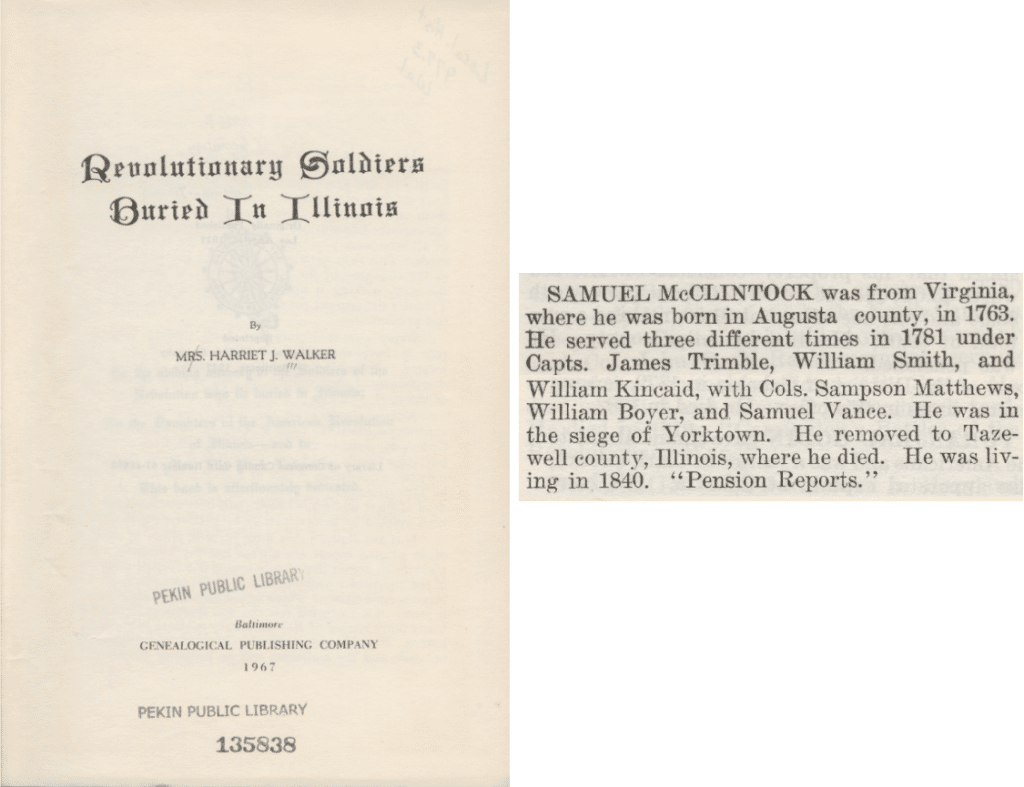
Samuel McClintick (also called “McClintock”) has long been known to be one of Tazewell County’s Revolutionary War Patriots. His service in the American Revolution was first documented in 1917 by Harriet J. Walker, who compiled an index called “Revolutionary Soldiers Buried In Illinois.” The Pekin Public Library’s Local History collection includes a 1967 reprint of Walker’s 1917 volume. Samuel McClintock is found in Walker’s book on pages 151-152, as we see here:
Samuel McClintock is also listed in “Soldiers of the American Revolution Buried in Illinois,” an updated and expanded index that was compiled in 1876 for the U.S. Bicentennial. The 1976 lists eight men as Revolutionary War soldiers reportedly buried in Tazewell County, Illinois. Though this index has occasional errors and omissions regarding Tazewell County’s Patriots, in the case of Samuel McClintick/McClintock this index is accurate, as we see below:
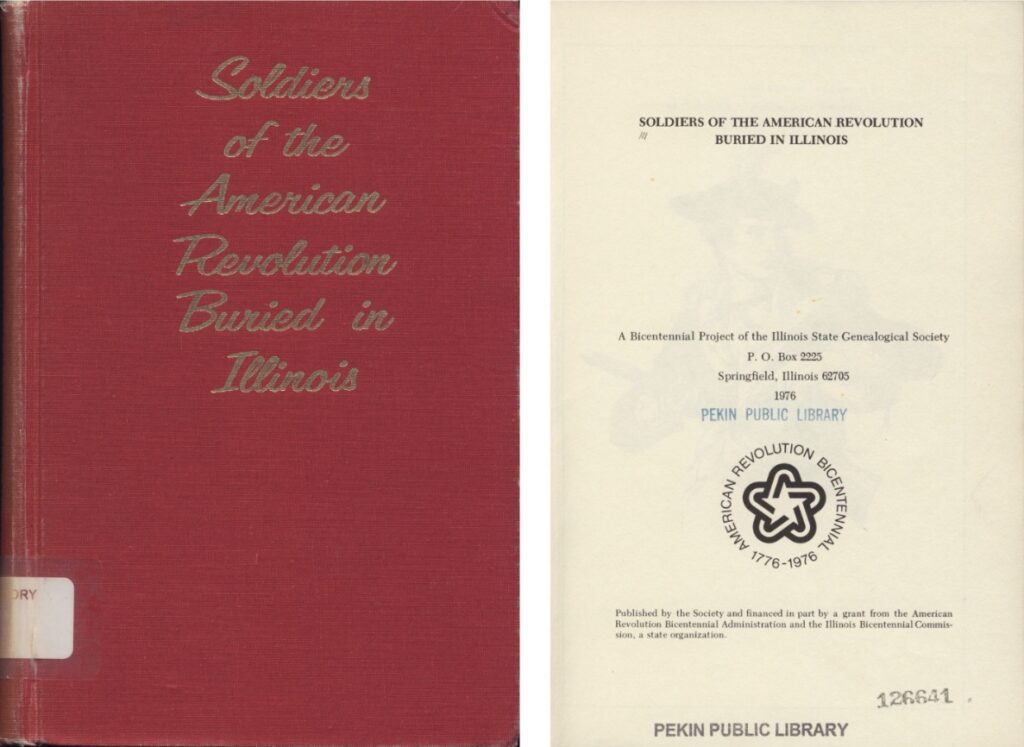
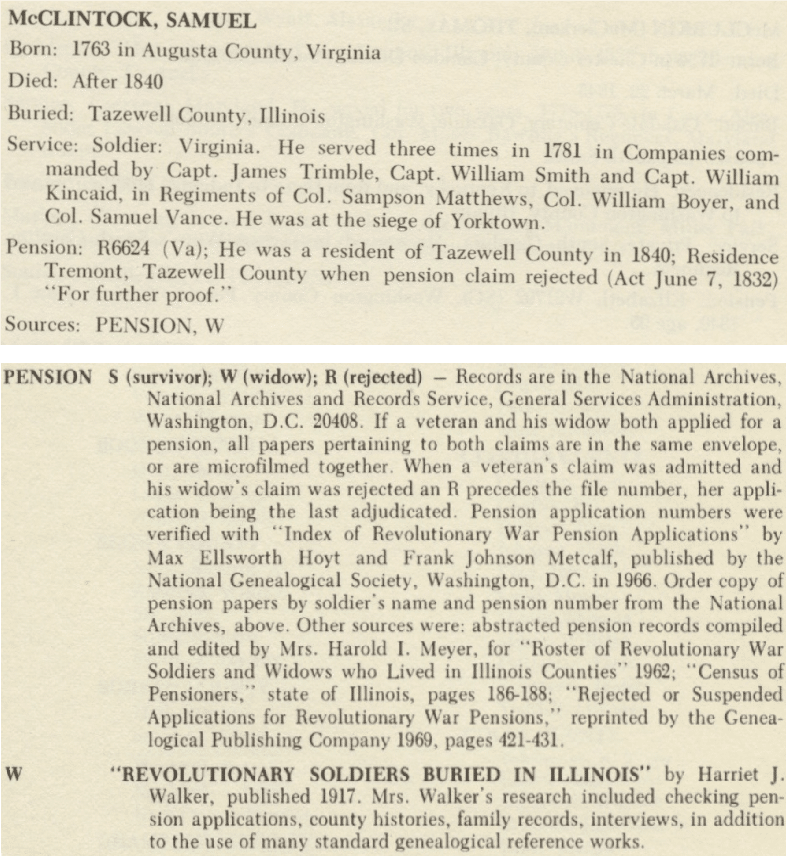
The 1976 index relies on sources of variable quality and reliability. In the case of Pvt. Samuel McClintick/McClintock, the sources on which it relies are good, especially because it cites Samuel’s Revolutionary War pension file, which bears the file name “R6624.”
Samuel McClintick (or McClintock or McClentick, etc.) was born in 1763, in Augusta, Virginia, a son of William McClintock, a Scots-Irish immigrant from Northern Ireland. The surname is an English phonetic spelling of Mac Gille Fhionndaig – “Son of the Devotee of St. Fintan [of Clonedagh].” Other spelling variants include McGellentak, M’Ilandick, and McLintog. The family is a sept of Clan Colquhoun (Calhoun) of Luss on Loch Lomond. The McClintick/McClintock family came to Ulster, Ireland, in the 1600s as Scottish colonists of the Ulster Plantation, settling in County Donegal. In the 1700s, they and other Scots-Irish or Ulster Scots came to America, settling in the Appalachian areas of Pennsylvania, Virginia, and the Carolinas.
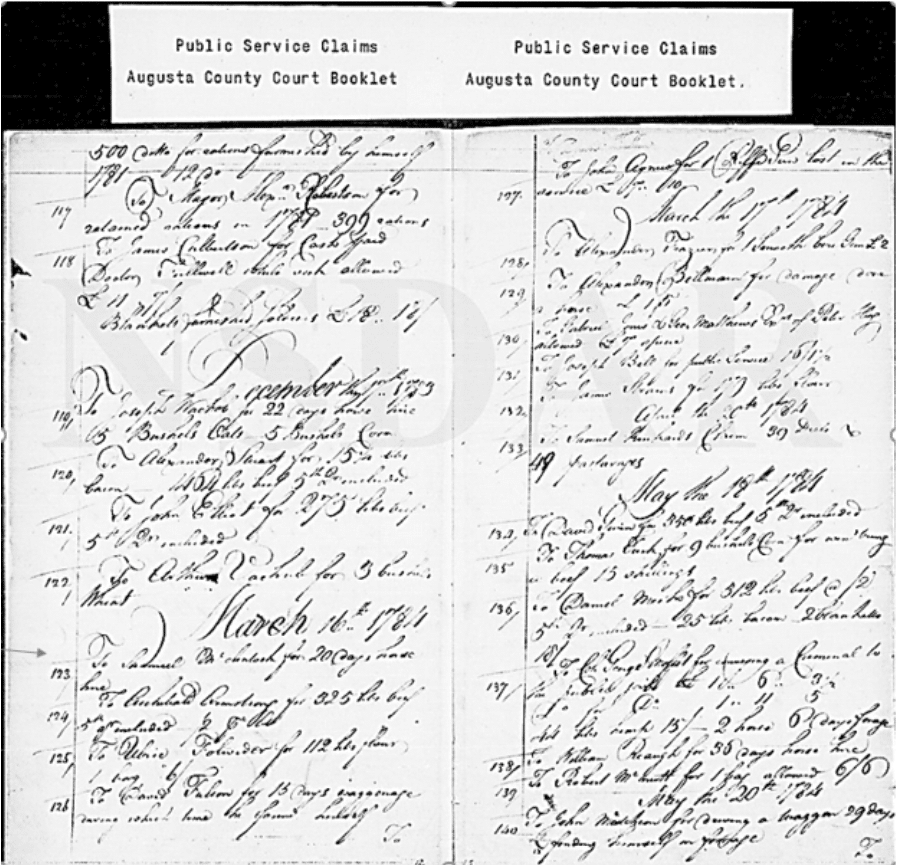
At the age of 18, when he was living near Staunton, Virginia, Samuel entered the Virginia Militia during the Revolutionary War in January of 1781, serving in the crucial Southern Campaign under Capts. James Trimble, William Smith, and William Kincaid, with Cols. Sampson Matthews, William Boyer, and Samuel Vance. He was at the Siege of Yorktown and witnessed the surrender of Lord Cornwallis on 19 Oct. 1781. Samuel received a verbal discharge from the militia shortly after Cornwallis’ surrender, then returned to Augusta. An Augusta County, Virginia, court document dated 16 March 1784 records payment for his militia service.
On 23 Nov. 1793 in Augusta, Samuel married Susanna King, daughter of Adam King, with whom he had a family of a daughter Martha and four sons, William, John, Robert, and Adam. His marriage to Susanna King is documented in a 1793 marriage register, as well as a marriage bond that dated 23 Nov. 1793, which can be retrieved from the online databases Marriage Bonds, 1785-1813, Augusta County, Virginia, and Marriage Records 1785-1813, Vital Records 1785-1813. The bond gives Samuel’s name as “Samuel McClentock,” his wife’s name as “Susanna King,” and notes that it was her father Adam King who put up the bond for their marriage. A further note on the record states, “This marriage record was originally published in ‘Chronicles of the Scotch-Irish Settlement in Virginia, 1745-1800. Extracted from the Original Court Records of Augusta County,’ by Lyman Chalkley.“
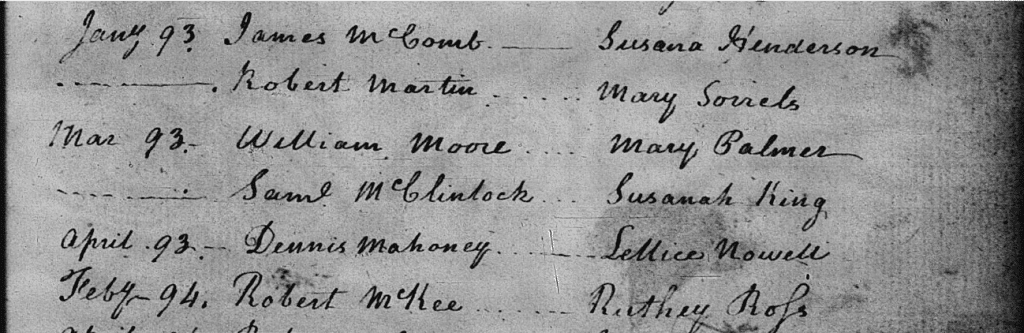
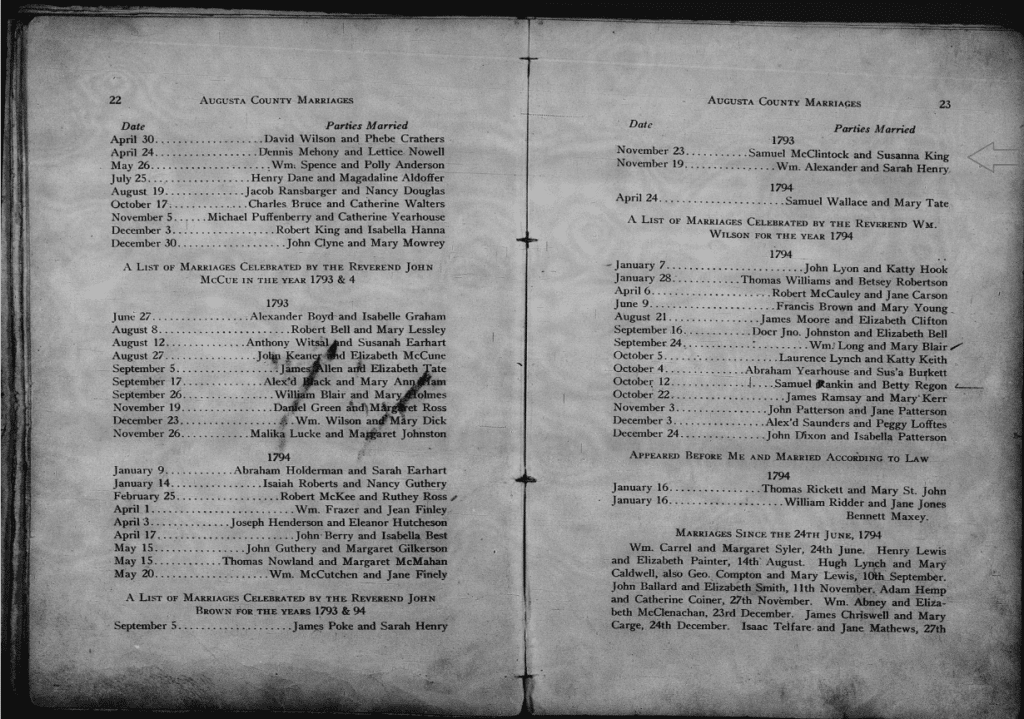
The U.S. Censuses of 1810, 1820, and 1830 enumerate Samuel and his family in Augusta County, Virginia. At the time of the 1820 census he was living at Waynesboro in Augusta County. In 1835, Samuel and his family left Virginia and settled near Circleville in Tazewell County, Illinois. His near neighbors, who knew him by reputation as a Revolutionary War veteran, included the pioneer settlers Alexander Robinson, Samuel Woodrow, and James Prettyman. The 1840 U.S. Census shows Samuel and his family living in Tazewell County.
On 24 Sept. 1840, when he was about 77, Samuel applied for a Revolutionary War pension under the Soldiers’ Pension Act of 1832, providing a narrative rich in circumstantial detail of his Virginia militia service. In support of Samuels’ pension application, Neill Johnson, a clergyman, and David Corwin submitted the standard supporting affidavits required for such applications. However, his application was rejected for lack of proof of service and because the extent and length of service of the Virginia militia during the Southern Campaign was disputed. At late as 1854, Samuel’s son Adam continued to seek approval of his late father’s pension application.
Samuel died in the summer of 1846 and is almost certainly buried in Woodrow Cemetery, which is the resting place of several members of the pioneer McClintock/McClintick family. Find-A-Grave lists 17 McClintick/McClintock burials in Woodrow Cemetery.
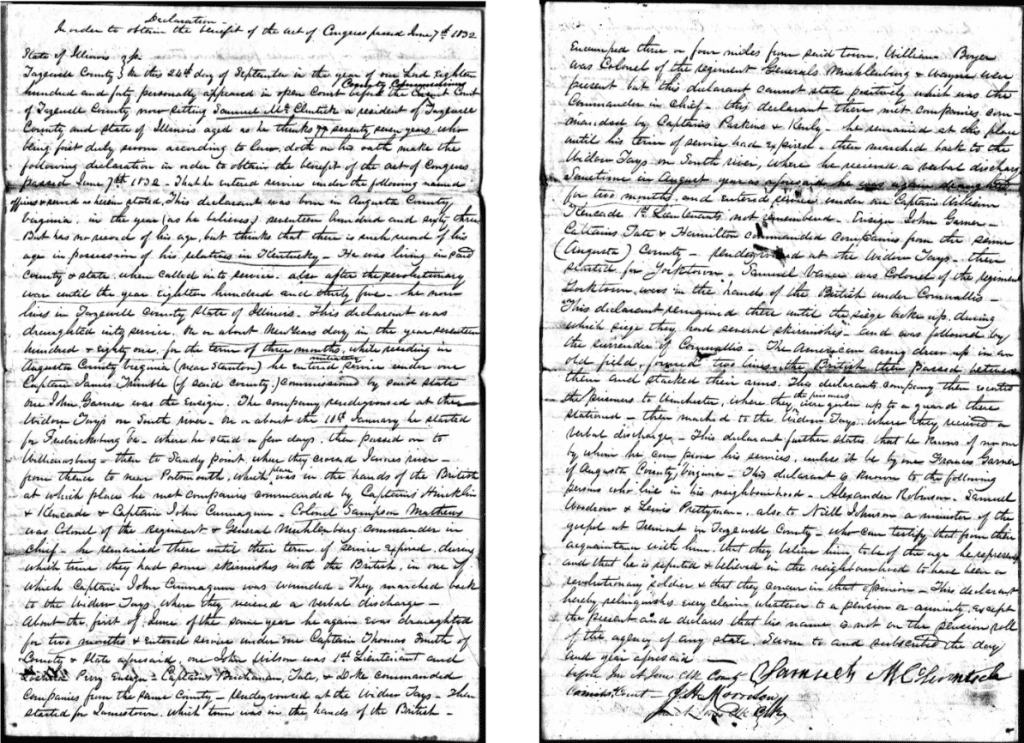

Following is a complete transcription (emphasis added) of Samuel’s memories of his life and military service during the Revolutionary War that he submitted with his 1840 pension application:
On this 24th day of September in the year of our Lord 1840 personally appeared in open Court before the County Commissioners Court of Tazewell County now sitting Samuel McClintick a resident of Tazewell County and State of Illinois aged as he thinks 77 years who being first duly sworn according to law doth on his oath make the following declaration in order to obtain the benefit of the act of Congress passed June 7th 1832. That he entered the service under the following named officers & served as herein stated. This declarant was born in Augusta County Virginia in the year (as he believes) 1763 but has no record of his age, but thinks that there is such record of his age in possession of his relatives in Kentucky. He was living in said County & State when called into service. Also after the revolutionary war until the year 1835 – he now lives in Tazewell County State of Illinois.
This declarant was drafted in service on or about New Year’s day in the year 1781 for the term of 3 months, while residing in Augusta County Virginia (near Stanton) he entered military service under one Captain James Trimble (of said County) Commissioned by the said State one John Garner was the Ensign. The company rendezvoused at the Widow Tay’s on South River on or about the 10th January he started for Fredericksburg Virginia – where he stayed a few days, then passed on to Williamsburg – then to Sandy Point where they crossed James River – from thence to near Portsmouth, which place was in the hands of the British at which place he met companies commanded by Captains Hincklin & Kencade & Captain John Cunnagum – Colonel Sampson Mathews was Colonel of the Regiment & General Muhlenberg commander in chief – he remained there until their term of service expired during which time they had some skirmishes with the British, and one in which Captain John Cunnagum was wounded. They marched back to the Widow Tays where they received a verbal discharge – About the first of June of the same year he again was drafted for two months & entered service under one Captain Thomas Smith of County & State aforesaid, one John Wilson was 1st Lieutenant and Joshua Perry Ensign. Captains Buchanan, Tate, & Doke commanded Companies from the same County – Rendezvoused at the widow Tays – They started for Jamestown, which town was in the hands of the British – Encamped 3 or 4 miles from said town, William Bowyer was Colonel of the Regiment Generals Muhlenberg & Wayne were present but this declarant cannot state positively which was the Commander in Chief – this declarant there met Companies commanded by Captains Parkins & Kenly – he remained at this place until his term of service had expired – then marched back to the widow Tays on South River, where he received a verbal discharge.
Sometime in August year as aforesaid he was again drafted for two months, and entered service under one Captain William Kencade first Lieutenant not remembered – Ensign John Garner – Captains Tate & Hamilton commanded Companies from the same (Augusta) County – Rendezvoused at the Widow Tays – then started for York town – Samuel Vance was Colonel of the Regiment. Yorktown was in the hands of the British under Cornwallis – This declarant remained there until the siege broke up during which siege they had several skirmishes – And was followed by the surrender of Cornwallis. The American Army drew up in an old field, formed two lines – the British then passed between them and stacked their guns. This declarant’s company then escorted the prisoners to Winchester, where they the prisoners were given up to a guard there stationed – then marched to the Widow Tays where they received a verbal discharge – This declarant further states that he knows of no one by whom he can prove his services, unless it be by one Francis Garner of Augusta County Virginia. This declarant is known to the following persons who live in his neighborhood – Alexander Robinson, Samuel Woodrow & James Prettyman –, also to Niell Johnson a minister of the gospel at Tremont in Tazewell County – who can testify that from their acquaintance with him, that they believe him to be of the age he represents and that he is reputed & believed in the neighborhood to have been a revolutionary soldier & that they concur in that opinion. This declarant hereby relinquishes every claim whatever to a pension or annuity except the present and declares that his name is not on the pension roll of the agency of any state.
Sworn to and subscribed the day and year aforesaid. S/ Samuel McClintick
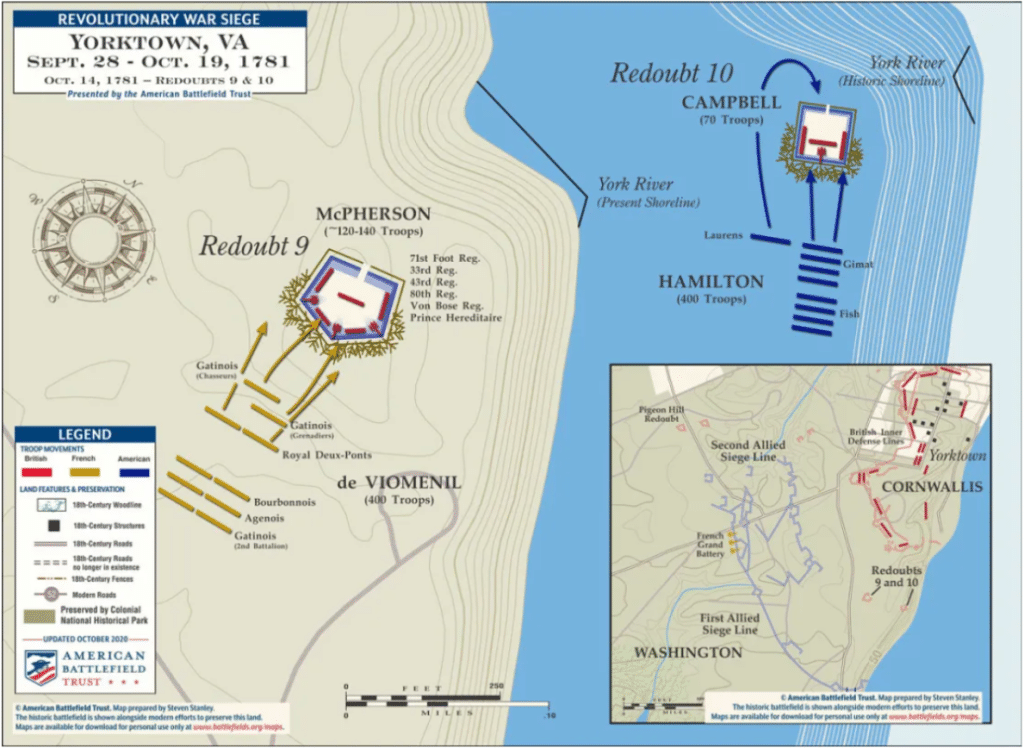
While Samuel recalled engaging in several skirmishes with the British during the Siege of Yorktown in 1781, he would not have participated in the most crucial military missions during the siege — namely, the capture of the British “redoubts,” a group of fortified outposts that the British Army has established around Yorktown. The Americans and their French allies knew that it was vitally important to capture the British redoubts. This is how the American Battlefield Trust describes the campaign against the redoubts:
“In the weeks before the Americans and French laid siege to Yorktown and commenced the last major battle of the American Revolution, the occupying British had been hard at work constructing a series of outposts surrounding the city called redoubts. Gen. Washington and his French allies knew that if they took the redoubts, they could then fire directly on Yorktown itself and force the Cornwallis to surrender. After more than a week of bombardment, the assault finally came on 14 Oct. Alexander Hamilton and the Vicomte de Viomenil each led 400 American and French troops against the 9th and 10th redoubts, just south of the British inner defenses. Heavily outnumbered, the British and Hessian soldiers stood as valiantly as they could against overwhelming forces, but were driven away at the points of their enemies’ bayonets. The next day, as Washington commenced bombardment of Yorktown itself, the allied troops repulsed a British attempt to retake the redoubts, and Cornwallis decided to wave the white flag only two days later.”
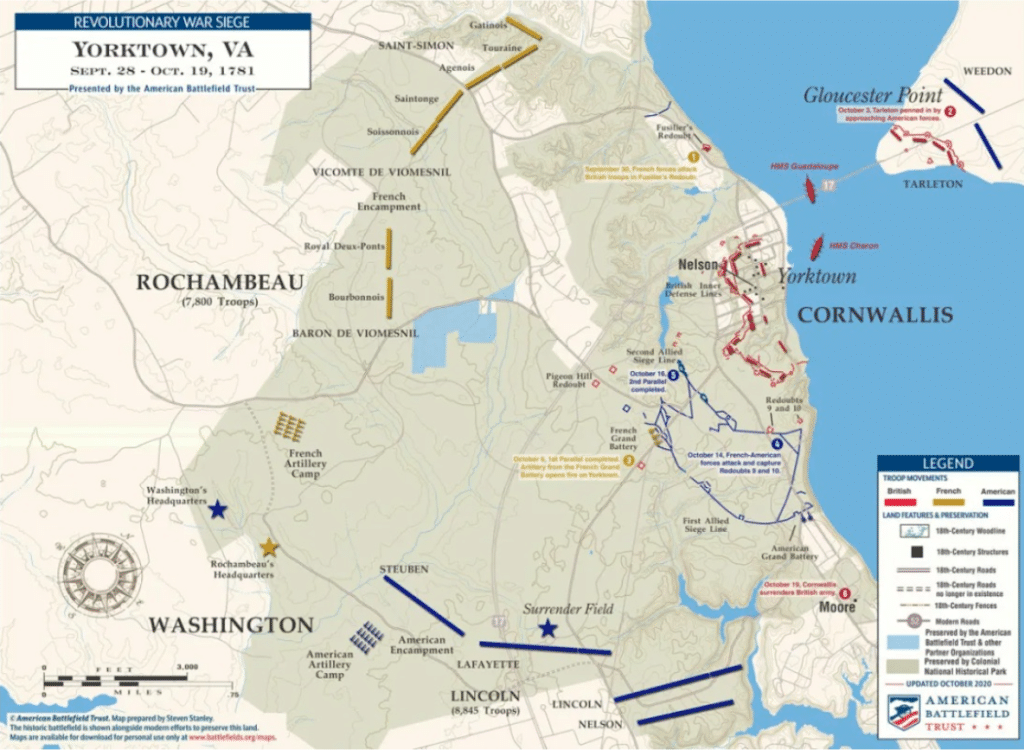
Once the British redoubts had been taken, the Americans and French were able to bombard Cornwallis’ forces at Yorktown, forcing him to surrender. As the American Battlefield Trust tells it:
“In 1781, American and French troops laid siege to Yorktown, Virginia, a stronghold of the British Army. The strength of American and allied artillery, which only increased as the siege wore on, ultimately forced the British to realize that the situation was hopeless. General Charles Lord Cornwallis formally surrendered to George Washington on 19 Oct. 1781. This proved to be the last major action of the Revolutionary War, and though the Treaty of Paris would not be signed until almost two years later, many view Cornwallis’ surrender as the unofficial end of the war.”
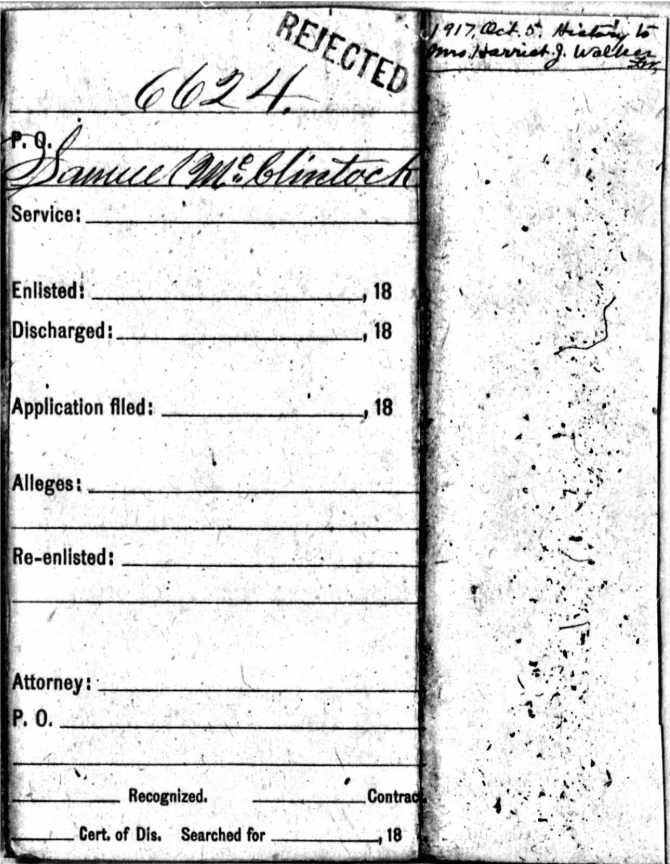
In spite of Samuel’s narrative of his Revolutionary War service, his name never appears on any state’s pension rolls. That is because the first time he applied for a pension was in 1840 – only six years before his death – and his application was rejected. Thus, this summary page from his pension file is mostly blank, and is stamped “REJECTED.”
When his application for a soldier’s pension was not immediately approved, follow-up inquiries were made regarding the status of his application and that of his fellow Virginia militiaman James Broyhill. In reply, on 1 July 1842 a two-page letter was written delineating the reasons for the rejection of their applications. Regarding McClintick’s application, the letter says, “The Virginia militia did not perform so much as eight month(s) actual service during the period stated. He cannot be allowed for more than six months service. The reason for not making an earlier application for a pension should be given.”
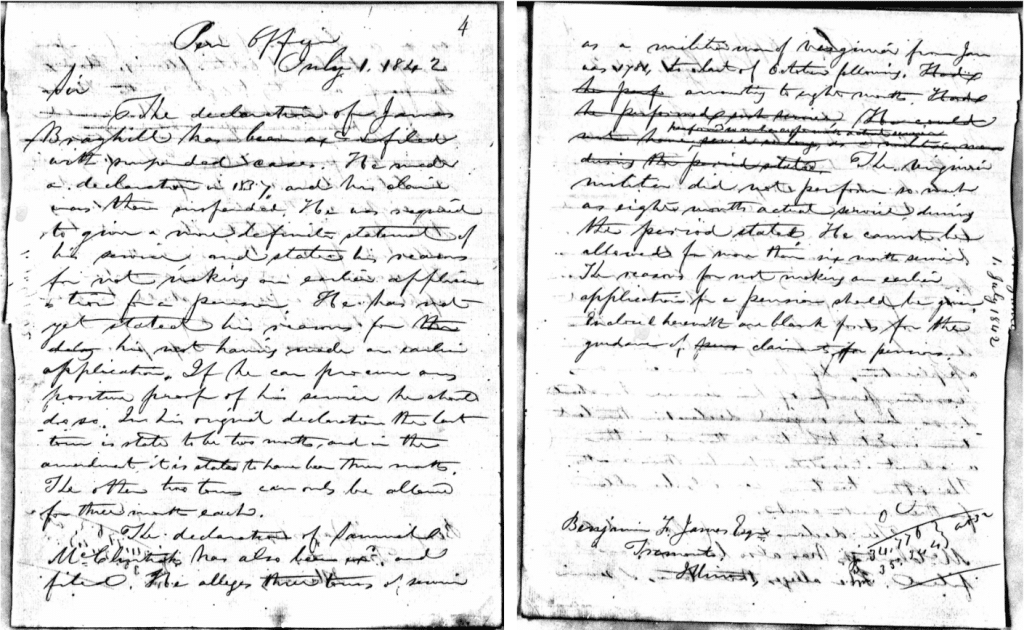
The Broyhill family continues to seek a pension for him, and eventually it was approved and paid, but only after the deaths of James and his wife. In the case of Samuel McClintick, though, his pension was never approved despite the persistent efforts of his son Adam. Despite the rejection of Samuel’s pension request, while the pension board disputed just how long the Virginia militia served in 1781, and Samuel’s own 1840 narrative indicates that his memory of his service was somewhat hazy 59 years later (!), nevertheless there is no doubt that he served in the Virginia militia during the Revolutionary War. The website of the National Society Daughters of the American Revolution provides an Augusta County court document that records payment for Samuel McClintock’s service, dated 16 March 1784, about seven months after the Treaty of Paris that formally ended the Revolutionary War, and less than three years after the surrender of Cornwallis. This record shows McClintock did not only tell a story of Revolutionary War service six decades later, but had already submitted his claim of militia service to his home state of Virginia well prior to March 1784.
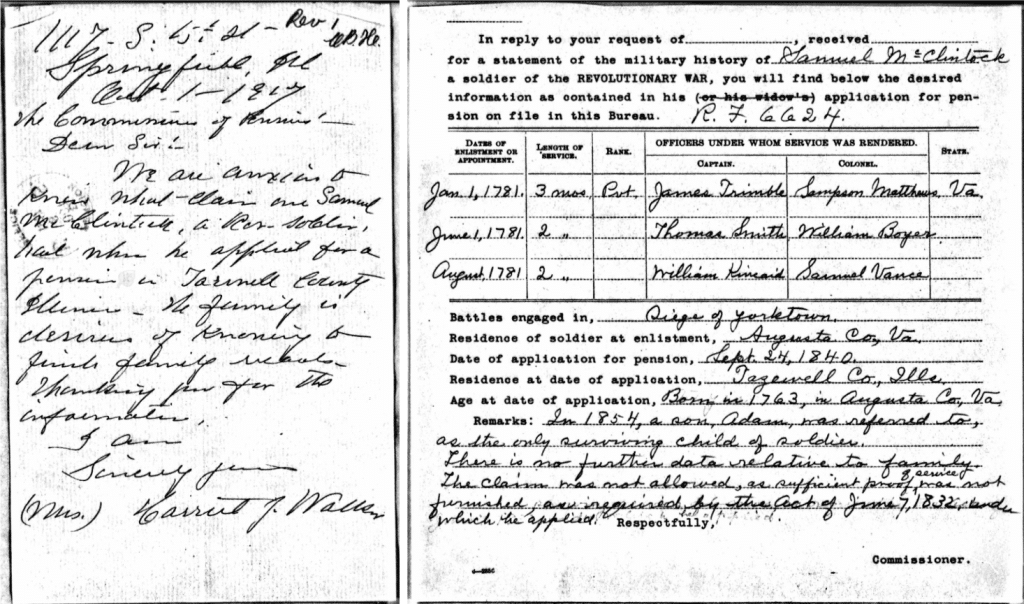
Among the various documents in Samuel’s 1840 pension file, two of them are records of the research that Harriet Walker conducted in 1917 to produce her index of Revolutionary War soldiers buried in Illinois. As you can see here below, even though she was told that Samuel’s “claim was not allowed,” Walker’s research led her to conclude that Samuel’s narrative of his Revolutionary War service was generally trustworthy, and therefore he should be included in her book.
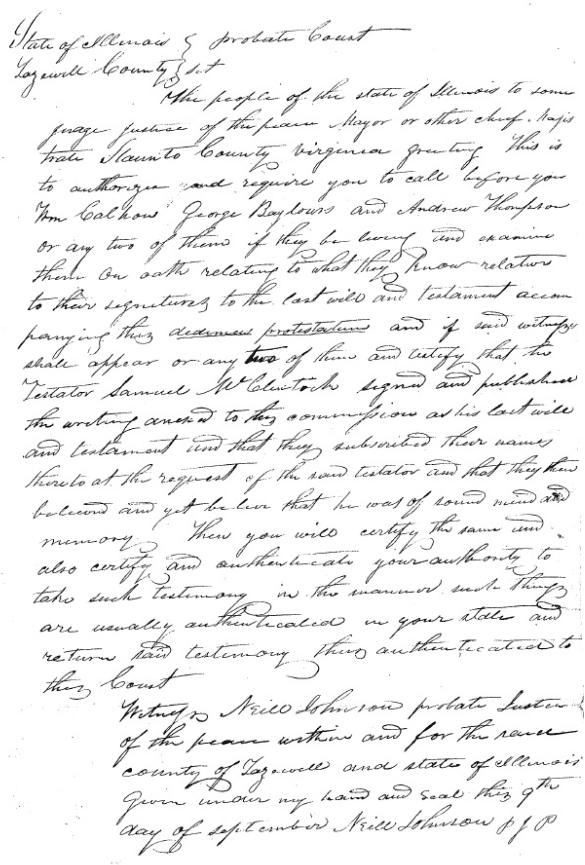
In addition to the documents that we have reviewed above, Susan Rynerson of the Tazewell County Genealogical & Historical Society has also retrieved a few documents from Samuel McClintock’s rather slender probate file that is archived at the Tazewell County Courthouse. Thanks to the probate file, we can determine the approximate time of Samuel’s death and learn basic facts regarding the settlement of his estate.
Unfortunately Samuel’s will is missing from the probate file. However, one of the documents from his file refers to his last will and testament, asking William Calhoun, George Baytoun, and Andrew Thompson to appear in court in Staunton, Virginia, to swear that they had indeed signed Samuel’s will that he had made in Virginia before coming to Tazewell County, Illinois. Notably, the surnames Colquhoun (Calhoun), Mac Beatha (Beatoun or Baytoun), Mac Thomáis (Thomson or Thompson), and Mac Gille Fhionndaig (McClintick/McClintock) have all long been commonly found in the Lennox near Loch Lomond, Scotland. It is probable that when the McClinticks left the Lennox and settled in County Donegal in Ireland, they were accompanied by other Lennox families from among the McClinticks’ neighbors and wider kin groups, and then in a subsequent generation some of those same families decided to settle near each other in the Appalachians of Virginia.
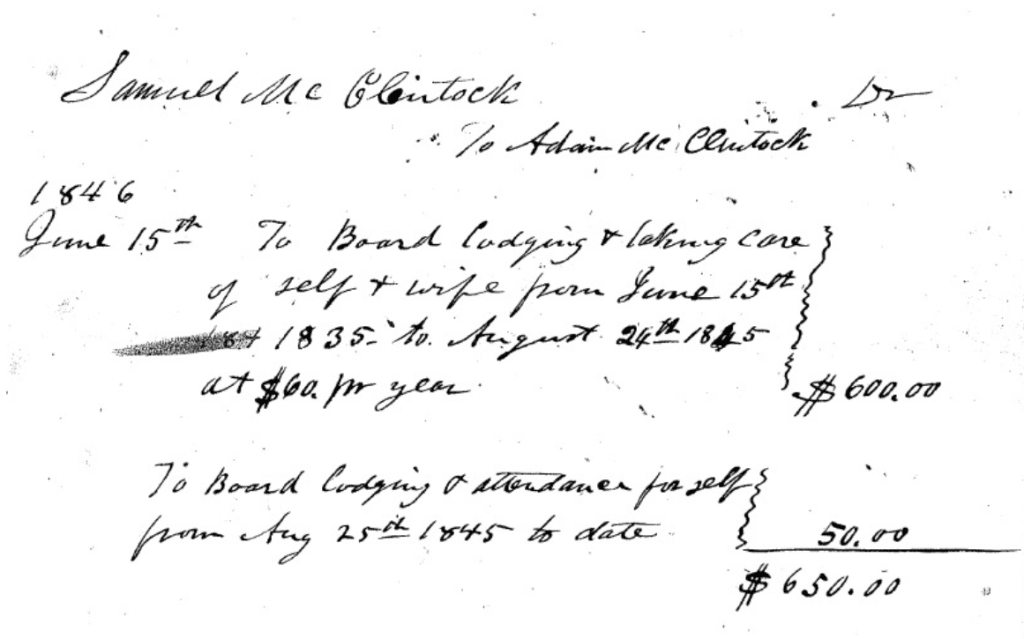
Another document from Samuel’s probate file is a care bill that tells us the year, and even the time of year, when Samuel died. The stated period of care for Samuel is apparently from June 1835 to 24 Aug. 1845, and again from 25 Aug. 1845 to 15 June 1846. From this, it appears that Samuel died on or about 15 June 1846.
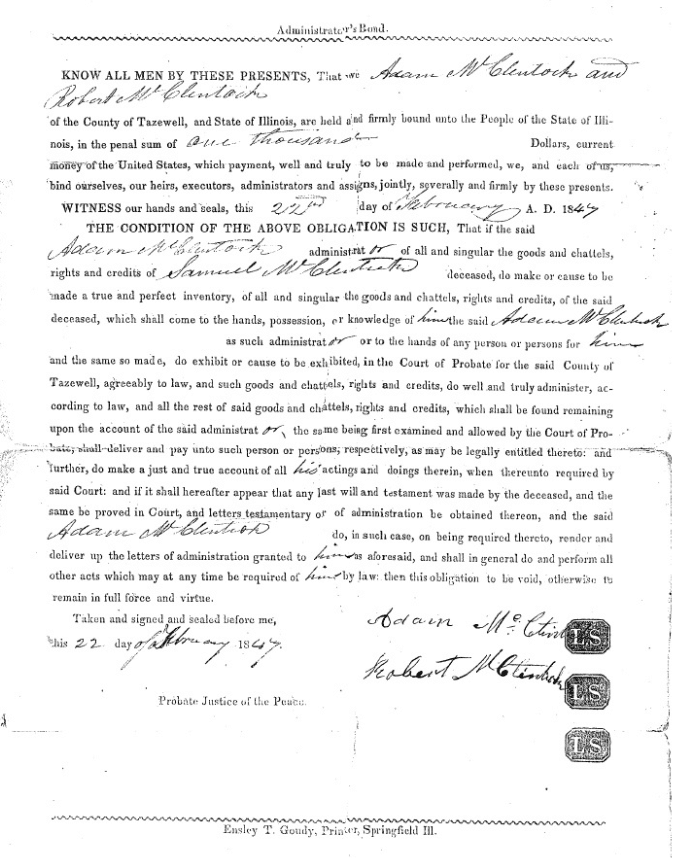
Finally, we have the probate adminstrator’s bond that Samuel’s sons Adam and Robert took out when they assumed their duties as administrators of their late father’s estate:
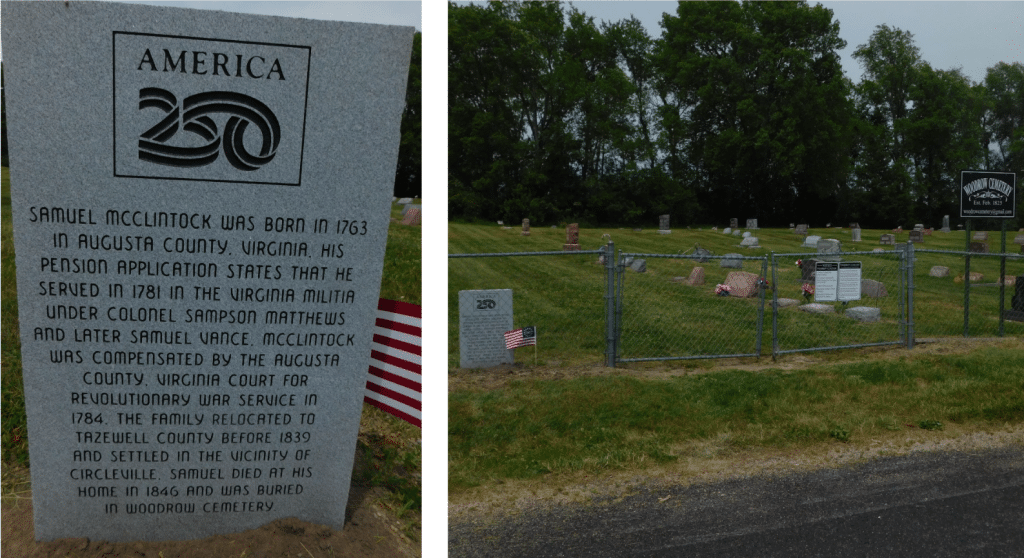
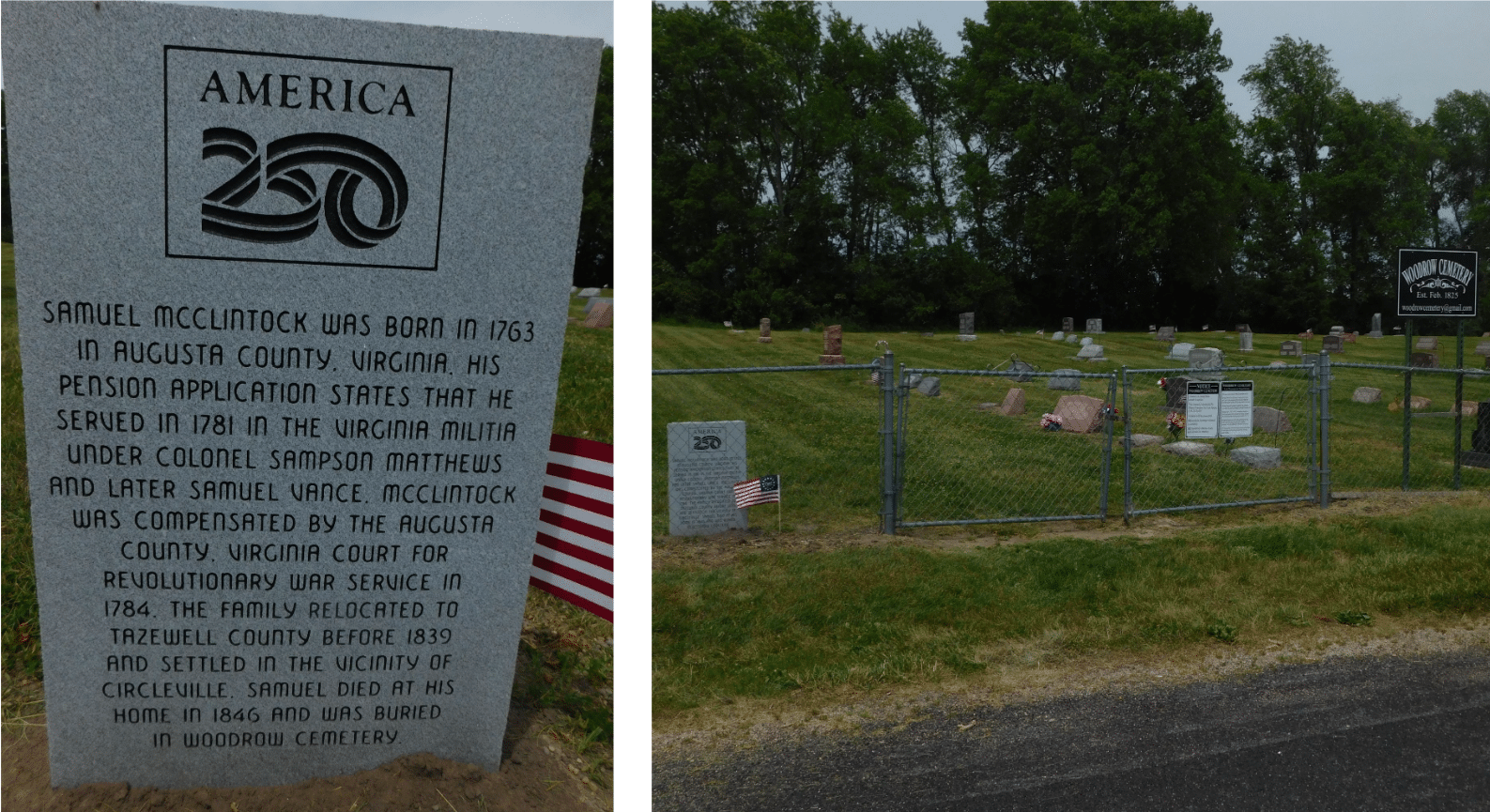
As noted above, following his death Samuel was almost certainly buried in Woodrow Cemetery, located just north of where his farmstead was located, and where many of his children and grandchildren are buried. Whatever grave marker he may have had is long gone, though. To remedy that circumstance, and to give Samuel the honor he deserves, in the month of May a new “America 250” monument was placed at Woodrow Cemetery, briefly telling the story of his Revolutionary War service. The monument, and four others honoring other Tazewell County Patriots, was formally dedicated in a special program at Antioch Cemetery on traditional Memorial Day, Saturday, 30 May 2026.