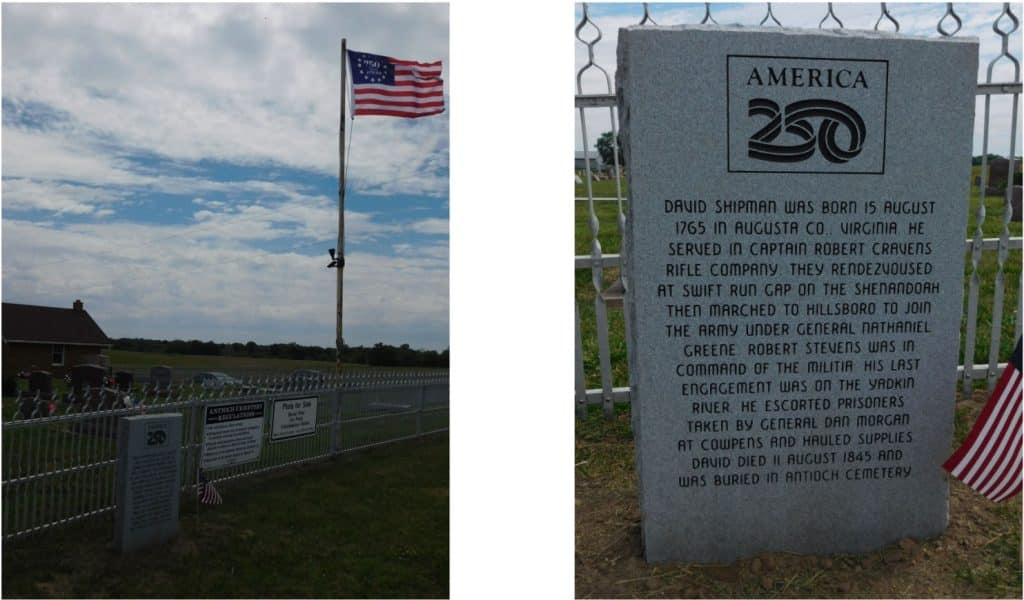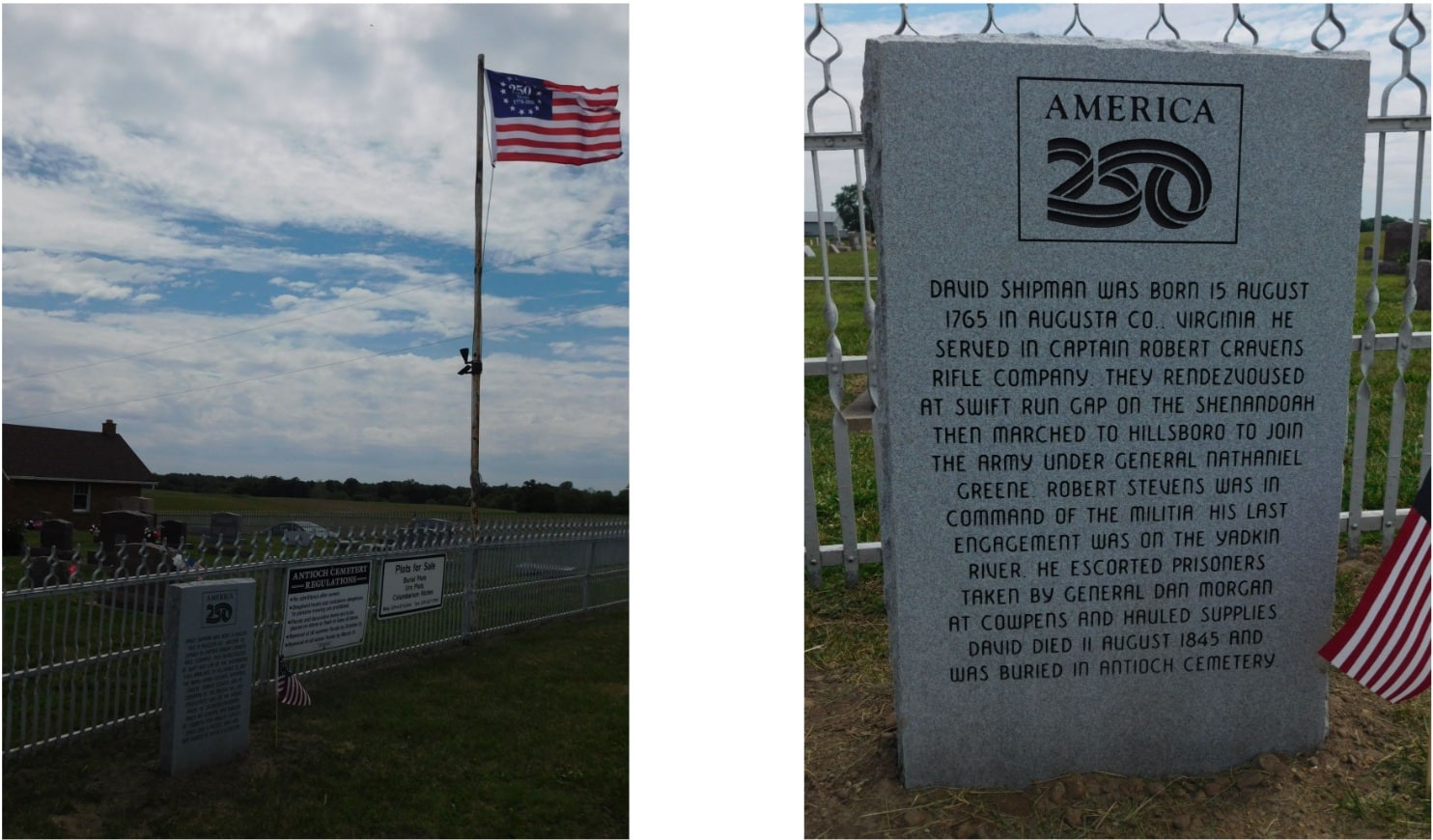

Perhaps the most notable of all the Revolutionary War Patriots who are buried in Tazewell County is Pvt. David Shipman (1765-1845) of Elm Grove Township, who is buried in Antioch Cemetery on Townline Road a few miles south of Tremont. David Shipman stands out among Tazewell County’s Patriot soldiers not only for his courage and devoted service during the American Revolution, but for the way he personally put into action the high moral ideals of liberty and equality for all Americans.

David Shipman was born 15 Aug. 1765 in Augusta County, Virginia, a son of Stephen and Jemima (McCleary) Shipman. When he was only 15 years old, David volunteered to serve in the Virginia militia during the Revolutionary War, enlisting in Sept. 1780 in Rockingham Co., Virginia, and serving at the rank of Private under Capt. Robert Cravens. David served during the all-important Southern Campaign of the war. After his enlistment, the militia rendezvoused at Swift Run Gap on the Shenandoah River, then marched to Hillsboro, North Carolina, to join the army under Gen. Nathanael Greene. Brig. Gen. Edward Stevens was in command of the militia. David’s last engagement was on the Yadkin River, after which he escorted prisoners taken by Gen. Daniel Morgan at the Battle of Cowpens on 11 Jan. 1781. After his discharge, he returned home in March 1781.
In 1792, when he was 27, David moved to Kentucky, where he lived in Fayette County and then Shelby County. He was allowed a war pension on his 1833 application, at which time he lived in Tazewell County to which he had come in Oct. 1826. He first lived in Sand Prairie Township but didn’t stay long, moving north to Elm Grove Township about 1828, where he operated a mill. His mill was powered by a tread wheel using horses or oxen, rather than being water-powered.
His miller was Moses Shipman, a former slave whom David had freed in Indiana while on his way to Tazewell County. Remarkably, the 1840 U.S. Census lists David, age 75, as head of household with 10 free colored people living with him – most of them being the family of Moses Shipman and Moses’ wife Milly Shipman. David had fled from Kentucky, bringing his slaves, stopping in Madison, Indiana, just long enough to file emancipation papers freeing all of his slaves, and then bringing them with him to live in freedom among the abolitionist settlers of Tazewell County. In one of the most dramatic – and traumatic – episodes in Tazewell County’s early history, Moses and Milly Shipman and their children were kidnapped by his nephew Stephen Smith’s bounty hunters in 1827, but were rescued through the determined efforts of David Shipman’s friends and fellow settlers.
David died 11 August 1845 and was buried in Antioch Cemetery in an unmarked grave. Having no surviving wife or children, his estate went to Moses Shipman and to David’s Shipman nephews (but, of course, nothing was bequeathed to his nephew Stephen Smith).
Indexes and pension rolls
Here follows a review of previous publications and historical records that documented and compiled David Shipman’s Revolutionary War service, including David’s own narratives of what he did during the Revolutionary War which he submitted to obtain his war pension in 1833.
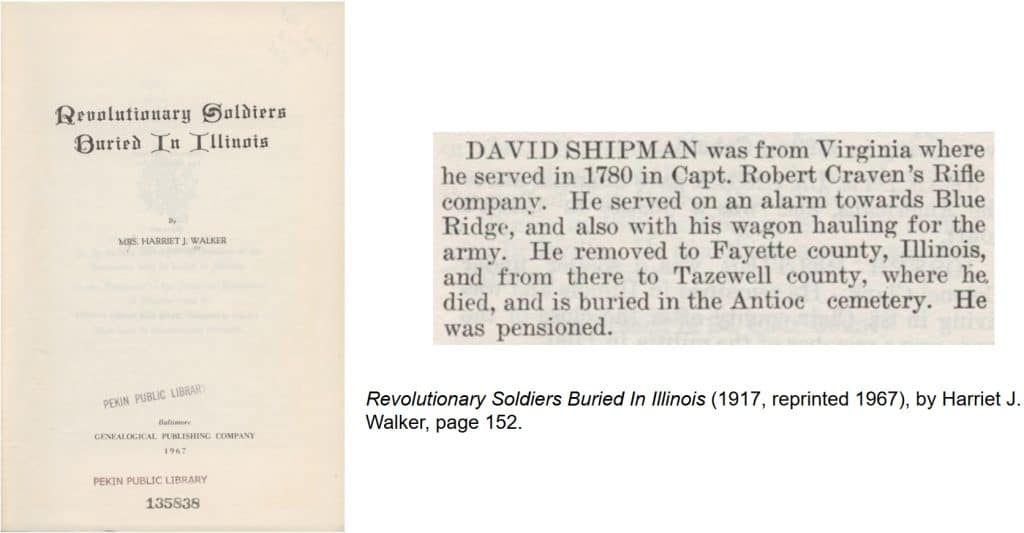
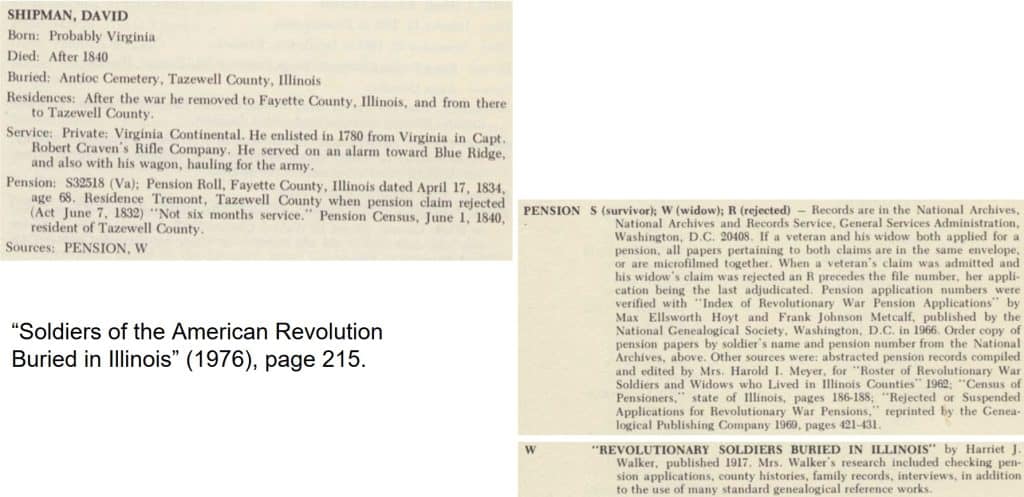
The 1976 index says David Shipman is listed as a Fayette County, Illinois, military pensioner, age 68, on a pension roll dated 16 April 1834. That roll is what is known as the Pension Roll of 1835, which, as we have seen in earlier articles in our “America 250 – Portrait of a Patriot” series, is not always a reliable source. It is no doubt from the Pension Roll of 1835 that Harriet Walker derived her 1917 statement that David Shipman had settled in Fayette County first, then moved to Tazewell County. Walker’s erroneous statement was then repeated in the 1976 index.
Here below is the page from the Pension Roll of 1835 that shows David Shipman as a Revolutionary War pensioner, said to be living in Fayette County, Illinois:
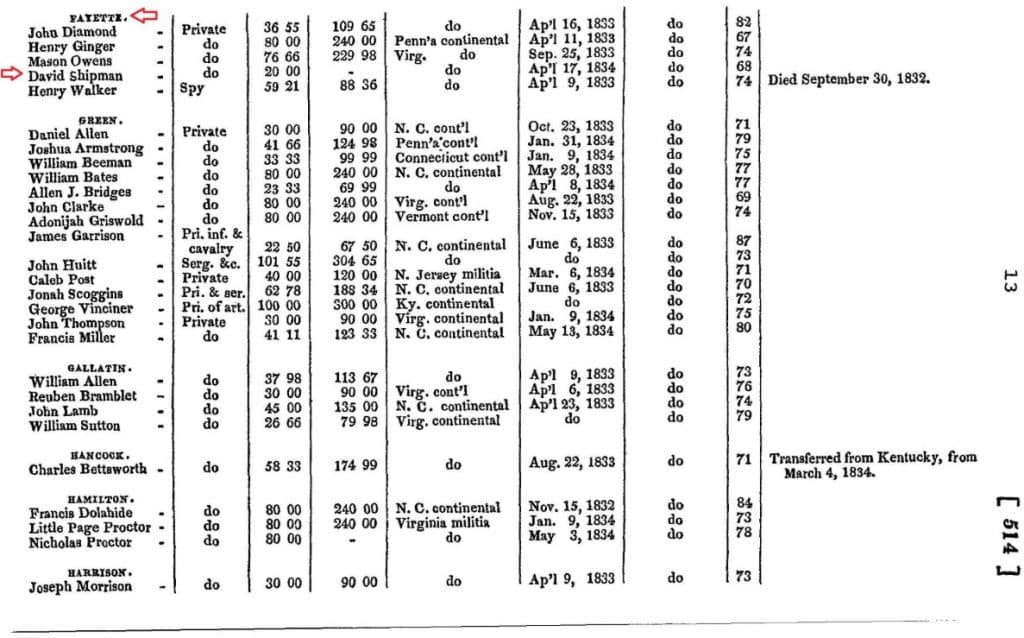
As we can see, in that publication David is listed as a resident of Fayette County, Illinois, in 1834. However, it is known that Shipman had settled in Tazewell County in 1826 and remained in our county until his death, so he could not have been living in Fayette County in 1834. How did the Pension Roll of 1835 come to mistakenly list him in Fayette rather than Tazewell, and thereby mislead Harriet Walker and the compilers of the 1976 index? Perhaps it was a misreading of an old cursive spelling of “Tazwell” as “Fayett,” mistaking a cursive “T” for an “F,” a cursive “z” for a “y,” mentally eliding the loops of the “w,” and mistaking the double lower case “l”s as double lower case “t”s. But as we shall see, there may be another explanation for this “Fayette County, Illinois” error.
Besides the above secondary and tertiary sources, David Shipman is also listed on an original Illinois pension roll that covers the years 1833-1849. These state rolls did not identify the counties where the pensioners lived, but they verify that pension payments were being made (or were supposed to be made) to the soldiers listed on the state rolls. In some cases, though, the soldiers on these rolls lived in an adjoining state and would cross state lines to pick up their twice-a-year pension payments.
Here is the Illinois state pension roll in question:
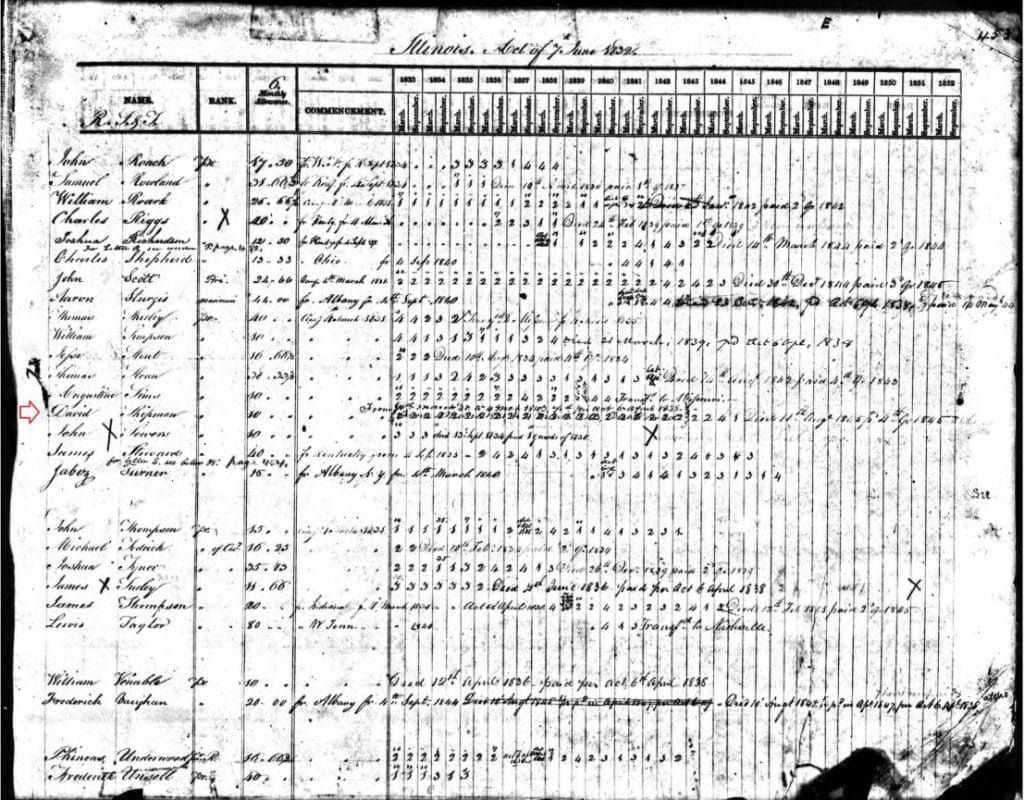
This state pension roll shows that David’s pension payments commenced March 1833 and continued up to March 1845. As we have seen, he died 11 Aug. 1845, which was prior to his second 1845 pension payment sent 4 Sept. 1845. Note, however, the curious mark or notation at the middle of 1843 — more on that farther below.
The Battle of Cowpens, 17 Jan. 1781
As noted above, David Shipman was one of the Virginia militiamen who took part in the Battle of Cowpens in January of 1781. This is how the American Battlefield Trust tells the story of Cowpens, the first battle of 1781 in the all-important Southern Campaign of the Revolutionary War that ended successfully with the surrender of Lord Cornwallis at Yorktown, Virginia.
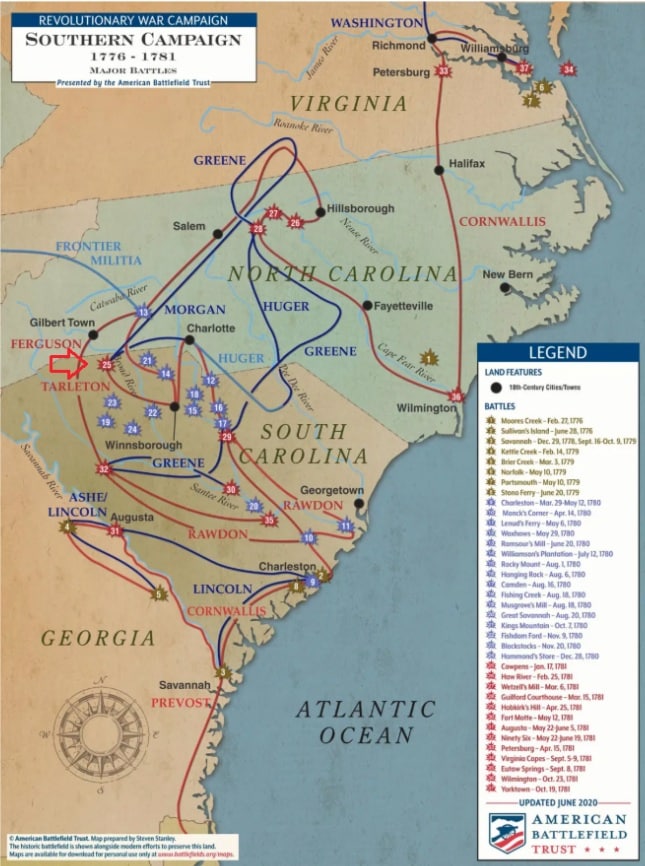
“Hoping to eliminate the threat posed by General Daniel Morgan’s American troops, 26-year-old Lt. Col. Banastre Tarleton led a combined force of cavalry and infantry into the South Carolina backcountry. Morgan learned of Tarleton’s pursuit and marched his troops toward the Broad River, arriving at a place called Cowpens on the night of January 16, 1781. Bolstered by South Carolina militia under Andrew Pickens, Morgan was determined to stand and fight.
“Using their poor reputation to their advantage, Morgan’s militia briefly resisted the British advance before retreating. After driving in two successive lines of militia, Tarleton’s men considered the Americans to be in full retreat and advanced headlong into a trap. Instead of facing more militia, they encountered a third and final line composed of Continental Regulars from Maryland and Delaware. The Continentals unleashed a volley which brought the enemy advance to a grinding halt. Morgan then launched a bayonet charge and supported by a mounted force under Col. William Washington achieved a double envelopment, striking both British flanks simultaneously. Tarleton’s line collapsed and the British were driven from field.”
David Shipman’s pension file and recollections of war service
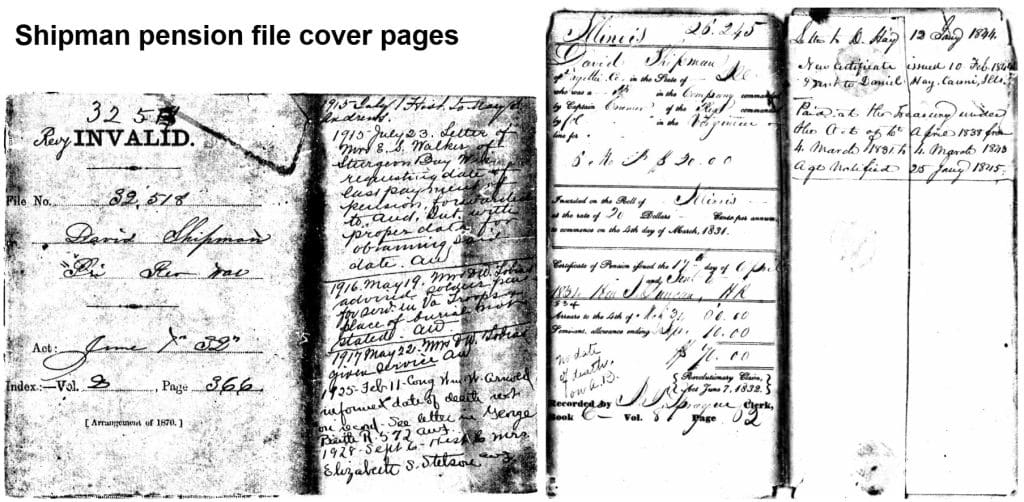
On 2 Sept. 1833, David, age 68, applied for a Revolutionary War pension under the U.S. Congress’ Pension Act of 1832, and in so doing he supplied his own recollections of his service in the Virginia militia. Here are the two keys pages from his pension application that include David’s narrative of his militia service during the war.
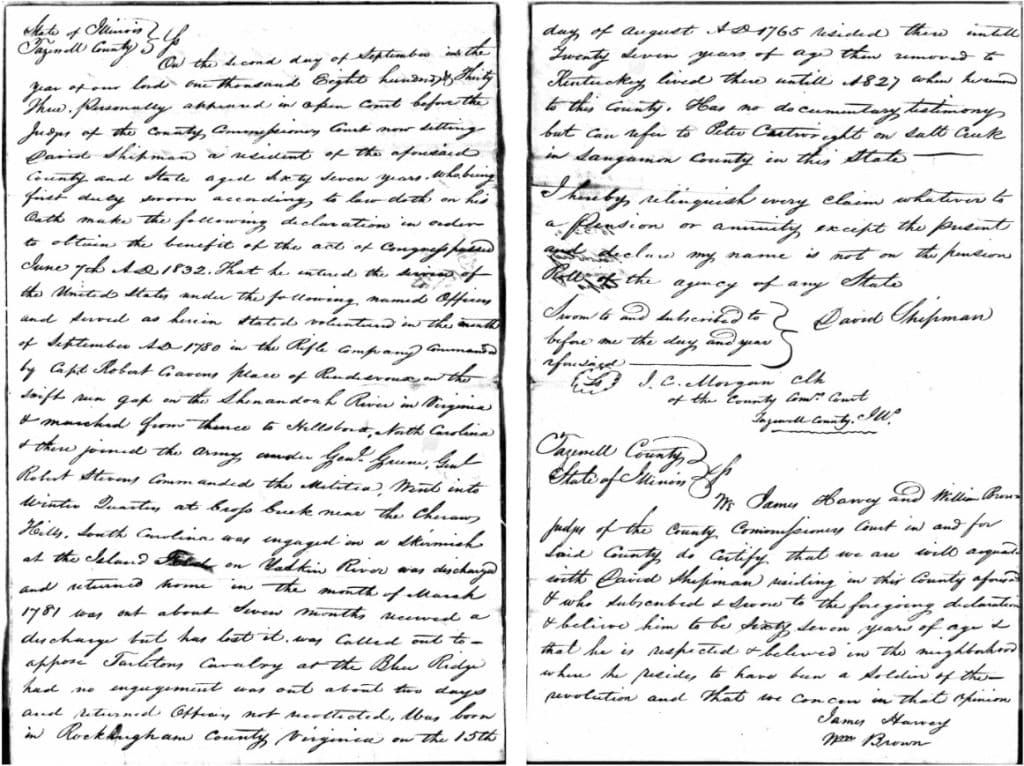
Here is a transcription of the above service narrative:
State of Illinois Tazewell County: SS
On the second day of September in the year of our Lord 1833 Personally appeared in open Court before the Judges of the County Commissioners Court now sitting David Shipman a resident of the aforesaid County and State aged sixty-seven years, who being first duly sworn according to law doth on his oath make the following declaration in order to obtain the benefit of the act of Congress passed June 7th A.D. 1832. That he entered the service of the United States under the following named Officers and served as herein stated volunteered in the month of September A.D. 1780 in the Rifle company commanded by Captain Robert Cravens place of Rendezvoused on the Swift run Gap on the Shenandoah River in Virginia & marched from thence to Hillsboro North Carolina & there joined the Army under General Greene, General Robert Stevens [sic – prob. Edward Stevens] Commanded the Militia, Went into winter quarters at Cross Creek near the Cheraw Hills, South Carolina was engaged in a skirmish at the Island Ford on Yadkin River was discharged and returned home in the month of March 1781 was out about seven months received a discharge but has lost it, was called out to oppose Tarleton’s Cavalry at the Blue Ridge had no engagement was out about 10 days and returned. Officers not recollected, Was born in Rockingham County Virginia on the 15th day of August A.D. 1765 resided there until 27 years of age then moved to Kentucky lived there till 1827 when he removed to this County. Has no documentary testimony but can refer to Peter Cartwright on Salt Creek in Sangamon County in this State
I hereby relinquish every claim whatever to a pension or annuity except the present and declare my name is not on the pension Roll of the Agency of any State.
Sworn to and subscribed before me the day and year aforesaid S/ J. I. Morgan, Clk S/ David Shipman
Note that David’s narrative mentions Fayette County, Virginia (that is, Kentucky, originally a part of Virginia). Could that help explain how the Pension Roll of 1835 and later publications mistakenly placed David in Fayette County, Illinois?
David Shipman’s initial pension application was rejected because it was incomplete, not supplying all of the required information and documentation. In addition, the pension commission questioned the duration of David’s militia service.
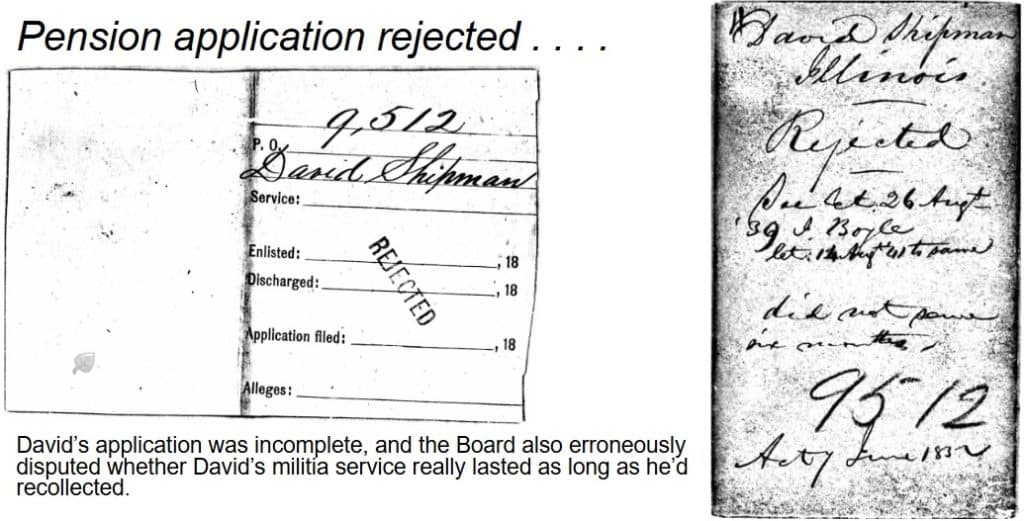
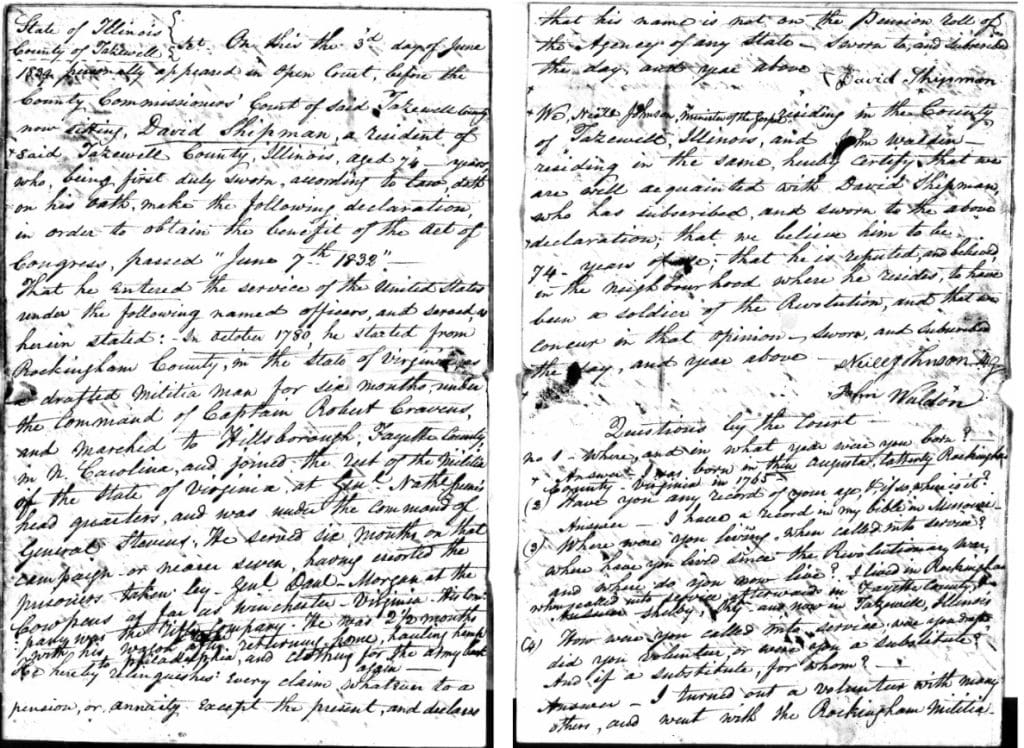
After his first application was rejected, on 3 June 1839 David reapplied for his pension, supplying the missing content of his first application, including the transcript of his formal interview at the Tazewell County Courthouse in Tremont. In this second application, David substantially repeated his service narrative of 1833. David was then approved for a pension of $20 a year. Here is his second application and service narrative, followed by a transcription of these pages.
State of Illinois County of Tazewell: SS
On this the 3rd day of June 1839 personally appeared in open Court, before the County Commissioners Court of said Tazewell County now sitting, David Shipman, a resident of said Tazewell County, Illinois, aged seventy-four years who, being first duly sworn, according to law, doth on his oath, make the following declaration in order to obtain the benefit of the Act of Congress passed June 7th 1832. That he entered the service of the United States under the following named officers and served as herein stated: In October 1780 he started from Rockingham County, in the State of Virginia, as a drafted militia man for 6 months, under the command of Captain Robert Cravens, and marched to Hillsboro, Fayette [sic – Orange] County, in North Carolina, and joined the rest of the militia of the State of Virginia at general Nathanael Greene‘s headquarters, and was under the command of General Stevens. He served six months on that campaign – or nearer seven, having escorted the prisoners taken by General Daniel Morgan at the Cowpens as far as Winchester – Virginia. His Company was the Rifle Company. He was 2 1/2 months with his wagon after returning home hauling hemp to Philadelphia and clothing for the Army back again. He hereby relinquishes every claim whatever to a pension or annuity except the present, and declares that his name is not on the Pension roll of the Agency of any State. Sworn to and subscribed the day and year above. S/ David Shipman
Questions by the Court
No. 1. Where and in what year were you born? Answer – I was born in then Augusta taken by Rockingham County Virginia in 1765
2nd Have you any record of your age and if so where is it? Answer – I have a record in my Bible in Missouri
3rd Where were you living when called into service: where have you lived since the Revolutionary War and where do you now live? I lived in Rockingham when called into service afterwards in Fayette County & Shelby Kentucky and now in Tazewell, Illinois
4th How were you called into service; were you drafted; did you volunteer or were you a substitute, and if in substitute, for whom? Answer – I turned out a volunteer with many others, and went with the Rockingham Militia.
5th State the names of some of the regular officers who were with the troops when you served, such Continental and militia regiments as you can recollect and the general circumstances of your service. Answer – Colonel Lee, and Colonel Washington, who fought at the cow pens – I knew also Captain Yancey, Graves, Rinker, Jamison, all of Virginia line – Aid de camp Clayton and Williams
6th Did you ever receive a discharge from the service, and if so, by whom was it given and what has become of it? Answer – I received none being sent home by General D. Morgan with the prisoners to Winchester Virginia
7th State the names of persons to whom you are known in your present neighborhood and who can testify as to your character for veracity and their belief in your services as a soldier in the revolution. Answer – Benjamin Briggs, Esquire a magistrate of our County – John Walden, formerly Constable and Squire Jesse Shanklin
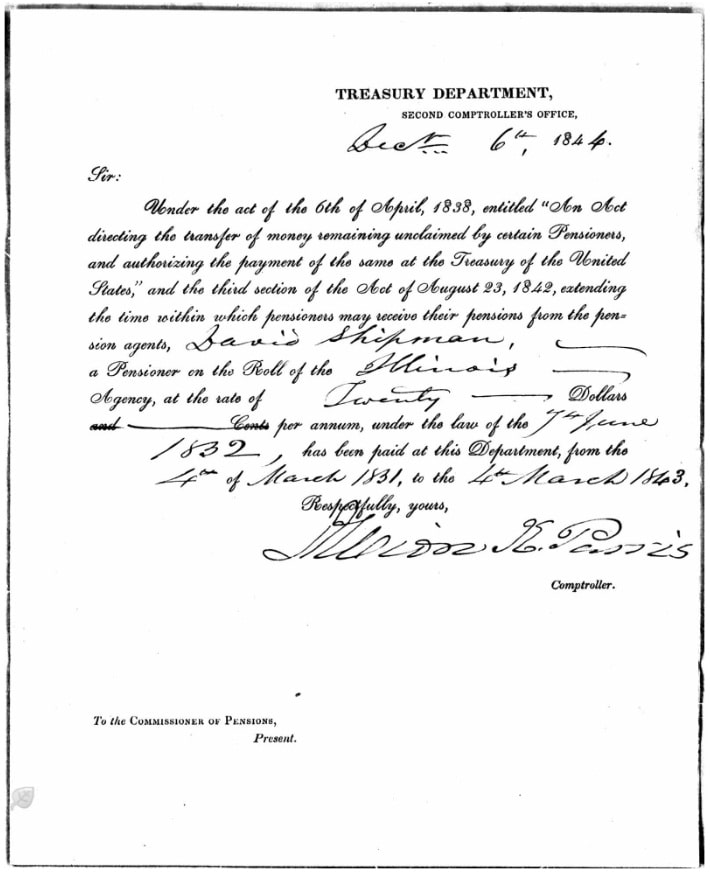
Despite his pension being approved and his being listed on the Illinois pension roll, the pension commission forgot to send David his Treasury Department pension certificate. Lacking that certificate would have interfered with David’s ability to collect his payments. So, on 12 Oct. 1843 he again wrote, asking for his certificate. Following is that letter, and a transcription:
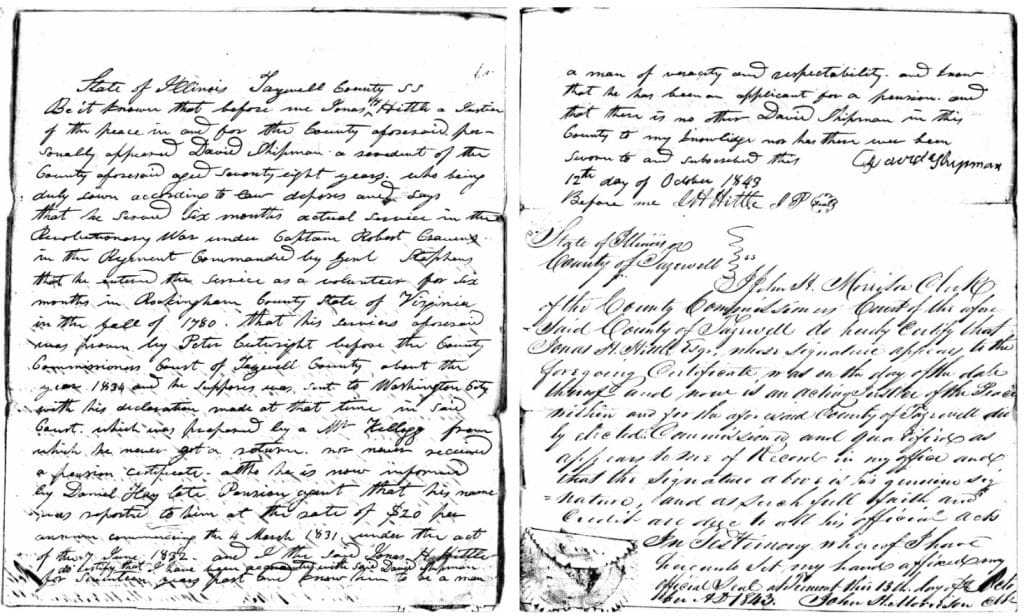
State of Illinois Tazewell County SS Be it known that before me Jonas H Hittle a Justice of the Peace in and for the County aforesaid personally appeared David Shipman a resident of the County aforesaid aged seventyeight years who being duly sworn according to law deposes and says that he served six months actual service in the Revolutionary War under Captain Robert Cravens in the Regiment commanded by General Stephens that he entered the service as a volunteer for six months in Rockingham County State of Virginia in the fall of 1780, that his services aforesaid was proven by Peter Cartwright before the County Commissioners Court of Tazewell about the year 1834 and he supposes was sent to Washington City with his declaration made at that time in said Court which was prepared by a Mr. Kellogg from which he never got a return, nor never received a pension certificate, although he is now informed by Daniel Hay late Pension agent that his name was reported to him at the rate of $20 per annum commencing the 4th of March 1831 under the act of the 7 June 1832, and I the said Jonas H Hittle do certify that I have been acquainted with said David Shipman for seventeen years past and knows him to be a man a man of veracity and respectability and know that he has been an applicant for a pension and that there is no other David Shipman in this County to my knowledge nor has there ever been. Sworn to and subscribed this 12th day of October 1843 S/ J. H. Hittle, JP S/ David Shipman
Note the change in David’s signature from 1833 to 1843 — this evidently shows his increasing debility due to old age.
But now, at long last, on 6 Dec. 1844, only eight months before he died, David received his pension certificate, removing the last roadblock to his receiving pension payments, backdated to 4 March 1831. This bureaucratic snafu apparently explains the curious pension roll marking in mid-1843.
David Shipman and the Shipman Family ‘Freedom Pursuit’
As I mentioned above, David Shipman’s story is significant not only for his faithful service during the United States of America’s struggle for independence from Britain, but also for his upholding the ideals and promises of America: liberty and human equality. In the decades following the Revolutionary War, David moved to Kentucky, where his moral opposition to slavery coalesced in his heart. While living in Shelby County, David Shipman borrowed money from his relatives so he could purchase of family of enslaved African Americans. He then set them free and brought them to the Free State of Illinois so they could enjoy their rights as free Americans, living and working in Tazewell County. But one of David’s relatives from whom he had borrowed money, his sister’s son Stephen Smith, was intent on seizing the free black Shipmans and selling them back into slavery. This drama led to a episode that is memorialized as the “Shipman Family Freedom Pursuit” by “the Three Horsemen of Tazewell County.”
The story of the “Freedom Pursuit” and the “Three Horsemen” is one that we have recalled several times here at “From the History Room” — first in September 2013, again in January 2016, and most fully in July 2022. In published sources of our local history, it first appears in Charles C. Chapman’s 1879 Tazewell County history. However, more recent research by Susan Rynerson of the Tazewell County Genealogical & Historical Society has revealed the full story (and also has shown that the 1879 Chapman account is not only incomplete but includes errors and some unsubstantiated or exaggerated details).
The account of the “Freedom Pursuit” that is now inscribed on a new State Historical Marker at Woodrow Cemetery near South Pekin was written by Rynerson. Following is the narrative from the historical marker, which I have expanded with various additional details from Rynerson’s research, more than could fit on the marker:
In the mid-1820s, American Revolutionary War veteran David Shipman (c.1760-1845) mortgaged all of his property in order to purchase nine black enslaved persons, possibly with the intention of enabling them to obtain their freedom. In 1826, however, two of them, Sarah and Eliza, were seized from him and sold due to his debts. Therefore, in October 1826, David Shipman fled his home in Shelby County, Kentucky, with the seven remaining enslaved blacks named Moses and Milly Shipman, their children Allen, Mary Ann, and David, and two others named Henry Dick and William. Crossing the Ohio River, they stopped at Madison, Indiana, where David immediately secured deeds of emancipation for them before moving swiftly to the homestead of Jesse Harrison (with whom Shipman had served during the Revolution), located where the town of Circleville would later be established at the northeast corner of Sand Prairie Township in Tazewell County. (Woodrow Cemetery is just to the north of where Harrison and Shipman lived.)
Shipman, his wife, and the now free blacks lived in peace for just two months before David’s nephew Stephen Smith of Kentucky located them and obtained a Replevin from the Peoria County Sheriff to take the free black individuals into his possession. This alarmed Shipman’s neighbors, and 14 of them signed a Replevin bond of their own when Shipman filed a countersuit for Trespass and Trover against Smith on Christmas Day 1826. Ironically, on this occasion, to obtain the release of the free blacks, Shipman had to argue that Smith had taken his “property” even though they all had manumission papers from Indiana. The sheriff returned the free blacks to Shipman on Dec. 29, and all parties were advised to appear in court in May of 1827.
However, rather than appear in court, on the night of 4 May 1827, Smith and returned to Circleville and kidnapped Moses Shipman, age 30, Moses’ wife Milly, age 25, their children David, age 2, and Charles, an infant, along with Henry Dick, and 16, and William, age 12. The kidnappers tied them together and led them towards their boat on the Mackinaw River, but Moses was able to break free and run back to alert his neighbors.
His neighbors quickly sprang to action. That very night, Johnson “John” Sommers (1792-1870), Samuel Woodrow (1798-1874), and Nathan Dillon (1793-1868) mounted horses and swiftly headed to St. Louis, the nearest slave auction block. On May 8, the three horsemen intercepted the kidnappers on the docks at St. Louis. Dillon signed an affidavit that the family members were all free, and he and his friends helped Milly, David, Henry, and William file Freedom Suits in St. Louis court, insisting that their being free citizens meant they could not be sold back into slavery.
Legal action in their cases took almost three years before their freedom was upheld, during which time Milly, David, Charles, Henry, and William had to be held in jail to prevent them from being “sold down the river” to Louisiana. At first the St. Louis court ruled in favor of Stephen Smith, claiming that because David Shipman was in debt to his nephew, Shipman should have let Smith take the enslaved individuals rather than setting them free. However, the Missouri Supreme Court in those days had a rule known as “once free, always free,” so the Supreme Court overturned the lower court rulings, confirming the freedom of the kidnapped family, with Tazewell County citizens having been called to testify. At long last, on 13 April 1830, with all legal actions exhausted, the family was finally freed and returned to Tazewell County.
As noted above, Susan Rynerson has remarked on the strange irony that in the “Free State” of Illinois, David Shipman’s neighbors and friends had to resort to the legal fiction that the family of Moses Shipman were David’s property in order to thwart Stephen Smith’s first kidnapping of the Black Shipmans, but in the Slave State of Missouri David’s friends argued successfully that these were free persons of color and therefore could not be re-enslaved.
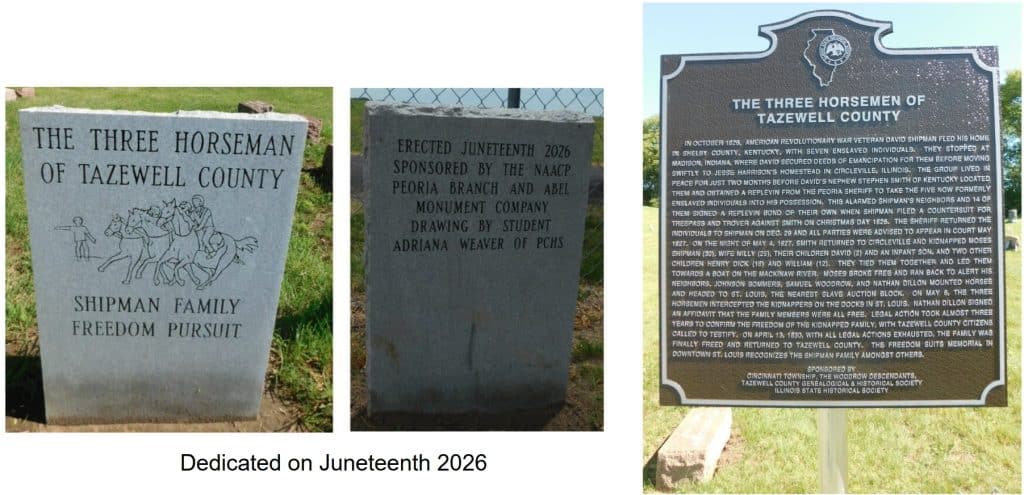
The new “Three Horsemen of Tazewell County” memorial that was dedicated this year on Juneteenth was placed at Woodrow Cemetery because both Samuel Woodrow and Johnson Sommers (whose first wife Amelia was a Woodrow) are buried there. Nathan Dillon is buried at Dillon Cemetery.
Significantly, the family of Moses and Milly Shipman has connections to the first Juneteenth in 1865. Their daughter Mary Ann was the mother of Pvt. George W. Lee of Pekin, who served in the 55th Massachusetts Colored Infantry during the Civil War and was present at Juneteenth — and George himself was a son-in-law of Nance (Legins) Costley of Pekin. In addition, Moses and Milly’s son David married Elizabeth Ashby, who was very probably a sister of Pvt. Nathan Ashby of Pekin and Peoria, a soldier in the 29th U.S. Colored Infantry who also was at Juneteenth (and a few of Nathan’s brothers and close Ashby kin were also at Juneteenth). Another son of Moses and Milly, Pvt. Thomas Shipman (c.1841-1865), was a sharpshooter in the 29th U.S. Colored Infantry, but was fell to a Confederate sniper’s bullet one week before Lee’s surrender at Appomattox Courthouse and so didn’t make it to Juneteenth that summer. On the Tazewell County Veterans Memorial outside the Tazewell County Courthouse, Thomas Shipman’s name is listed immediately below his fellow fallen Civil War soldier Lieut. Milton Stanford Sommers (1826-1862), who was a son of Johnson Sommers, one of the three men who pursued Stephen Smith to St. Louis and prevented Thomas’ mother and older brothers from being sold back into slavery. If not for their daring and noble action, Thomas would never have been born and go on to lay down his life in the fight for freedom.
Death, burial, and legacy
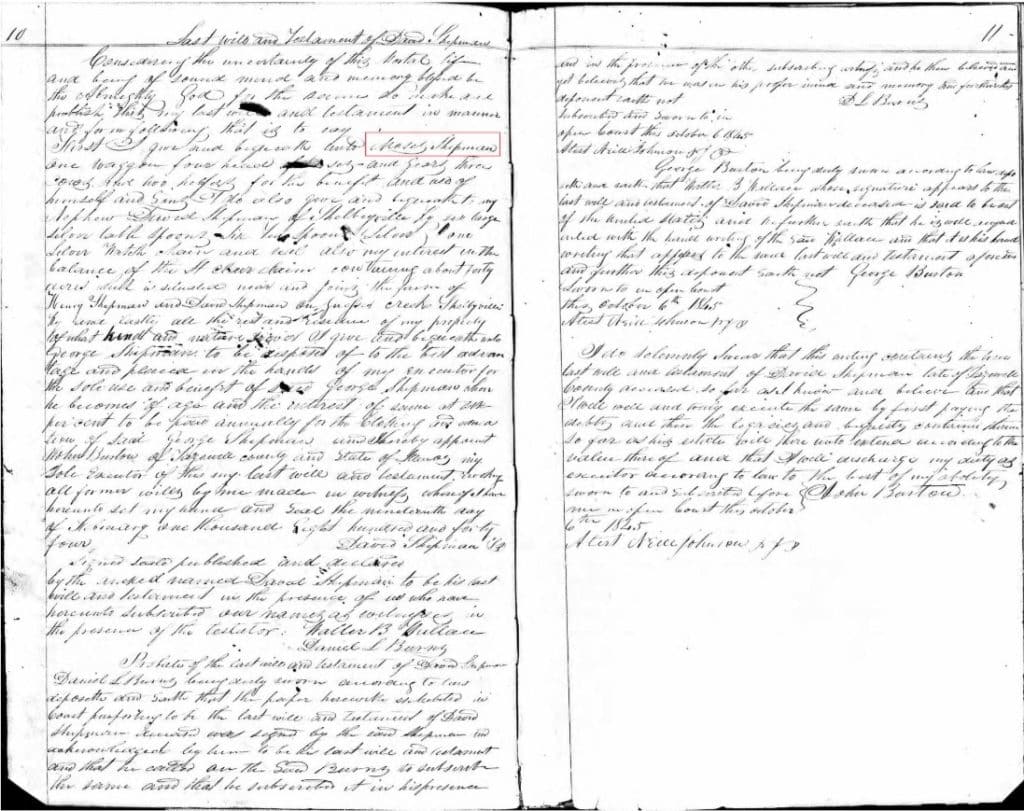
David Shipman made, signed, and published his last will and testament in Tazewell County on 19 Feb. 1844. After his death on 11 Aug. 1845, the will was probated on 6 Oct. 1845. David’s wife had predeceased him, and they apparently never had any children of their own. Thus, naturally many of his bequests were to his Shipman nephews in Kentucky. But very significantly, David’s first bequest in his will was to Moses Shipman:
“. . . one waggon four head of horses and gears three cows and two heifers for the use and benefit of himself and sons.”
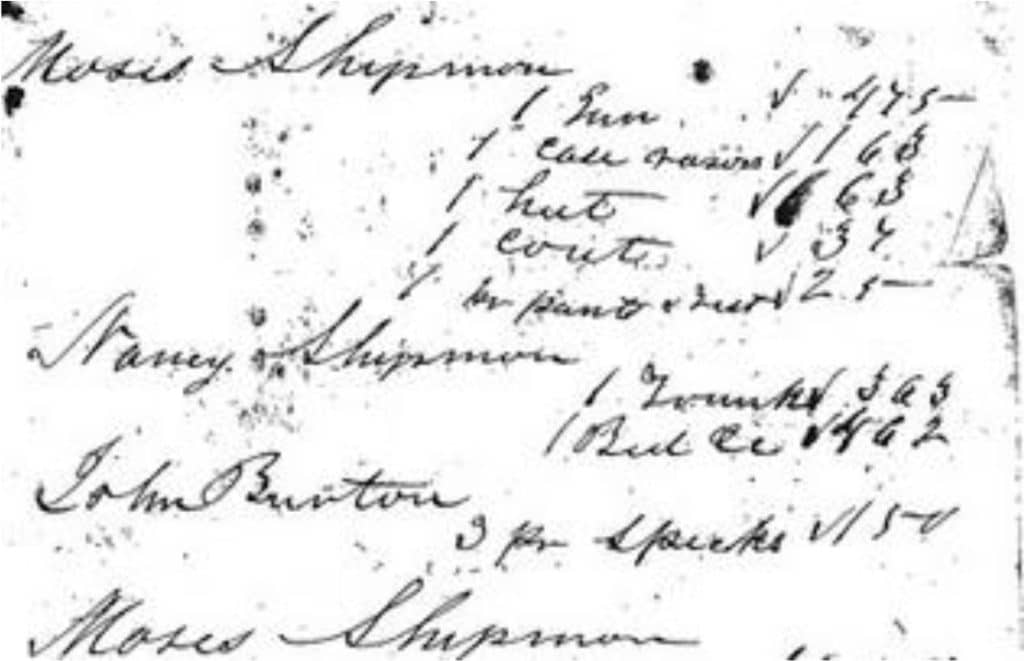
Among the documents from David’s Probate file at the Tazewell County Courthouse is one that tallies up payments made from David Shipman’s estate to Moses Shipman – these payments, totaling $2,407, were reimbursement for Moses having taken care of David and David’s wife from 1831 to 1845, and to repay Moses for the cost of David Shipman’s coffin. Another document is a statement that “David Shipman died August 11, 1845 after making his last will and testament filed herewith.” A third document is a receipt from the undertaker Willerson Richmond for David Shipman’s coffin. A fourth document is an inventory and appraisal of David Shipman’s property with a list of those who bought those items when they were auctioned off – Moses and his second wife Nancy bought most of them at the auction.
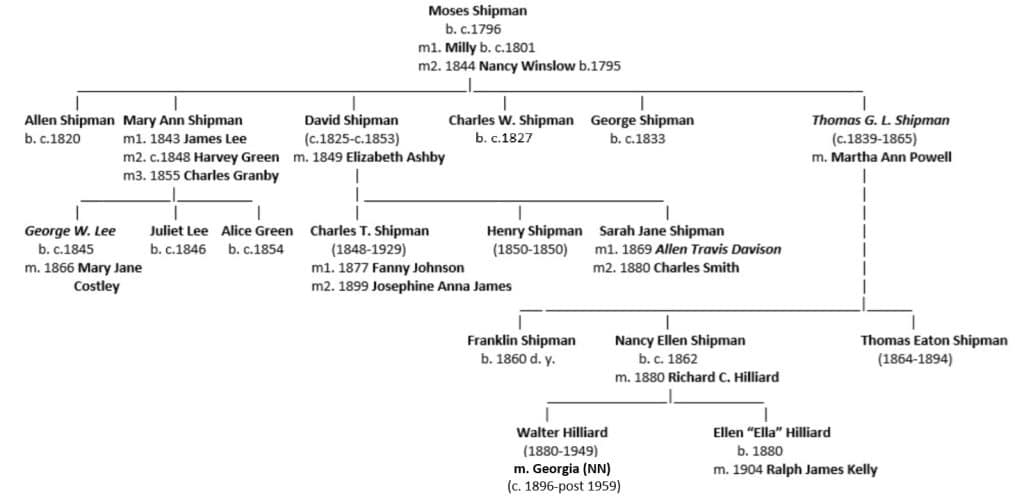
Though David Shipman had no children of his own, there was clearly deep affection between himself and Moses Shipman’s family. With Moses ensuring David received a Christian burial, and inheriting the majority of David’s estate — and above all, with the legacy of freedom and dignity that David had bequeathed Moses and his family, Moses may as well have been David’s son. Following is a pedigree chart of the known descendants of Moses and Milly Shipman, some of whom went on to join the struggle for the emancipation and dignity of all Black Americans during the Civil War, and one of whom, Walter Hilliard, enjoyed a long career as a singer and at the end of his career shared the stage with a young Lena Horne.
David Shipman’s ‘America 250’ monument
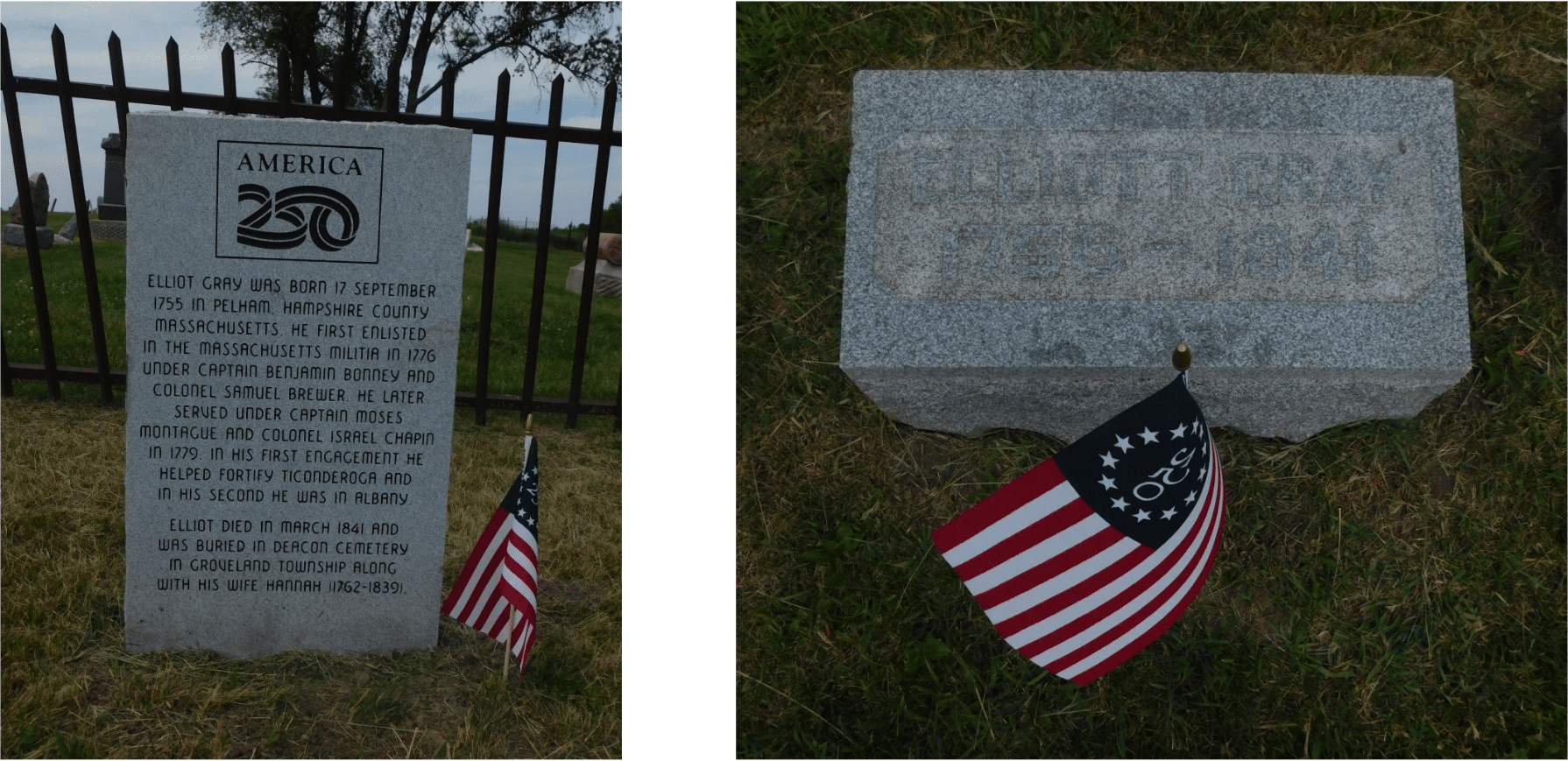
In anticipation of this year’s 250th anniversary of the creation of the United States of America, the Tazewell County Genealogical & Historical Society commissioned five new memorial stones that were placed in the month of May in five Tazewell County cemeteries that are, or are close to, the locations of five Revolutionary War veterans’ burial places. Previously these five locations had been overlooked by the public, but these new stone monuments have been placed near the entrance of the cemeteries to attract the public’s attention. Two of the soldiers — Elliot Gray and Moses Hoskins — have long had grave markers, and Hoskins also has an Sons of the American Revolution marker, but the other three soldiers — David Shipman, James Broyhill, and Samuel McClintock (or McClintick) — probably only ever had pioneer-era wooden grave markers that decayed long ago.
The life stories and military service of the five Revolutionary War Patriots were researched by Susan Rynerson. The five stone memorials, which have been prepared by Abel Vault & Monument of Pekin, all bear the official “America 250” Semiquincentennial logo, and have been engraved with summaries of their war service written by Rynerson. The dedication program for the five new monuments took place at Antioch Cemetery, the location of David Shipman’s grave. Unfortunately the exact site of his grave is unknown, but his remains are believed to rest at the back the the cemetery, in the oldest part of the burying ground.