Roots of religion in Illinois
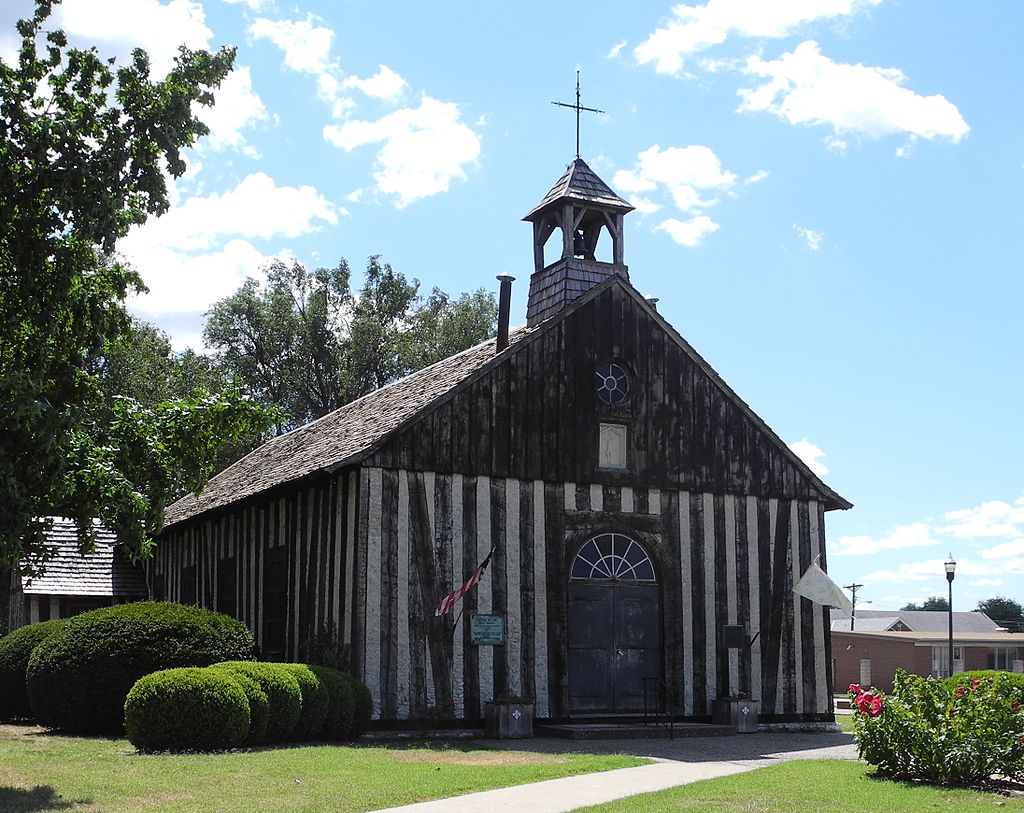
Before the arrival of European explorers and settlers in the Illinois Country, religion in Illinois took the form of the ancient nature-based or animist pagan religions of the Native American tribes. Catholic French explorers and missionaries introduced Christianity to Illinois in the 1600s, and French villages in Illinois often included Catholic chapels or churches – including La Ville de Maillet (Peoria) – and in places such as Cahokia or Prairie du Rocher religious missionaries offered Masses and provided religious instruction.
Catholic missionaries baptized many Native Americans, but sometimes the native tribes were not wholly converted from their ancient beliefs. One notable example was the influential Kickapoo prophet Kannekuk, who began a religious movement among Illinois’ native peoples in 1825 that mixed Catholic Christian doctrines and practices with Kickapoo religious beliefs and concepts. Though Kannekuk’s zealous preaching saved many of his people from the evils of alcohol abuse, Catholic priests in Illinois were grieved by his syncretistic approach which led members of their flocks to embrace beliefs that the Church condemns as heretical.
Despite the work of the Catholic missionaries, the regular practice of religious faith and the lasting establishment of churches, synagogues, temples, and mosques in Illinois did not really take root until the 1800s. This is not because Illinois’ early settlers were generally irreligious or secular in their outlook. Far from it – most of them were Catholic and Protestant Christians who had come from communities where religious practice and catechesis were a regular part of life. It rather had to do with the stark realities of pioneer life. As Illinois Gov. Edward Dunne explained in the first volume of his 1833 history, “Illinois: The Heart of the Nation,” pages 252-253:
“The prime necessity of the frontiersman was the preservation of his life and the lives of his dependents. To preserve life he needed shelter, food and clothing. To secure these he was compelled to give his whole time and energy. He had to build his cabin and shelter for his live stock, to watch the Indians, to track the wild game, and to make his traps and fish nets in order by hook or crook to keep hunger from his door. He had no time for education or for following the outward forms of religion. He built no schools or churches, nor had he the means to pay others for so doing.”

Further on in his account, Dunne sketches this picture of the religious landscape of Illinois in the days of the first European settlers (pages 253-254):
“The first waves of pioneer settlers in the state naturally by outward action showed but little evidence of the inner feelings of these hardy men towards religious ceremonies. The clergymen and Sunday school teachers of their old homes had not accompanied them into the wilderness. Except among the French habitants there were no preachers, teachers or houses of worship in the new land. Instead of hunting for churches which were non-existent for non-Catholics, they acquired the habit of hunting for game, which was abundant. This non-attendance at religious meetings was not proof that they were all irreligious. As soon as clergymen of their own respective religious [traditions] began to arrive and as soon as these reverend men secured churches or even temporary houses of worship, thousands of them felt and responded to the call to return to the teachings of their youth and filled the churches with zealous believers in the Christian faith.”
According to Dunne, many of Illinois’ newcomers in the early 1800s came from Methodist, Baptist, and Presbyterian backgrounds. Methodist clergy were among the most energetic in evangelizing the new state, and by 1824 the Methodists of Illinois already had a presiding elder, nine circuits, 11 preachers, and a membership of 3,705 European Americans and 27 African Americans. By the following year, the Baptists reported that they had 58 preachers and “exhorters” in Illinois. That same year there were 16 Presbyterian preachers in the state. Other Protestant denominations such as the Brethren (“Dunkards”), Covenanters, and Independents each had a single minister active in Illinois. Besides the orthodox Catholic and Protestant groups, a few Universalist ministers were also working in Illinois. As for the Catholics, almost all were of French origin in the first three decades of the 19th century, but a few Irish families had begun to arrive by the 1820s, and there were three English-speaking Catholic mission churches in Illinois by 1830.
Seeds of Pekin’s religious faith
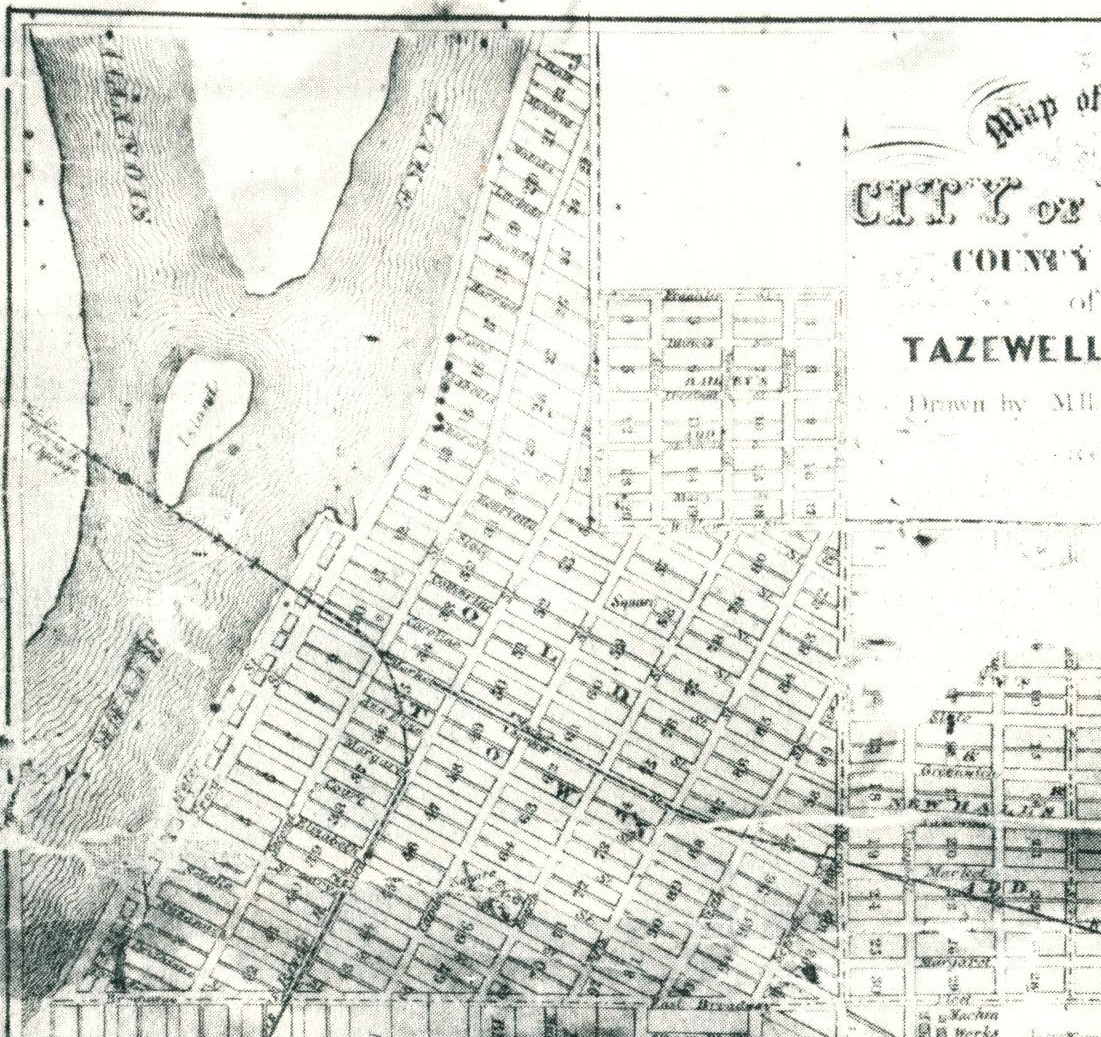
The first white settlers in Pekin, the Tharps, arrived in 1824 and 1825. “The Tharps had become Methodists before they left Ohio, and so Jacob Tharp welcomed a circuit-riding Methodist minister, Reverend Jesse Walker, into his log cabin in 1826 to conduct Town Site’s first preaching service,” says the 1974 Pekin Sesquicentennial.
In his 1879 History of Tazewell County, page 580, Charles C. Chapman quotes from the diary of Jacob Tharp:
“However, in the same season [1826], but I cannot now remember whether before or after Dillon and Hinkle’s goods arrived, the Methodists had established a mission or circuit for this part and range of the country. Religious services by that persuasion were first held at my friend’s, Gideon Hawley, on Sand Prairie, when I first met our preacher, Jesse Walker, and invited him to give us a discourse at the ‘Town Site.’ He thought it unnecessary, as no body but myself and family, and my son Jonathan and family, resided there, but I insisted and he complied. We had quite an audience. Pekin then giving promise of being something in the future. Some came to examine the site, some to do some trading, and some to look at the river and to fish, etc. The meeting was held in my house.”
From that seed grew Pekin’s first Methodist church, which met informally in members’ homes until the 1830s, following the 1829 arrival of “fiery, plainspoken John Mitchell,” who was installed as the church’s first minister.
“. . . it was under Reverend Mitchel’s guidance,” explains the 1974 Sesquicentennial, “that Pekin’s first church building was erected in the 1830’s on the north side of Elizabeth between Capitol and Third Streets. In an attempt to raise funds for the proposed two-story building, Jacob Tharp returned to Ohio, where he managed to raise $100. Unfortunately, he spent $200 on the trip, so only the lower half of the building could be completed. The congregation fondly called the building the ‘little brick church,’ but in later years it became known as the ‘foundry church,’ apparently because of its proximity to such an establishment.”
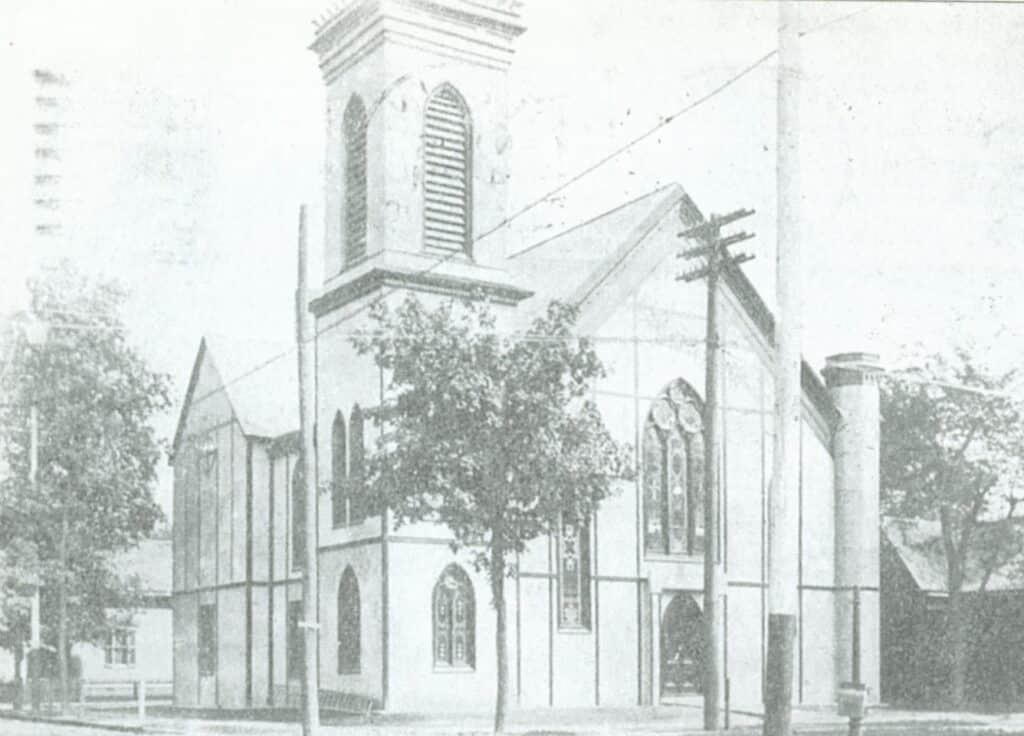
In his 1879 “History of Tazewell County,” pages 580-594, Charles C. Chapman provides an account of the history and progress of religion in Pekin, beginning with Rev. Jesse Walker’s preaching service. After Walker, a certain Rev. Lord ministered to Pekin’s first settlers. It was in 1827 that the first Methodist society, consisting of about eight or 10 members, was formed in Pekin by Smith L. Robinson. After Lord, Rev. John Sinclair arrived in 1831. Sinclair and Rev. Zadock Hall formally organized a Methodist Episcopal Church in Pekin, and Hall in turn was succeeded in 1834 by the church’s first regular installed minister, Rev. John Thomas Mitchell (1810-1863), a 24-year-old deacon who was active throughout northern and central Illinois.
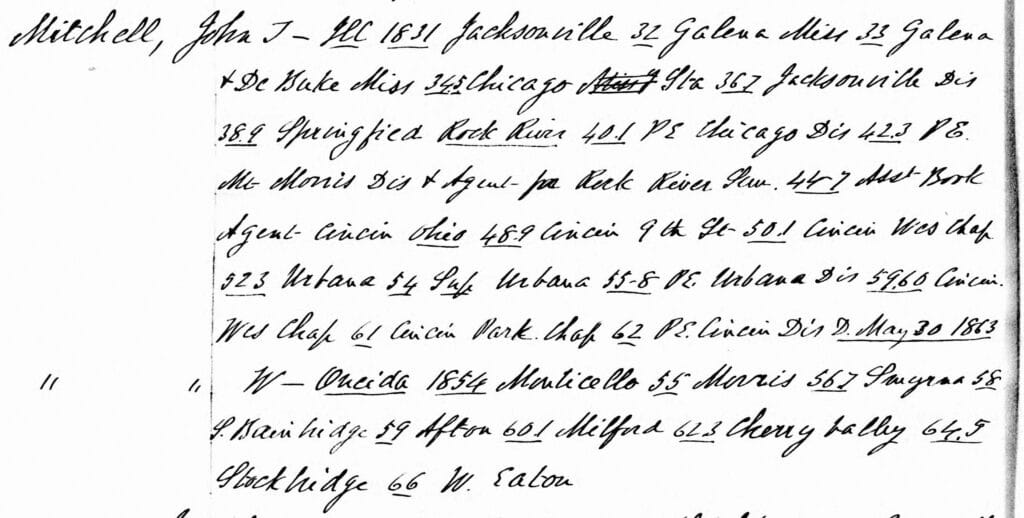
‘Fiery, plain-spoken John Mitchell’
The following excerpts from Chapman’s account provide some very colorful anecdotes from Mitchell’s time as Pekin’s Methodist minister.
“The Rev. John T. Mitchell followed Rev. Hall. He was a man of great power and eloquence, and eccentric to a great degree. His flights of oratory at times were truly sublime. He began his labors as the first regular installed minister, in 1834, in a little room, about twenty feet square, in the old barracks or stockades, which stood on the ground now occupied by the old frame residence of Joshua Wagenseller. . . .
“We will give one or two illustrations which, in themselves, will speak for the plain-tongued man of God, John T. Mitchell. One of his congregation, and a widow, who had but recently laid off her weeds, sold a cow and purchased what in those days was termed an elegant cloak, and she disposed of a brass preserving kettle and bought a bonnet (we presume a love of a one). This piece of wholesale extravagance had gone the rounds of the village, and loud were the censures for this wanton outlay, when to wear a bow or an artificial flower was equivilent (sic) to receiving sentence with the damned.
“Well, one Sunday morning when Father Mitchell was coming down on the pomps and vanities of the world, and earnestly hoping that none of his congregation would be guilty of putting on the flippery and flummery as worn by the worldings, just as his eloquence waxed warm on the subject of dress, in walked the widow with her new clothes, whereupon the sight of her was too much for him, and he said (pointing his finger directly at her,) ‘Yes, and there comes a woman with her cow upon her back and her brass kettle on her head.’ . . .
“In those days all the excitement the populace had, by way of breaking the monotony, was the landing of the steam-boats, and we are told that more always came on Sunday than any other day. Father Mitchell was exceedingly annoyed, from time to time, by many of his congregation jumping up and running to the river every time a boat whistled. Once, when the stampede began, Father Mitchell, with voice raised in tones of thunder, cried after them, ‘The wicked fleeth when no man pursueth.’ Whereupon a waggish fellow turned in the doorway, hat in hand, and, looking calmly at the divine, answered back, ‘and the righteous are as bold as a lion.’ . . .
“We think Father Mitchell must have been a firm believer in total depravity. There was a Universalist minister by the name of Carey, from Cincinnati (who was afterwards sent to Congress), came to Pekin and held a series of meetings in the two-story frame house directly opposite the old Foundry Church. This preacher, Carey, was brilliant and fluent of tongue, gathering about him, apparently, the whole village, to the disgust of Father Mitchell and his members. This was something new to them, it being the first time the broad-gauge religious track had struck Pekin, and many there were who were charmed with the doctrine. Still, some of the young men felt an innate sense of delicacy in openly and glaringly cutting old faithful Father Mitchell’s teachings, and they would walk about and reconnoitre until they would get to the corner of the building, and then stand and look around them for a few minutes, to see who was looking at them, and then like lightning dodge in. Father Mitchell, across the way, was of course taking in the full import of the scene, and feeling just a little bit of human chagrin at the boys leaving him for that glittering faith, he would walk up and down his church aisles, with his arms crossed behind his back, and as another and another would dodge in to hear Carey, he would say, very audibly, ‘there’s another one gone to hell.’”
Regarding Chapman’s comment on “total depravity,” it is unlikely that Rev. Mitchell, a Methodist, held to that doctrine. “Total depravity” is a Calvinist Protestant doctrine, whereas Methodism rejects Calvinism’s distinctive teachings on human salvation. Historically, however, Methodism has held to the orthodox Christian belief on the possibility of damnation, in opposition to the Universalist belief that all will be saved and no one will be finally damned – hence Mitchell’s displeasure with Carey’s preaching. (A biographical sketch of Rev. Mitchell was published in “Minutes of the Cincinnati Annual Conference of the Methodist Epicopal Church for the Year 1863,” pages 47-51.)
Chapman also provides an account of a memorable religious development in Pekin during the 1840s that the early settlers came to call the Sore-Throat Revival, when a frightening, deadly epidemic motivated many people to try to prepare their souls for Judgment Day, as these excerpts explain:
“The following persons composed the first choir: Samuel Rhoads, John W. Howard, James White, Daniel Creed, John M. Tinney, John Rhoads, and Henry Sweet, who acted as leader. This band of ‘ye singers’ met in Creed’s room for practice, and sometimes ‘took a hand,’ to pass the time until service. . . . This choir did valiant service in waiting on the sick during the fearful scourge and epidemic, called putrid sore throat, or black tongue, which swept over this part of the country during the winter of 1843 and 44. They paired off, night about, in watching the sick. But one evening Creed did not put in his appearance, and some of the boys suggested that he might be sick, and went to his room where they were wont to sing, but poor Daniel Creed had sung his last song on earth, and passed to the anthem choirs in the courts of Heaven, for they found him dead in his bed. The poor fellow had passed away in the loneliness of his own chamber, all alone, ‘to that bourne from whence no traveler returns.’ This fearful disease swept off, seemingly, half the village. The dead and the dying were in almost every house; men and women were aroused to a sudden sense of their obligations to their God, and with death apparently staring them in the face, they were crying out, ‘What shall we do to be saved?’ During this panic was started what was always afterwards termed the ‘sore-throat revival.’ Shops were shut, stores were closed, and all vocations for the time suspended, while the sick were nursed, the dead laid away, and the souls of the living presented to God for mercy. A pall hung over the infant town. A doom, at once dark, and deep, and solemn, seemed to settle over the citizens. Everybody joined the Church. Lucus Vanzant, the editor of the Pekin Gazette, . . . took sick early one night, and during the progress of the meeting, that same evening he sent his name down to the minister to be enrolled on the Church books. Vanzant got well.”
Pekin’s Catholic roots and the Convent Bell
Several other Christian and non-Christian faiths also established a visible presence around this general period of time, including Catholicism, which had retained a presence in central Illinois since the days of the French missionary explorers.
“Early records indicate that Pekin residents sought a Catholic Church as early as 1839; and it is reported, but not authenticated, that a St. Stephen’s Chapel was built shortly thereafter,” says the Sesquicentennial. Other records say the structure (apparently made of logs) was dedicated to St. Lawrence, not St. Stephen, but it seems rather that the St. Lawrence chapel may have been the first Catholic church building in Pekin, formerly located on the west side of Fifth Street between Court and Margaret. “Pekin: A Pictorial History” says that around 1850 the Catholics of Pekin (most of them being Germans and Irish) moved to Flint’s Hall on lower Court Street, where the first regular Masses began to be offered by Father John C. Brady.
In 1863, Father Jerome A. Ryan of Peoria presided at the laying of the cornerstone of St. Stephen’s Chapel at the corner of Second and Susannah. That served as the original church for St. Joseph’s Parish, which served the English-speaking Catholics in town (mostly Irish). Desiring a priest who spoke English, the Irish Catholics had separated from the German-speaking Catholics of Pekin, who subsequently built their own Sacred Heart Church in 1872. The original St. Joseph’s Church was replaced in 1904, and that church in turn was succeeded by the present structure in 1969.
Pekin’s old Methodist Church and the first St. Joseph Church were linked historically by a stolen Mexican convent church bell, as related in Chapman’s 1879 history, page 585:
“The bell, which for years was mounted in the tower of the old frame church, and which rung and toled (sic) alike in joy or sadness, for marriage or funeral, was presented to the Trustees of the Church by the following gentlemen: Samuel Rhoads, Colonel Frank L. Rhoads, William Tinney, and John M. Gill, and was captured by them when in Mexico, in the Mexican War. They took it from the tower of a Roman Catholic Monastery, at Vera Cruz, packed it in a flour barrel with straw, and brought it home with them to Pekin, and presented it the Methodist Church of this city, where it, with its old cracked chimes, made singular music for the masses in its ringing for service or fire. But the old bell wearied of Protestantism, and in the year 1867 was sold, with its full consent, to the English Roman Catholic Church of Pekin, where its peculiar tones may be heard at five in the morning, calling its devotees to the early mass. And thus the old bell has returned to its early faith and original creed.”
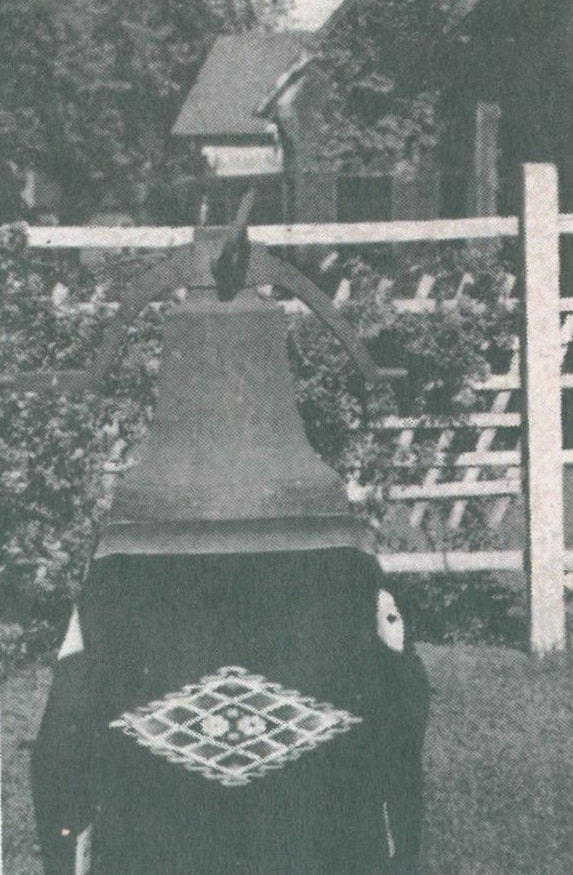
The Mexican convent bell remained in use at St. Joseph’s Church until the construction of a new church in 1904. What became of it after 1904 is unclear. Local historian William H. Bates said in his 1916 “Souvenir of Early and Notable Events” that, “The bell is still in possession of St. Joseph’s Society,” and the 1949 Pekin Centenary said only that it is “now no longer in use.” A 16 May 1978 Pekin Daily Times article says it was stored for a while in the church attic at St. Joseph’s Parish, and Lanson Pratt’s nephew Edward Neumann of Delavan says the parish had talked of donating it to the State of Illinois. The 1978 Pekin Times article only says that “its current location could not be determined.”