
The following article is adapted from a history program presented by Jared L. Olar, Pekin Public Library Local History Program Coordinator, at the annual meeting of the Friends of the Pekin Public Library Foundation on Thursday, 22 Oct. 2026.
Almost nine decades have passed since Orson Welles’ radio broadcast of “War of the Worlds” led panicked Americans to believe the East Coast had been devastated by a Martian invasion.
H. G. Wells’ science fiction work The War of the Worlds was first published in serial form in two magazines in 1897, then as a complete book in 1898. Since then it has been adapted in many ways, most notably as a Technicolor motion picture by Paramount Pictures in 1953 – which changed the story’s setting from Victorian England to (where else?) 1950s Southern California – and again in 2005 by Paramount, directed by Steven Spielberg and starring Tom Cruise, Dakota Fanning, Miranda Otto, and Tim Robbins, with narration by Morgan Freeman, with the setting in the New Jersey and New York area. The book was also adapted musically in 1978 by Jeff Wayne, whose rock concept album was released under the CBS Records label.
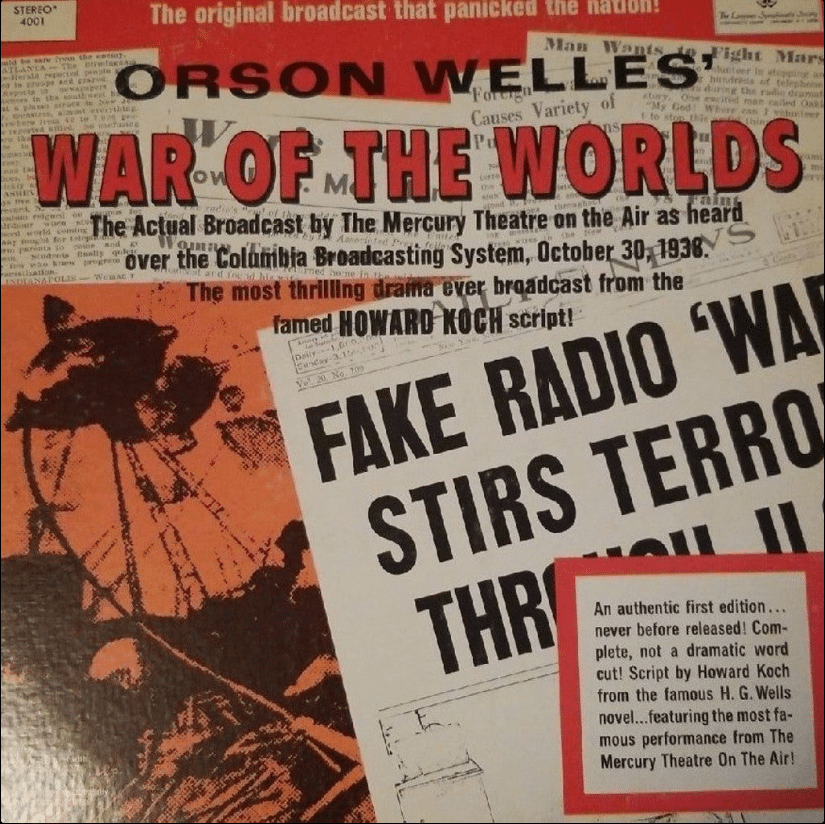
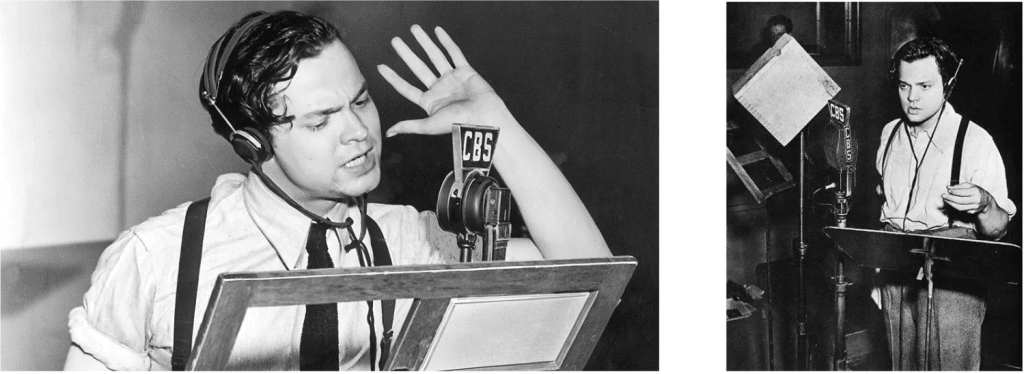
But no doubt the best known adaptation was a 1938 production on CBS radio, by Orson Welles.
Welles’ adaptation of H. G. Wells’ classic science fiction story, which aired 30 Oct. 1938, was an episode of Welles’ own show, “First Person Singular,” which was aired as a part CBS’ popular series known as The Mercury Theater on the Air, and was delivered in the style of a regular radio programming that was repeatedly interrupted by realistic emergency news reports of growing urgency and anxiety. Welles played the part of an anxious radio announcer reading breaking news dispatches, opening with news that aliens had landed at Grover’s Mill, New Jersey, and he did so convincing a job that thousands of frightened people across the country believed the earth had really been invaded.
The morning after, newspaper headlines all across the country announced the panic. Below are the 31 Oct. 1938 front pages, above the fold, of The New York Times and The Boston Daily Globe:
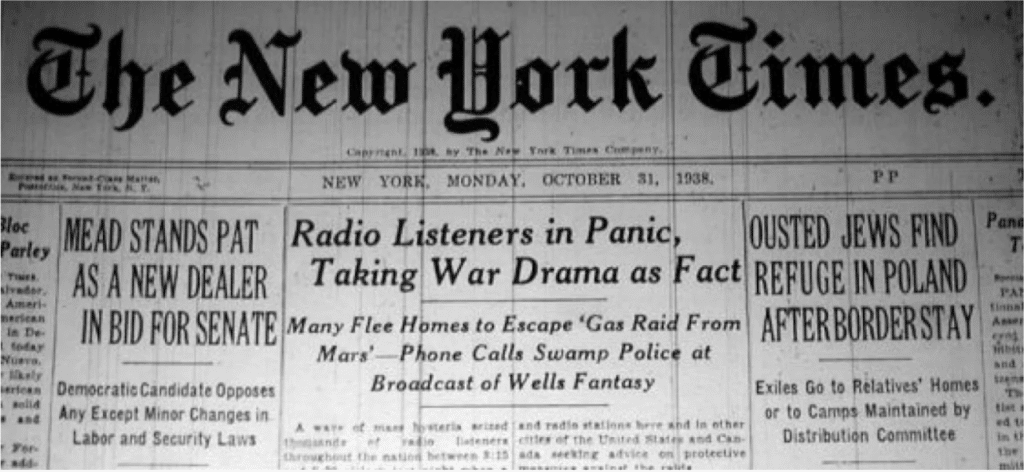
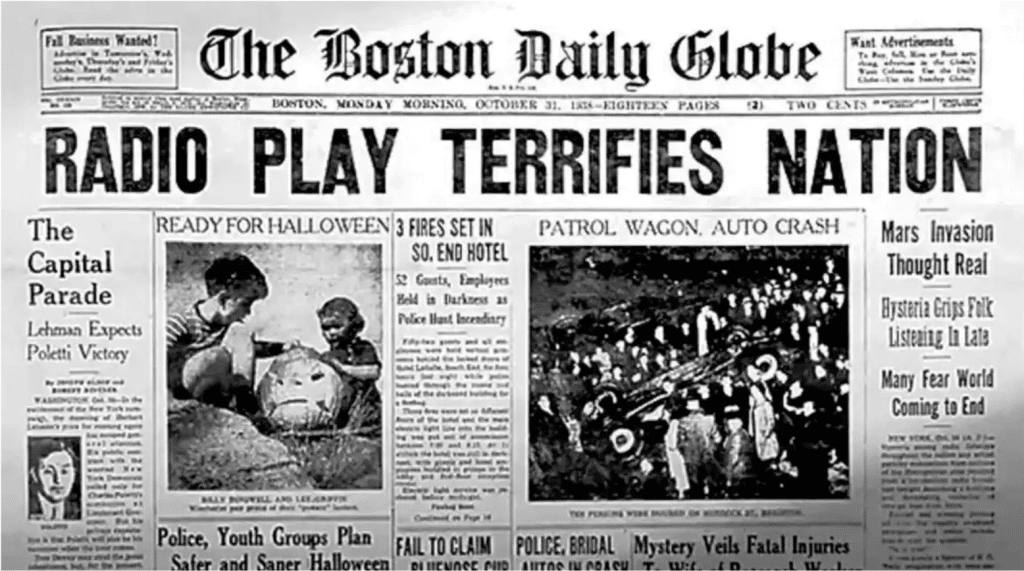
The panic mostly affected the northeastern parts of the U.S. – but it reached even as far as Pekin, as was reported on the front page of the 31 Oct. 1938 edition of the Pekin Daily Times, in a story headlined, “Investigate ‘War of Worlds’ Radio Program; Thousands Thought Eastern United States Had Been Invaded,” with a subheadline, “Pekinites Alarmed.”
Those who were caught in the panic turned had missed the start of the show or did not hear later interruptions of the program, when it was explained that the program was to be presented in the style of breaking news. As the Pekin Daily Times reported, “Altho the program was preceded by an announcement of its nature and was interrupted by the additional statements that it was a dramatization of the Wells novel, thousands of listeners thought they were an actual news report.”
Here are excerpts from the Daily Times story highlighting reports of panicked local residents that the newspaper staff had received:
“The ‘War of the Worlds’ radio program affected Pekin people just as it did others in communities thruout the country which listened to CBS between 8 and 9 p. m. CST last night.
“Scores of people admitted today they were disturbed to the point of extreme anxiety. One Pekin woman suffered a heart attack and fainted despite the fact that her son caught onto the idea immediately, and tried to explain to her.
“One Halloween party here was almost broken up when the bulletins and news flashes were broadcast. One woman sobbed; everybody wanted to go home to their children and loved ones, and when it looked as if the host could no longer control them, the program ended, and what they all thought was the end of the world turned out to be just another radio program. All heaved sighs of relief but later when the hostess served luncheon, which she had very painstakingly prepared, nobody could eat.
“A Pekin business man said his wife became hysterical, and confessed he removed his better slippers and put on shoes ready to run, but added that he didn’t know where he would run. He said all the neighbors were at his house. . . .
“Several Pekin people called relatives in the east to inquire about their safety.
“It was reported that the pastor of the Mackinaw Christian church was informed of the ‘bulletins’ during the evening church service. He told the congregation that an alarming report had been broadcast, and advised them to go quietly to their homes. They gathered in the streets near the church while G. S. Stowell, amateur radio station operator, attempted to contact similar stations in the east to get information.”
Note: G. “S.” Stowell is apparently Gilbert Warren Stowell (1909-1976), who later served two terms as Mayor of Mackinaw (1941-1949).

On 30 Oct. 2018 – the 80th anniversary of Orson Welles’ broadcast – the online magazine “Inside Hook” published an appraisal of the impact and significance of the 1938 War of the Worlds panic, titled, “The Original ‘Fake News’: Orson Welles’ ‘War of the Worlds’ Turns 80 — Amid audio storytelling’s comeback and doubts about press, we look back at hoax.” This excerpt from the “Inside Hook” article explains how the radio panic had come about and attempts to quantify just how many people were taken in by Welles’ dramatic adaptation:
“In 1938, radio was still a relatively new medium. Radio programming had only begun in 1920 with the KDKA station in Pittsburgh. Yet for making an immediate connection with an audience beyond a theater or an auditorium, it was the only game in town. The first regularly scheduled U.S. television broadcast didn’t happen until 1939, with the transmission of President Franklin Roosevelt’s World’s Fair inaugural address.
“Radio had been around long enough to be established as a trusted source of information, yet was new enough that people didn’t grasp it could be utilized in unreliable ways. So when the War of the Worlds broadcast came along, the American public never knew what hit them. No wonder the New York Times reported the next day: ‘A wave of mass hysteria seized thousands of radio listeners. At least a score of adults required treatment for shock and hysteria.’
“In recent years, the impact of The War of the Worlds has been reexamined, with attempts to quantify the exact size of its audience and how it affected them. Radiolab reported a massive impact. They noted there were 12 million listeners and that ‘about 1 in every 12’ thought it was true, meaning a million people bought in completely. This was a particularly impressive number considering the U.S. population was still under 130 million.”
Others argue that the reported widespread panic was itself mostly or entirely a hoax perpetrated by newspapers that were jealous of radio’s impact and wanted to discredit radio as a source of news. While we cannot tell just how many people were panicked by Orson Welles’ broadcast, even accounting for the penchant for the exaggeration and sensationalism that were common with 1930s-era newspapers, it is highly improbable that every single one of the hundreds of newspaper reports (including the Pekin Daily Times’ own report) was spurious.
One thing that cannot be disputed — the radio panic provided CBS Radio with some unexpected and very welcome publicity, and did much to boost Orson Welles’ entertainment career as well. This is suggested by the bulletin that the Pekin Daily Times published alongside its report on the panic:
BULLETIN
Washington, Oct. 31. – Officials of the Columbia Broadcasting system here reported today that they were receiving a deluge of telephone calls concerning the “War of the Worlds” broadcast and that “five out of six” requested that the feature be repeated. It was announced that the CBS is considering the request and a decision will depend on the number received.
“Most of the calls we have received here,” one CBS official said, “come from people who failed to hear the original broadcast and would like to have it repeated.”