‘Conqueror of the Northwest’: the Illinois Campaign of George Rogers Clark
While the majority of the military action during the Revolutionary War naturally took place within the territories of the 13 original states, the war even spread as far west as the future State of Illinois during the “Illinois Campaign” of Col. George Rogers Clark of Virginia. On Saturday, Aug. 1, I presented an “America 250” program at the Pekin Public Library on Clark’s Illinois Campaign, again presenting in Peoria on Aug. 26 for the Capt. Zeally Moss Chapter Sons of the American Revolution, and repeating the same program in September at several of Pekin’s assisted living facilities. The following article is adapted from my Illinois Campaign program:
George Rogers Clark’s life and times
One of the best publications on George Rogers Clark’s life and military exploits is William Hayden English’s masterful 1895 two-volume Conquest of the Country Northwest of the River Ohio, 1778-1783, and Life of Gen. George Rogers Clark, which collects a valuable hoard of information of Clark’s life and military career. Prior to that, a decent overview of the Illinois Campaign was included in Charles C. Chapman’s 1879 History of Tazewell County, Illinois, pages 51-55. In telling this story, I rely on both English and Chapman.
Brig. Gen. George Rogers Clark (1752-1818), watercolor portrait from circa 1830 by James Barton Longacre, copied after an earlier portrait by John Wesley Jarvis. From the National Portrait Gallery, Smithsonian Institution.
George Rogers Clark (1752-1818) was born on 19 Nov. 1752 in Albemarle County, Virginia, near Charlottesville, the second of 10 children of John and Ann (Rogers) Clark, who were of English and (traditionally) Scottish descent. His youngest brother was none other than William Clark of the famed Lewis & Clark expedition. Five of the sons of John and Ann Clark were officers in the American Revolution.
In 1756, his family moved from the frontier to Caroline County, Virginia, acquiring a 400-acre plantation that they increased in size to more than 2,000 acres. Clark’s grandfather taught him surveying, which took him out to west Virginia at age 19 and Kentucky at age 20. In 1774, at age 22, while planning a surveying expedition down the Ohio River, war broke out between west Virginia settlers and the Shawnee (known as Lord Dunmore’s War). Clark served as a captain in the Virginia militia in that conflict.
Afterwards, just prior to the start of the Revolutionary War, Clark spent a few months surveying Kentucky and helping to organize it as a Virginia county. Clark spent most of the Revolutionary War as a Lieutenant Colonel in the Virginia militia, serving in Kentucky. The greatest exploit of his life and career was the Illinois Campaign (1778-1779), which neutralized the threat of Britain opening a western front against the 13 states.
After the Illinois Campaign, Clark spent the remainder of the war defending the Ohio River against incursions by the British and their Native American allies. In Aug. 1780, he led a retaliatory strike on the Shawnee at Peckuwe after a mixed British-Indian invasion of Kentucky two month’s prior. In 1781, Virginia Gov. Thomas Jefferson promoted Clark to the rank of Brigadier General with command of the Virginia militia in Kentucky and Illinois counties, though his campaigns as a general did not meet with success. After the war, Clark served briefly, and unsuccessfully, early in the Northwest Indian War.
After 1786, Clark left Kentucky to live on his bounty land in the Indiana Territory, but the Virginia government’s bureaucratic incompetence during that time led them to refuse to fully reimburse him for his wartime expenses. During the final decades of his life, he worked to evade creditors and suffered in increasing poverty and obscurity, and sadly turned more and more to the bottle. In 1809 he suffered a stroke and had to move back to Kentucky. Virginia finally granted him a pension in 1812 and gave him a fine ceremonial sword in commemoration of the Illinois Campaign. He died at Locust Grove near Louisville, Kentucky, on 13 Feb. 1818. Gen. Clark never married and had no children, but as a young man had courted Teresa de Leyba, sister of Fernando de Leyba, lieutenant governor of Spanish Louisiana, who spurned his attentions.
Chapman’s narrative of the Illinois Campaign
Since the Illinois Campaign — Clark’s “conquest” (taking and establishing Virginia’s and the United States’ claim to the Old Northwest) — was a significant moment in both the history of America and the history of Illinois, let us now turn our attention to that moment. I will mainly follow Chapman’s overview, augmenting it with details and documents from English’s monograph, with emphasis added:
“The hero of the achievements by which this beautiful land was snatched as a gem from the British Crown, was George Rogers Clark, of Virginia. He had closely watched the movements of the British throughout the Northwest, and understood their whole plan; he also knew the Indians were not unanimously in accord with the English, and therefore was convinced that if the British could be defeated and expelled from the Northwest, the natives might be easily awed into neutrality. Having convinced himself that the enterprise against the Illinois settlement might easily succeed, he repaired to the capital of Virginia, arriving Nov. 5, 1777. While he was on his way, fortunately, Burgoyne was defeated (Oct. 17), and the spirits of the colonists were thereby greatly encouraged. Patrick Henry was Governor of Virginia, and at once entered heartily into Clark’s plans. After satisfying the Virginia leaders of the feasibility of his project, he received two sets of instructions, — one secret, the other open. The latter authorized him to enlist seven companies to go to Kentucky, and serve three months after their arrival in the West. The secret order authorized him to arm these troops, to procure his powder and lead of General [Edward] Hand at Pittsburg, and to proceed at once to subjugate the country.
Col. Clark’s public instructions from Virginia Gov. Patrick Henry, from English’s “Conquest of the Country Northwest of the River Ohio,” Vol. I, page 94.Facsimile of Col. Col. Clark’s private instructions from Virginia Gov. Patrick Henry, from English’s “Conquest of the Country Northwest of the River Ohio,” Vol. I, pages 96-97.
“With these instructions Col. Clark repaired to Pittsburg, choosing rather to raise his men west of the mountains, as he well knew all were needed in the colonies in the conflict there. He sent Col. W. B. Smith to Holstein and Captains [Leonard] Helm and [Joseph]Bowman to other localities to enlist men; but none of them succeeded in raising the required number. The settlers in these parts were afraid to leave their own firesides exposed to a vigilant foe, and but few could be induced to join the expedition.
“With these companies and several private volunteers Clark commenced his descent of the Ohio, which he navigated as far as the falls, where he took possession of and fortified Corn Island, a small island between the present cities of Louisville, Ky., and New Albany, Ind. Here, after having completed his arrangements and announced to the men their real destination, he left a small garrison; and on the 24th of June, during a total eclipse of the sun, which to them augured no good, they floated down the river. His plan was to go by water as far as Fort Massac, and thence march direct to Kaskaskia. Here he intended to surprise the garrison, and after its capture go to Cahokia, then to Vincennes, and lastly to Detroit. Should he fail, he intended to march directly to the Mississippi river and cross it into the Spanish country.
A depiction of Clark and his men shooting the Falls of the Ohio River, from English’s “Conquest of the Country Northwest of the River Ohio” (1895).Map of George Rogers Clark’s Illinois Campaign of 1778-1779, from English’s “Conquest of the Country Northwest of the River Ohio,” to which I have added four red arrows indicating the British forts and the settlements seized by Clark and his men.
“Before his start he received good items of information: one, that an alliance had been formed between France and the United States, and the other, that the Indians throughout the Illinois Country and the inhabitants at the various frontier posts had been led by the British to believe that the ‘Long Knives,’ or Virginians, were the most fierce, bloodthirsty and cruel savages that ever scalped a foe. With this impression on their minds, Clark saw that proper management would cause them to submit at once from fear, if surprised, and then from gratitude would become friendly, if treated with unexpected lenity. The march to Kaskaskia was made through a hot July sun, they arriving on the evening of the 4th of July, 1778. [Note: Just two years after the publication of the Declaration of Independence.] They captured the fort near the village and soon after the village itself, by surprise, and without the loss of a single man and without killing any of the enemy.
“After sufficiently working on the fears of the natives, Clark told them they were at perfect liberty to worship as they pleased, and to take whichever side of the great conflict they would; also he would protect them against any barbarity from British or Indian foe. This had the desired effect; and the inhabitants, so unexpectedly and so gratefully surprised by the unlooked-for turn of affairs, at once swore allegiance to the American arms; and when Clark desired to go to Cahokia on the 6th of July, they accompanied [Bowman], and through their influence the inhabitants of the place surrendered and gladly placed themselves under his protection.
Taking Kaskaskia by surprise, Clark and his men caught the British commandment Philippe de Rocheblave and his wife asleep. Clark’s troops seized all of Rocheblave’s possessions as war booty, including a few hundred African-American slaves who were sent to Williamsburg, Virginia, and were auctioned off. Apart from the slaves and his papers detailing Britain’s war plans, Rocheblave’s possessions were later returned to him.
“In the person of M[onsignor Pierre] Gibault, priest of Kaskaskia, Clark found a powerful ally and generous friend. Clark saw that, to retain possession of the Northwest and treat successfully with the Indians, he must establish a government for the colonies he had taken. St. Vincent, the post next in importance to Detroit, remained yet to be taken before the Mississippi valley was conquered. M. Gibault told him that he would alone, by persuasion, lead Vincennes to throw off its connection with England. Clark gladly accepted this offer, and July 14th, in company with a fellow-townsman, Gibault started on his mission of peace.
“On the 1st of August he returned with the cheerful intelligence that everything was peaceably adjusted at Vincennes in favor of the Americans. During the interval, Col. Clark established his courts, placed garrisons at Kaskaskia and Cahokia, successfully re-enlisted his men, and sent word to have a fort (which proved the germ of Louisville) erected at the falls of the Ohio.
Father Pierre Gibault, mission priest for the Catholic French colonists and Catholic Native Americans at Kaskaskia, was an important ally and friend of Clark.
“While the American commander was thus negotiating with the Indians, [Col. Henry] Hamilton, the British Governor of Detroit, heard of Clark’s invasion, and was greatly incensed because the country which he had in charge should be wrested from him by a few ragged militia. He therefore hurriedly collected a force, marched by way of the Wabash, and appeared before the fort at Vincennes.
“The inhabitants made an effort to defend the town, and when Hamilton’s forces arrived Captain Helm and a man named Henry were the only Americans in the fort. These men had been sent by Clark. The latter charged a cannon and placed it in the open gateway, and the Captain stood by it with a lighted match and cried out, as Hamilton came in hailing distance, ‘Halt!’
“The British officer, not knowing the strength of the garrison, stopped, and demanded the surrender of the fort.
“Helm exclaimed, ‘No man shall enter here till I know the terms.’
“Hamilton responded, ‘You shall have the honors of war.’ The entire garrison consisted of one officer and one private.
“On taking Kaskaskia, Clark [had] made a prisoner of [Philippe de] Rocheblave, commander of the place, and got possession of all his written instructions for the conduct of the war. From these papers he received important information respecting the plans of Col. Hamilton, Governor at Detroit, who was intending to make a vigorous and concerted attack upon the frontier. After arriving at Vincennes, however, he gave up his intended campaign for the winter, and trusting to his distance from danger and to the difficulty of approaching him, sent off his Indian warriors to prevent troops from coming down the Ohio, and to annoy the Americans in all ways.
“Thus he sat quietly down to pass the winter with only about eighty soldiers, but secure, as he thought, from molestation. But he evidently did not realize the character of the men with whom he was contending. Clark, although he could muster only one hundred and thirty men, determined to take advantage of Hamilton’s weakness and security, and attack him as the only means of saving himself; for unless he captured Hamilton, Hamilton would capture him.
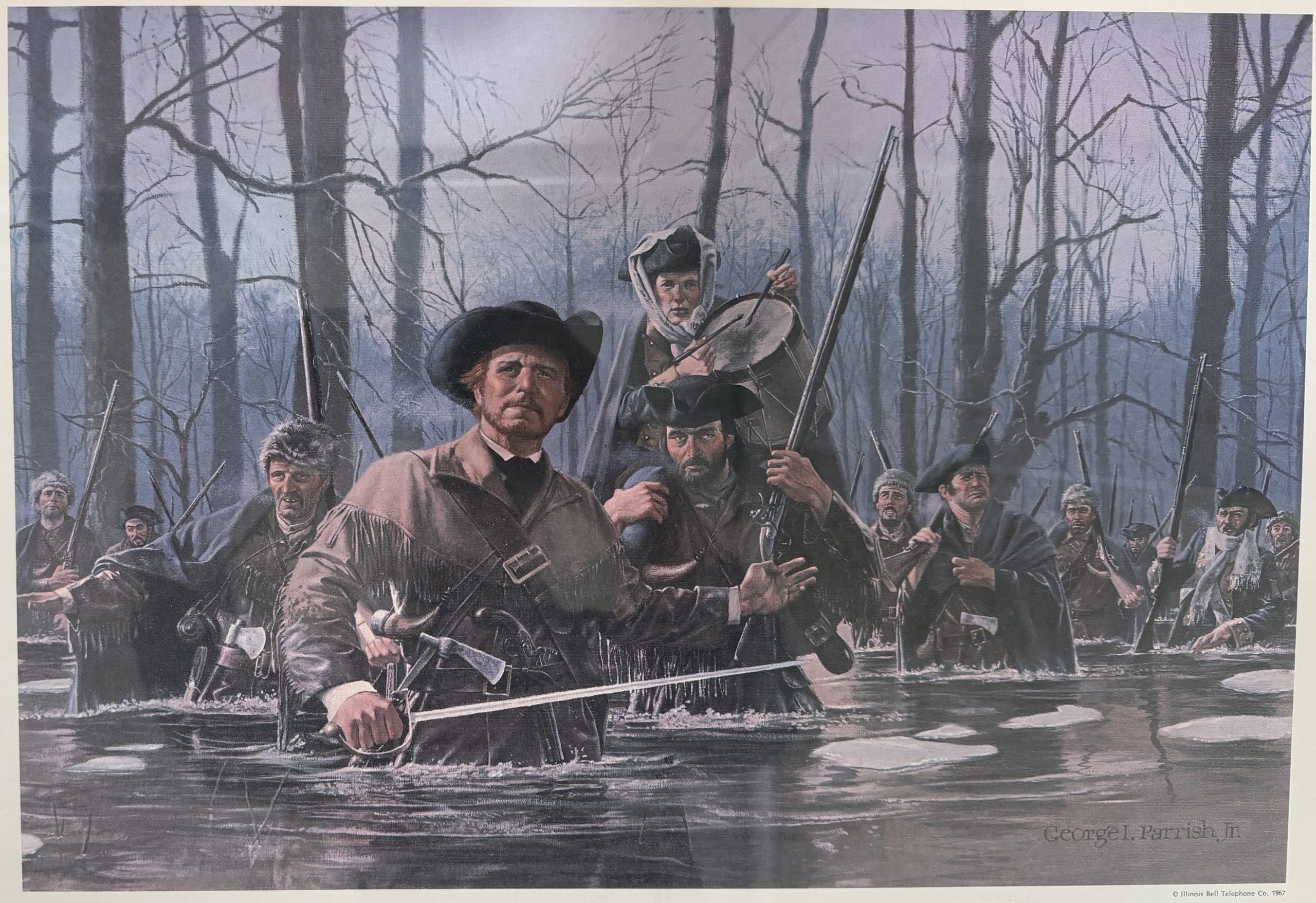
“Accordingly, about the beginning of February, 1779, [Clark] dispatched a small galley which he had fitted out, mounted with two four-pounders and four swivels and manned with a company of soldiers, and carrying stores for his men, with orders to force her way up the Wabash, to take her station a few miles below Vincennes, and to allow no person to pass her. He himself marched with his little band, and spent sixteen days in traversing the country from Kaskaskia to Vincennes, passing with incredible fatigue through woods and marshes. He was five days in crossing the bottom lands of the Wabash; and for five miles was frequently up to the breast in water.
This framed print of George I. Parrish Jr.’s 1967 painting “George Rogers Clark Raids Fort Sackville” was recently donated to the Pekin Public Library by Jim Miller of the Capt. Zeally Moss Peoria Chapter Sons of the American Revolution. The print is now displayed in the library’s Local History Room.
“After overcoming difficulties which had been thought insurmountable, he appeared before the place and completely surprised it [on23 Feb. 1779]. The inhabitants readily submitted, but Hamilton at first defended himself in the fort. Next day, however, he surrendered himself and his garrison prisoners-of-war. [Note: Maj. Bowman suffered a head injury in the assault on Fort Sackville, succumbing to it on 15 Aug. 1779.]
“By his activity in encouraging the hostilities of the Indians and by the revolting enormities perpetrated by [them], Hamilton had rendered himself so obnoxious that he was thrown in prison and put in irons. During his command of the British frontier posts he offered prizes to the Indians for all the scalps of the Americans they would bring him, and earned in consequence thereof the title, ‘Hair-Buyer General,’ by which he was ever afterward known.
[Note: Though Chapman’s account mentions Hamilton’s atrocity of paying his Native American allies for American scalps, he omits the detail, mentioned by English, that Clark (who personally held Native Americans in great disdain) had obtained Hamilton’s surrender by ordering the execution of five of Hamilton’s Indian warrior prisoners of war, who were killed in full view of Hamilton and his men.]
After the British surrender at Fort Sackville, the British commander Col. Henry Hamilton and Capt. William Lamothe were sent as prisoners of war to Williamsburg, Virginia.
“The services of Clark proved of essential advantage to his countrymen. They disconcerted the plans of Hamilton, and not only saved the western frontier from depredations by the savages, but also greatly cooled the ardor of the Indians for carrying on a contest in which they were not likely to be the gainers. Had it not been for this small army, a union of all the tribes from Maine to Georgia against the colonies might have been effected, and the whole current of our history changed.
“In October, 1778, after the successful campaign of Col. Clark, the assembly of Virginia erected the conquered country, embracing all the territory northwest of the Ohio river, into the County of Illinois, which was doubtless the largest county in the world, exceeding in its dimensions the whole of Great Britain and Ireland. To speak more definitely, it contained the territory now embraced in the great States of Ohio, Indiana, Illinois, Wisconsin and Michigan [and part of Minnesota]. On the 12th of December, 1778, John Todd [Jr.] was appointed Lieutenant-Commandant of this county by Patrick Henry, then Governor of Virginia, and accordingly, also, the first of Illinois County.”
Significance of Clarks’ ‘conquest’
The seizure of Fort Massac, Kaskaskia, Cahokia, and Fort Sackville by Clark and his troops, and their immensely arduous trek across Southern Illinois and wading of the frigid February waters of the Wabash, are in themselves achievements of the greatest courage and heroism. We see further that thanks to Col. Clark’s Illinois Campaign, from 1778 to 1784 the future State of Illinois was a part of Virginia’s Illinois County. Clark’s seizure of four important British forts in the Old Northwest, and establishment of county administration at Kaskaskia on behalf of the Commonwealth of Virginia, helped to ensure that in the 1783 Treaty of Paris that formally ended the Revolutionary War, Britain would agree to U.S. demands that the fledgling nation should have borders extending westward as far as the Mississippi. It would take a while, though, for the U.S. to establish actual control and ownership of its new territories, and to get Britain to give up their forts in the Old Northwest — something that would only come through further wars with Native Americans and Britain.
VirginiaPlaces.org’s map of Virginia in 1783, at the time of the Treaty of Paris, when Virginia had possession of both Kentucky County (now the Commonwealth of Kentucky) and Illinois County (now the states of Ohio, Indiana, Illinois, Michigan, Wisconsin, and part of Minnesota).
However, Virginia’s northwestern land claims and their administration of their new “Illinois County,” was much resented by the other states, several of whom had ambitions to extend their territories out to the Mississippi as well. To address the rival western claims of the states, the U.S. Congress under the Articles of Confederation convinced all of the states to cede all their claims to the U.S. government so Congress could decide what to do with these lands. Virginia gave up its northwestern lands in 1784. Three years later, Congress passed the Northwest Ordinance, which erected “Illinois County” as the Northwest Territory, and established rules for surveying the new territory’s “Townships” and procedures for admitting new states to the Union from portions of the Northwest Territory. Also very important is that the Northwest Ordinance banned slavery in the Northwest Territory and in any states that would later be formed from it.
Several of the first 13 states entertained hopes for a share of the newly acquired western lands between the Appalachians and the Mississippi, and their land claims often clashed with each other — but only Virginia had taken practical steps to establish county administration in the western territories.This VirginiaPlaces.org map shows Virginia’s boundaries after ceding Illinois County to the U.S. government, and after the Northwest Ordinance of 1787 created the Northwest Territory.
Rich in bounty land, but ‘land-poor’
State militia officers during the Revolutionary War were responsible for the expenses of their military campaigns, with the expectation that their states would reimburse them. As mentioned above, in Clark’s case, despite his detailed and accurate accounting of his expenses, Virginia refused to reimburse him. The Commonwealth of Virginia did, however, promise bounty land to Clark and his troops if they were successful in their campaign – and they did make good on that promise at least.
This letter dated 3 Jan. 1778 was sent by George Wythe, George Mason, and Thomas Jefferson to Col. Clark, promising bounty land to Clark and his men if their campaign succeeded. Facsimile from English’s “Conquest of the Country Northwest of the River Ohio” (1895).This plat of Clark’s Grant in Indiana – also known as the Illinois Grant – shows the bounty land awarded to Clark and his men in recognition of their service during the Illinois Campaign. This was the origin of Clarksville, Indiana. From English’s “Conquest of the Country Northwest of the River Ohio.”
Despite his land grants, however, Clark was “land-poor” – possessing vast land holdings, but lacking the resources to develop them. He soon began to sink deeper into debt and poverty.
In Sept. 1779, Virginia had bought a sword as a gift to Clark in recognition of his valor during the Illinois Campaign. According to Clark family tradition, angered by Virginia’s continued refusal to reimburse him, Clark later snapped that sword in two and is said to have exclaimed, “When Virginia needed a sword, I gave her one. She sends me a toy; I want bread!” Virginia’s legislature eventually commissioned a unique ceremonial sword for Clark in 1812 when they approved his colonel’s pension. Believing that Virginia had been unjust to Clark, Virginia Delegate Chares Fenton Mercer (1778-1858) had introduced the bill to grant the pension and sword, and is said to have personally given Clark the sword. By that time Clark was a wheelchair-bound invalid, having recovered from three strokes but having lost his left leg below the knee after suffering severe burns from stumbling and falling against his fireplace. Clark replied, “You have made a very handsome address, and the sword is very handsome, too. When Virginia needed a sword, I gaveher one. I am too old and infirm, as you see, to ever use a sword again, but I am glad that my old mother state has not entirely forgotten me, and I thank her for the honor and you for your kindness and friendly words.“
An artist’s depiction of C. F. Mercer’s presentation of a new ceremonial sword to Gen. Clark in 1812, in honor of Clark’s successful Illinois Campaign during the Revolutionary War. From English’s “Conquest of the Country Northwest of the River Ohio” (1895).
Two days after his death, Gen. Clark was buried Sunday, 15 Feb. 1818, in a private burying ground at Locust Grove, the country seat of his brother-in-law and sister, Mr. William and Mrs. Lucy (Clark) Croghan, situated a few miles above Louisville, Kentucky. His body reposed in that secluded spot for over half a century, when his relatives determined to have his remains reinterred in the great public cemetery which had been established nearer the city, known as Cave Hill, on 29 Oct. 1869. By that time his grave at Locust Grove no longer had a marker, so eight graves had to be opened before his was found – his remains being easily identified by his missing leg and the military buttons, which were all that was left of his coat.
At left are the Clark family monuments in Cave Hill Cemetery, Louisville, Kentucky, with a Clark historical marker placed by Louisville-Thruston Chapter, Kentucky Society S.A.R. At right is the statue of Gen. George Rogers Clark in Indianapolis, Indiana. Clark is a significant figure and founder in the history of Virginia, Kentucky, Indiana, Illinois, and all the other states formed from the Northwest Territory.