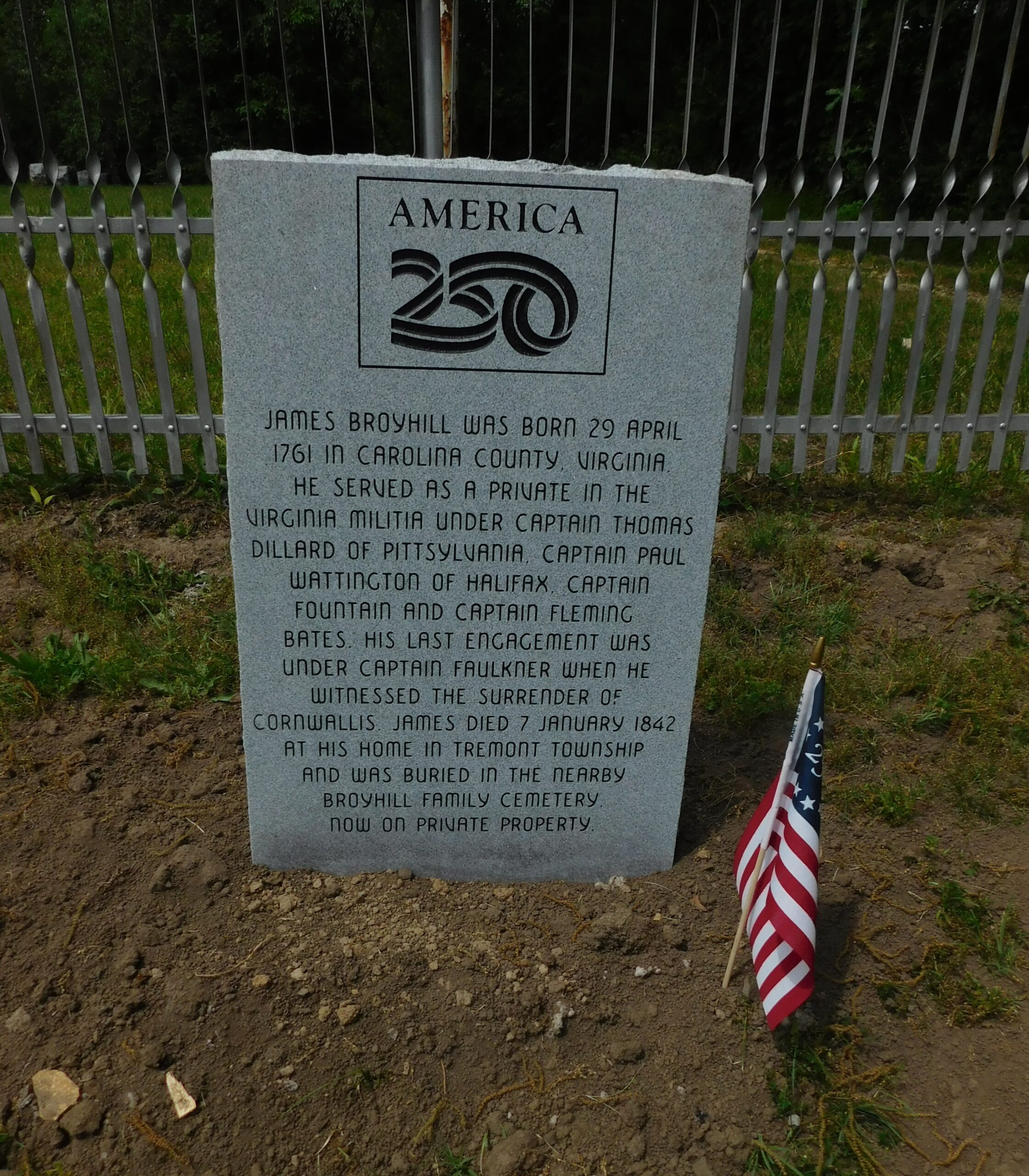

On Saturday, 9 May 2026, the Pekin Public Library presented an “America 250” local history program on the life and career of Pvt. James Broyhill Sr. (1761-1842), a Virginian militiaman who served in the all-important Southern Campaign during the Revolutionary War, afterwards settling in Tremont Township in Tazewell County. This week’s “From the History Room” article is adapted from last month’s “Portrait of a Patriot” program.
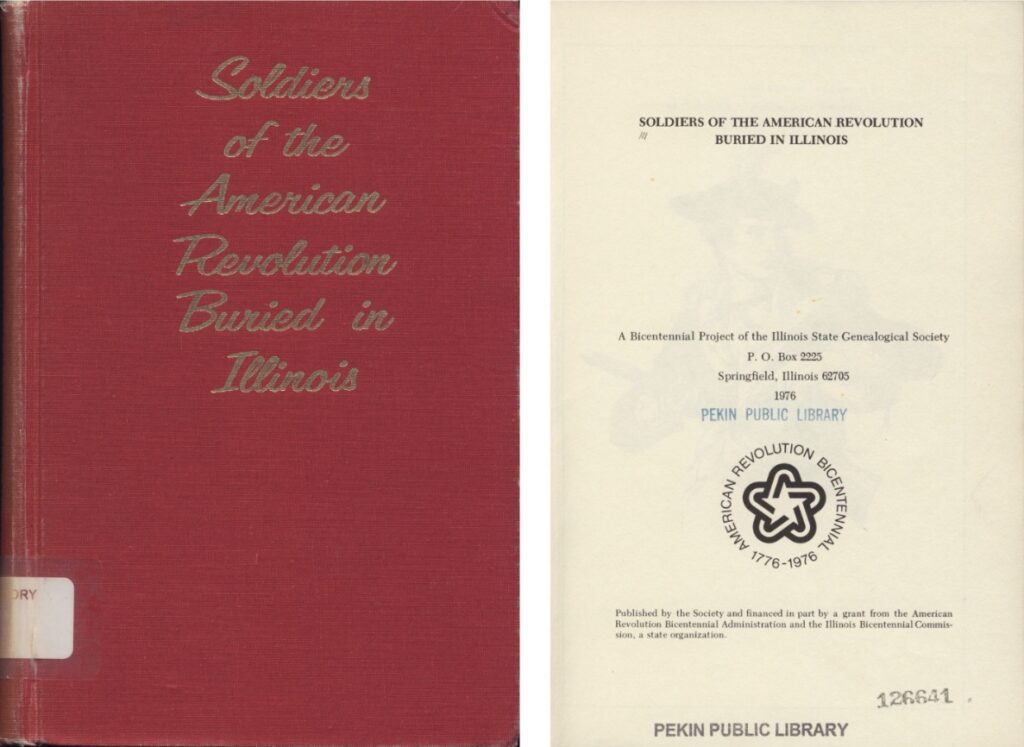
As we have noted in the past, a handy old resource for Revolutionary War Patriots who later settled in Tazewell County and are buried here is “Soldiers of the American Revolution Buried in Illinois,” an index that was prepared by the Illinois State Genealogical Society for the U.S. Bicentennial in 1976. However, as we have seen, that 50-year-old index must be used judiciously, as it contains various errors and omissions. One error is that one of the purported Tazewell County Patriots, James Campbell, has no connection to Tazewell County and in fact served in the War of 1812 rather than the Revolutionary War. Likewise, it has since been found that two other Patriots that the 1976 index lists as buried in Tazewell County are in fact not buried in our county.
Furthermore, there are two other Revolutionary War soldiers who are unquestionably buried in Tazewell County but who are not listed in the 1976 index at all. One of those two overlooked Patriots is the subject of our “Portrait of a Patriot” this week: James Broyhill Sr.
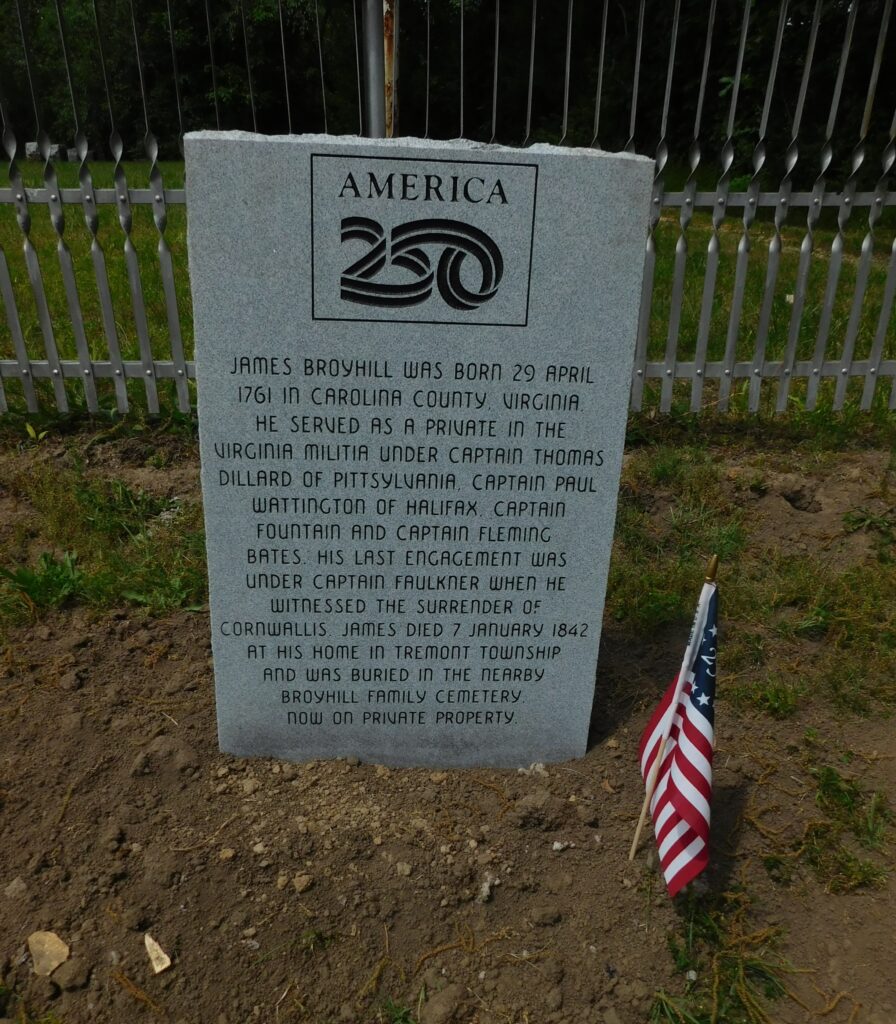
James was born 29 April 1761 in Caroline County, Virginia, grandson of an Irish immigrant named William Broughill. The family name derives from the Gaelic patronymic surname Ó Bruathail, meaning “grandson/descendant of Bruathal”, a surname that first appears in Irish records in 1312 as “Brohale” in Co. Waterford. There are also Broyhill families of English origin, but their surname is toponymic, deriving from a place in Shropshire, England, called Broughall — from the Anglo-Saxon Burhhyll, “hill of the walled stronghold.” The English and Irish Broyhills have no known connection to each other. In contemporary records, James’ surname is alternately spelled Brayhill, and James himself sometimes went by the name “James Bray.”
James Broyhill Sr. was a resident of Halifax County, Virginia, when he enlisted in the Virginia Militia in Feb. 1778 during the Revolutionary War. James served in Kentucky at the rank of private for five months in 1778, again for four months during the Southern Campaign in 1780, and finally for two months in the fall of 1781, and was present at the surrender of Cornwallis at Yorktown. He first applied for a Revolutionary War soldier’s pension on 6 Sept. 1837 and again on 9 Sept. 1840.
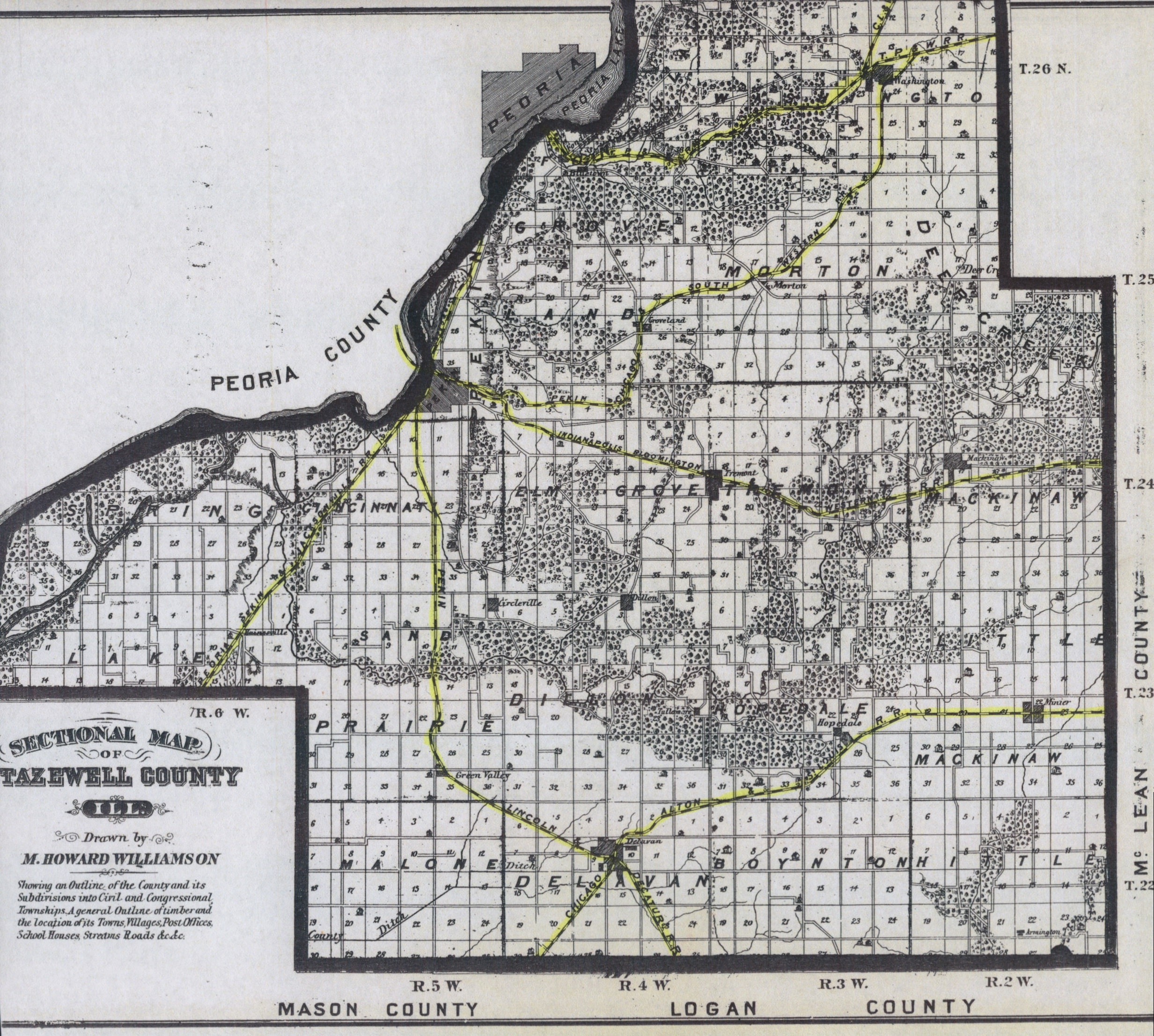
After the war, James lived in Pittsylvania County, Virginia, for several years, then moved to Warrior Creek in Wilkes County, North Carolina, where he lived for about 22 years. The 1820 U.S. Census shows him living in Wilkes County. He next moved to McMinn County, Tennessee, where he lived for two years. The 1830 U.S. Census shows him living there. In or about 1831, he moved to Sangamon County, Illinois, and finally in March 1833 he settled in Tazewell County where he remained for the rest of his life. His homestead was in Section 22 of Tremont Township (on private land east of Tremont, at the cul-de-sac on Michel Road, off Lake Windermere Road and Ropp Lane).
James married Rebecca Bailey (1763-1845) on 25 Sept. 1785 in Virginia. They had seven children, all born in Virginia: John Norman, Mary “Polly” (who married Nathaniel Brown), William, Sarah (who married Isaiah Hampton), Frances (who married Elijah Hampton), James Jr., and Anna Louisa (who married Mathias Mount).
James died 7 Jan. 1842 at his home, and is very probably buried in the old Broyhill family cemetery located on his former home place (though there is a possibility he may be buried in Tennessee Point Cemetery instead).
On 6 Sept. 1837, James Sr. applied for a Revolutionary War pension under the Act of 1832, which the U.S. Congress had passed to allow militiamen to receive pensions for the service during the Revolutionary War. Pension payments to “James Brayhill Sr.” are recorded on the following Illinois pension roll:
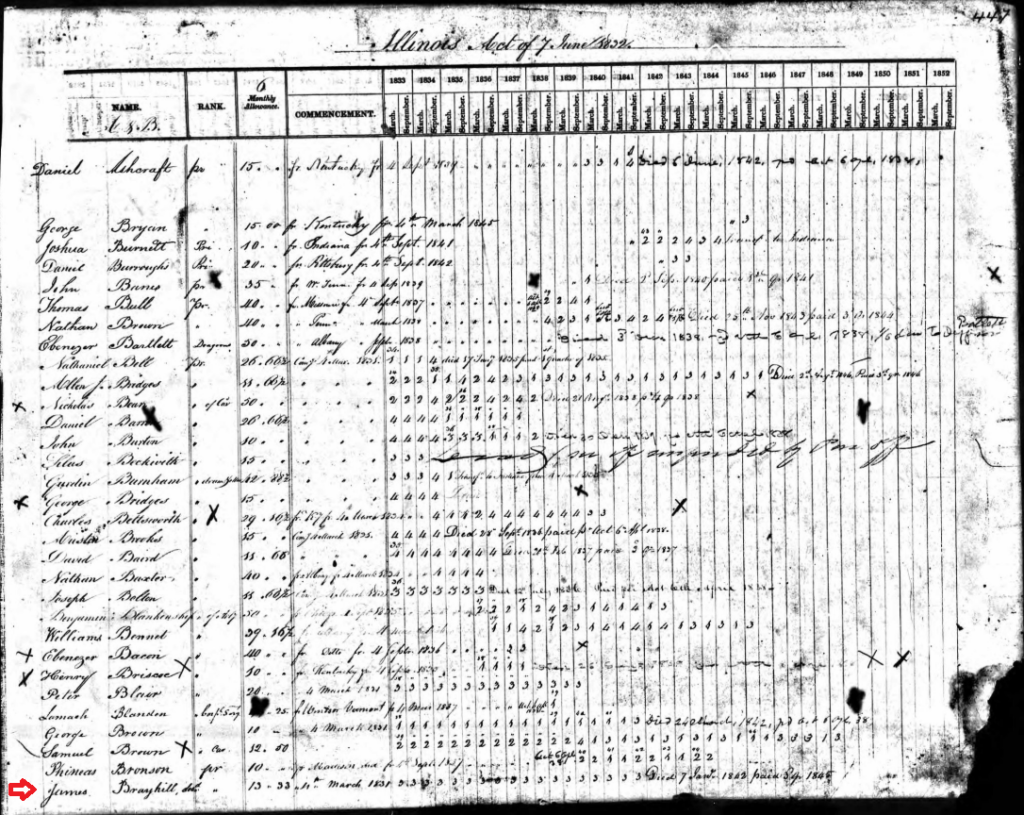
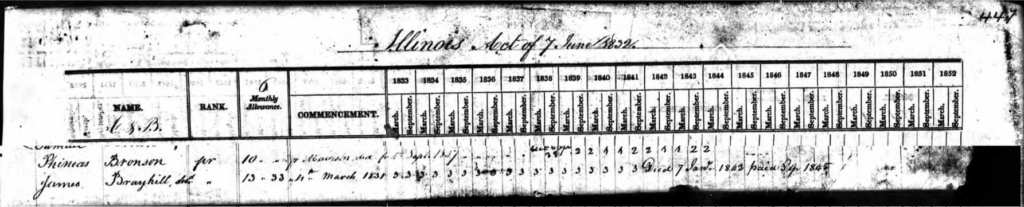
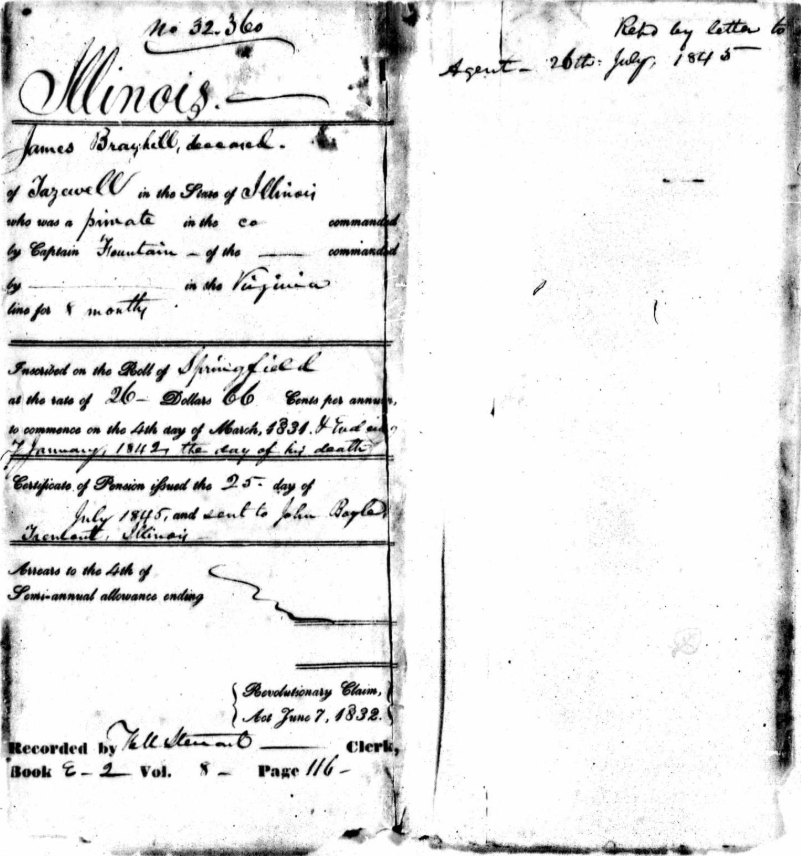
James Broyhill’s pension application was not accepted until after his death January of 1842, so the funds were paid to his widow Rebecca instead. However, the money – with payments backdated to March 1833 per the Act of 1832 – did not actually arrive until after her death in 1845. Neither James nor Rebecca saw a penny of his pension money. Instead, it went to James’ heirs, who apportioned it among themselves.
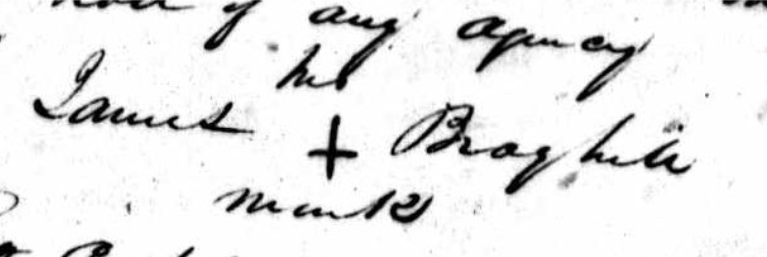
In his pension application is a three-page handwritten narrative of James’ Revolutionary War service. At the conclusion of his narrative, James attested to the accuracy of his accounting with his mark, showing that he could not read or write. Here are the three pages of James’ recollections of his militia service during the Revolutionary War, followed by his mark:
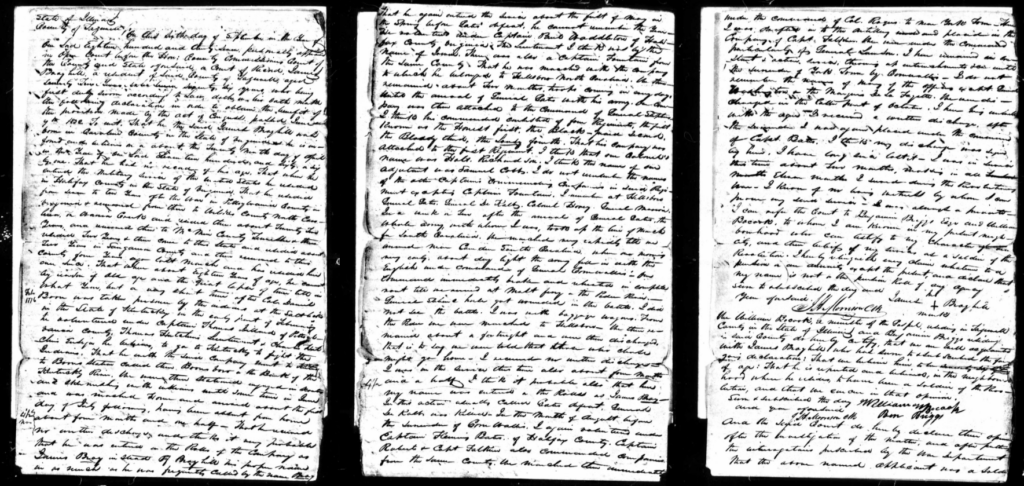
Following is a transcription of James’ service narrative, with paragraph breaks added for ease of reading:
State of Illinois, County of Tazewell. On this sixth day of September in the Year of our Lord 1837, personally appeared in Open Court before the Honorable County Commissioners Court of the County and State aforesaid, a Court of Record, James Brayhill, a resident of said County of Tazewell, aged Seventy Six Years, who being first duly sworn according to Law, doth, on his oath make the following declaration in order to obtain the benefit of the provision made by the Act of Congress passed June 7th 1832.
To wit: That he the said James Brayhill was born in Caroline County in the State of Virginia – he is informed and believes on or about, the 29th day of April in the Year of our Lord 1760 or 61. That he has no record of his age. That when he entered the military service of the United States he resided in Halifax County in the State of Virginia. That he resided from seven to ten years of the War in Pittsylvania County in Virginia & removed from there to Wilkes County North Carolina, on Warrior Creek and resided there about twenty-two Years, and removed then to McMinn County Tennessee & there resided two years & then came to this State and resided about two years in Sangamon County and then removed to this County four years ago last March and has resided here ever since.
That when about Eighteen years of age, he cannot by reason of old age and the great lapse of time tell in what Year, but a very short time after Colonel Daniel Boon was taken prisoner by the Indians at the Salt Licks in the State of Kentucky in the early part of February he volunteered under Captain Thomas Dillard of Pittsylvania County, Thomas Hutchins Lieutenant & Charles Hutchins Ensign he believes, to go to Kentucky to fight the Indians. That he with the said company went to Kentucky to Boone’s Station called then Boonsboro on the Bank of the Kentucky River, the men there stationed engaged in scouting and skirmishing with the Indians until sometime in June and was marched Home and arrived about the first day of July following, having been absent from home about four months and one half – That he received no written discharge, and thinks it was probable that he was entered in the Rolls of the Company as James Bray instead of Broyhill his proper name in as much as he was frequently called by the name Bray.
That he again entered the Service about the first of May in the Spring before Gates defeat, he cannot remember the Year. He volunteered under Captain Paul Waddleton of Halifax County Virginia. The Lieutenant I think was by the name of Irwin. There was also a Captain Fountain from the same County. That he was marched with the Company to which he belonged to Hillsboro North Carolina. We there remained about two months, troops coming in every day until the arrival of General Gates with his Army. Our company was then attached to the Command of General Stephens I think his command consisted of four Regiments, the first known as the Honest first, the Black-guard Second, the Bloody third, the Lousy fourth. That his company was attached to the first Regiment. I think that our Colonel’s name was in Holt Richardson. I think the name of our adjutant was Samuel Cobbs. I do not remember the names of the other captains commanding companies in said Regiment except Captain Fountain. I remember at Hillsboro General Gates, General DeKalb, Colonel Horey, General Marion. In a week or Ten [days] after the arrival of General Gates, the whole Army, with whom I was, took up the line of march for South Carolina. We marched very rapidly till we arrived near Camden South Carolina, when one morning very early, about day light the Army fell in with the English under command of General Cornwallis. Our command immediately broke and retreated in complete rout till we arrived at Mast ferry on the Pedee River. General Steuben’s horse got wounded in the battle. I did not see the battle. I was with baggage wagons. From the Pedee we were marched to Hillsboro – we there remained about a fortnight and were then discharged, that is to say we were told that those who chose might go home – I received no written discharge – I was in the service this time also about four months and a half. I think it probable also that here my name was entered on the Rolls as James Bray. In this action usually called Gates defeat, General DeKalb was killed.
In the month of August before the surrender of Cornwallis, I again volunteered under Captain Fleming Bates of Halifax County. Captain Roberts & Captain Falkner also commanded companies from the same County. We marched then immediately under the command of Colonel Rogers to near York Town – Here I was drafted into the artillery and placed in the Company of Captain Falkner. We were under the Command particularly of General Lawson. I here remained in constant & active service, throwing up entrenchments &c until the surrender of York Town by Cornwallis. I do not remember the names of any of the officers except General Washington & the Marquis De Lafayette. We were discharged in the latter part of October. I here being [afflicted] with the ague, I received a written discharge, after the surrender I was again placed under the command of Captain Bates. I think my discharge was signed by him. I have long since lost it. I was in the Service this time about two months, making in all eleven months I served during the Revolutionary War.
I know of no living witness by whom I can prove my said service. I was always a private. I can refer the Court to Benjamin Briggs Esq. and William Bocook, to whom I am known in my present neighborhood who can testify to my character for veracity, and their beliefs of my services as a Soldier of the Revolution.
I hereby relinquish every claim whatever to a pension or an annuity except the present, and declare that my name is not on the pension Roll of any Agency.
Sworn to & subscribed the day and year aforesaid.
S/ J. H. Morrison, Clk S/ James Broyhill, X his mark
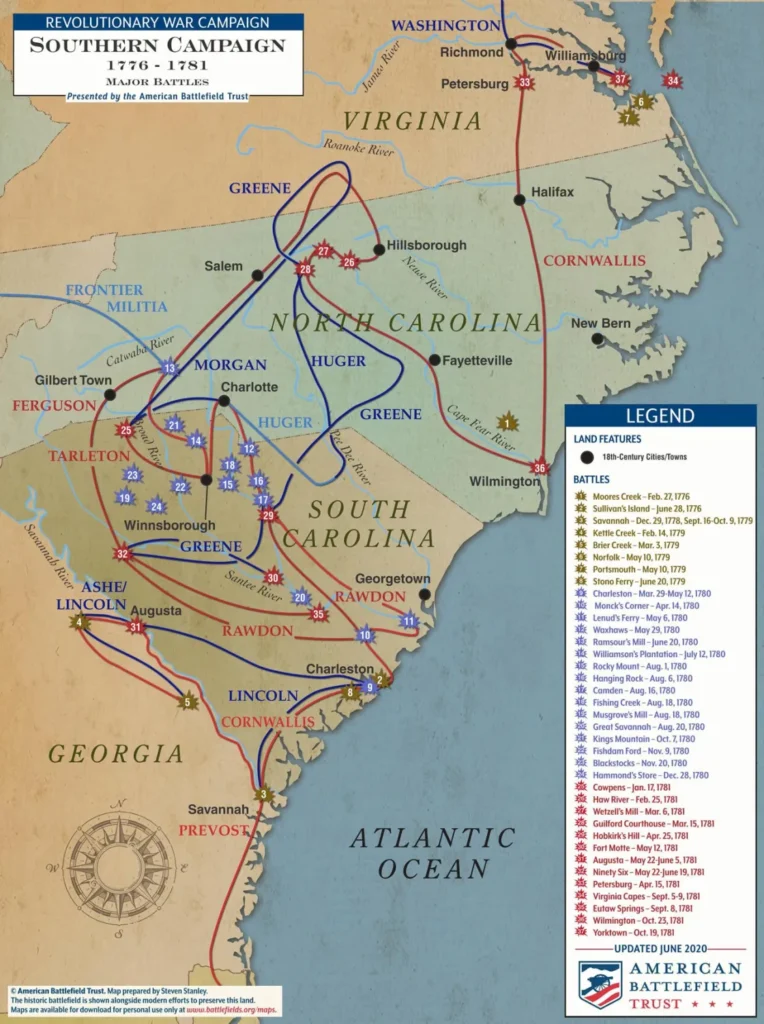
From James’s recollections of his Revolutionary War service, we can construct the following summary of his experiences during the War:
- James Broyhill, aged about 18, volunteered with the Virginia Militia in early Feb. 1778, shortly before Daniel Boone was captured by the Shawnee near Blue Licks, Kentucky, on 7 Feb. Served under Capt. Thomas Dillard, on the service rolls as “James Bray,” engaging in scouting and skirmishes against Britain’s Indian allies in Kentucky until July 1778.
- Again volunteered with the Virginia Militia on or about 1 May 1780, serving under Capt. Paul Waddleton in the ‘Honest’ 1st Regiment under Brig. Gen. Edward Stevens. Present at the Battle of Camden, South Carolina (16 Aug. 1780) – a demoralizing American defeat. The Americans under Maj. Gen. Horatio Gates were defeated by Lord Cornwallis’ British troops. American Brig. Gen. Johann Baron de Kalb was mortally wounded and died three days after the battle. James himself was assigned to the supply wagons and did not take part in the fighting, but when the Virginia militiamen broke and fled in disarray, he fled with them.
- In Aug. 1781, James volunteered a third time with the Virginia Militia. Served under Capt. Fleming Bates, being assigned to the artillery at the Siege of Yorktown, Virginia (Oct. 1781), under Gen. Robert Lawson. Present for the surrender of Cornwallis on 19 Oct. 1781. Contracted a fever (“ague”) and was discharged in late October. Pvt. James Broyhill served a total of 11 months during the Revolutionary War.
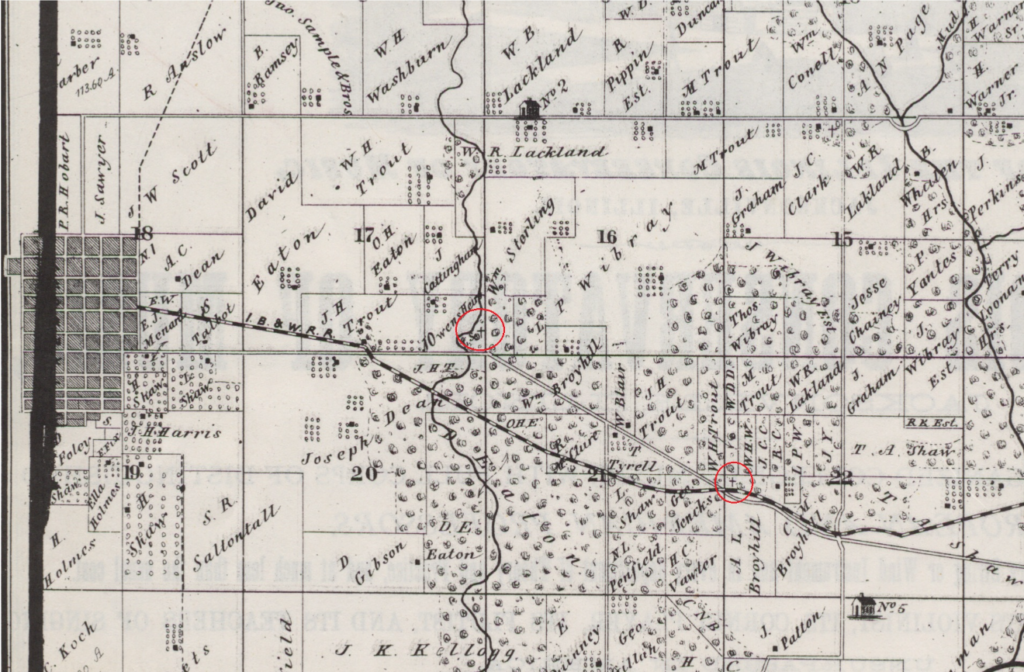
As mentioned above, James passed away 7 Jan. 1842 at his home, and is very probably buried in the old Broyhill family cemetery located on his former home place, located in Section 22 of Tremont Township. Ground penetrating radar has found apparent evidence of two unmarked graves at the Broyhill family cemetery, which are likely to be the graves of James and his wife Rebecca. Off to the west, however, in Section 17 of Tremont Township, is Tennessee Point & Walnut Cemetery, which was established on land that was co-owned by Broyhill, Michael Trout, and William Sterling. There are several Broyhill burials at Tennessee Point, so it is possible that James may rather have been buried there. It is more likely, however, that his remains lie at the old family burying ground.
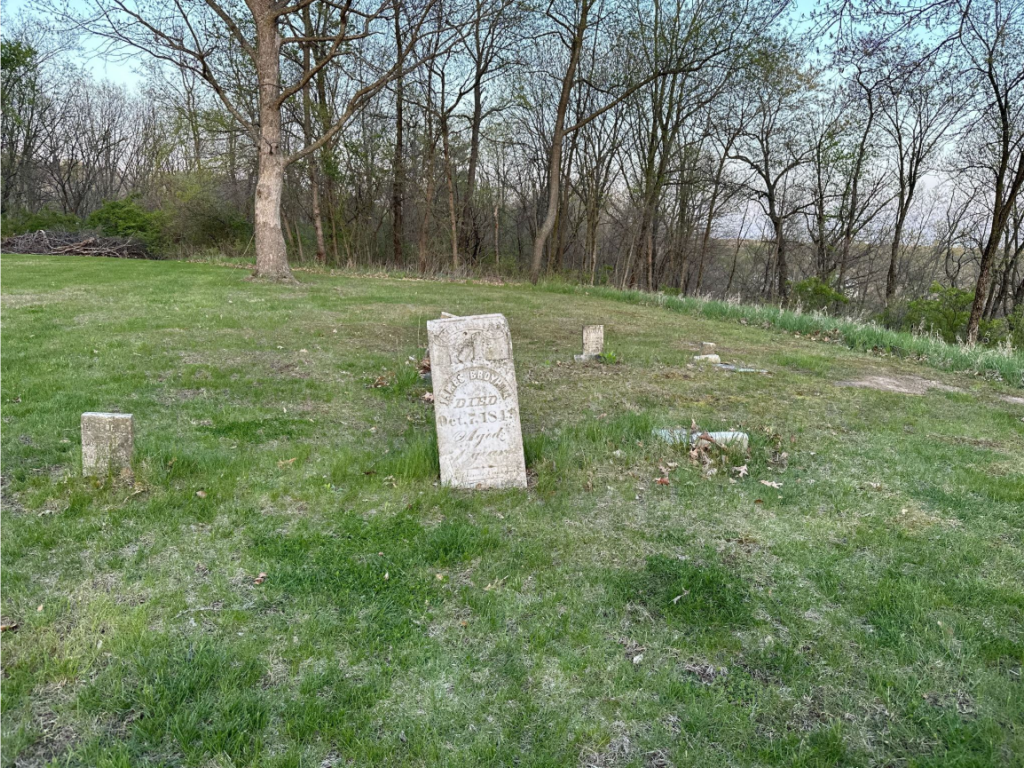
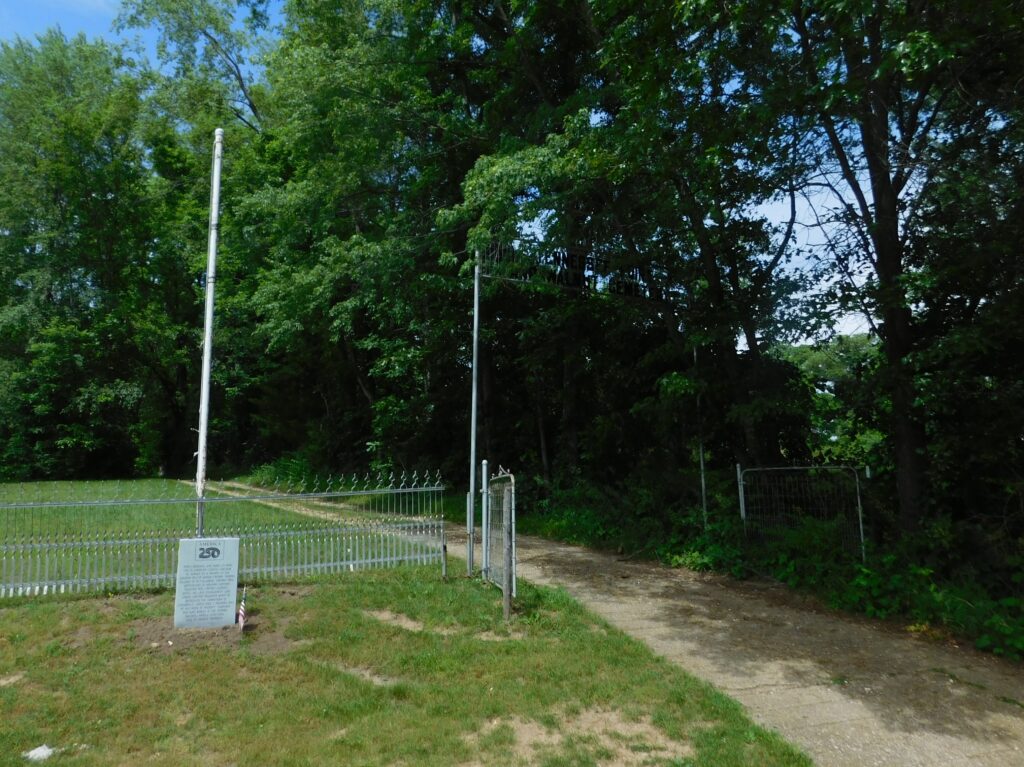
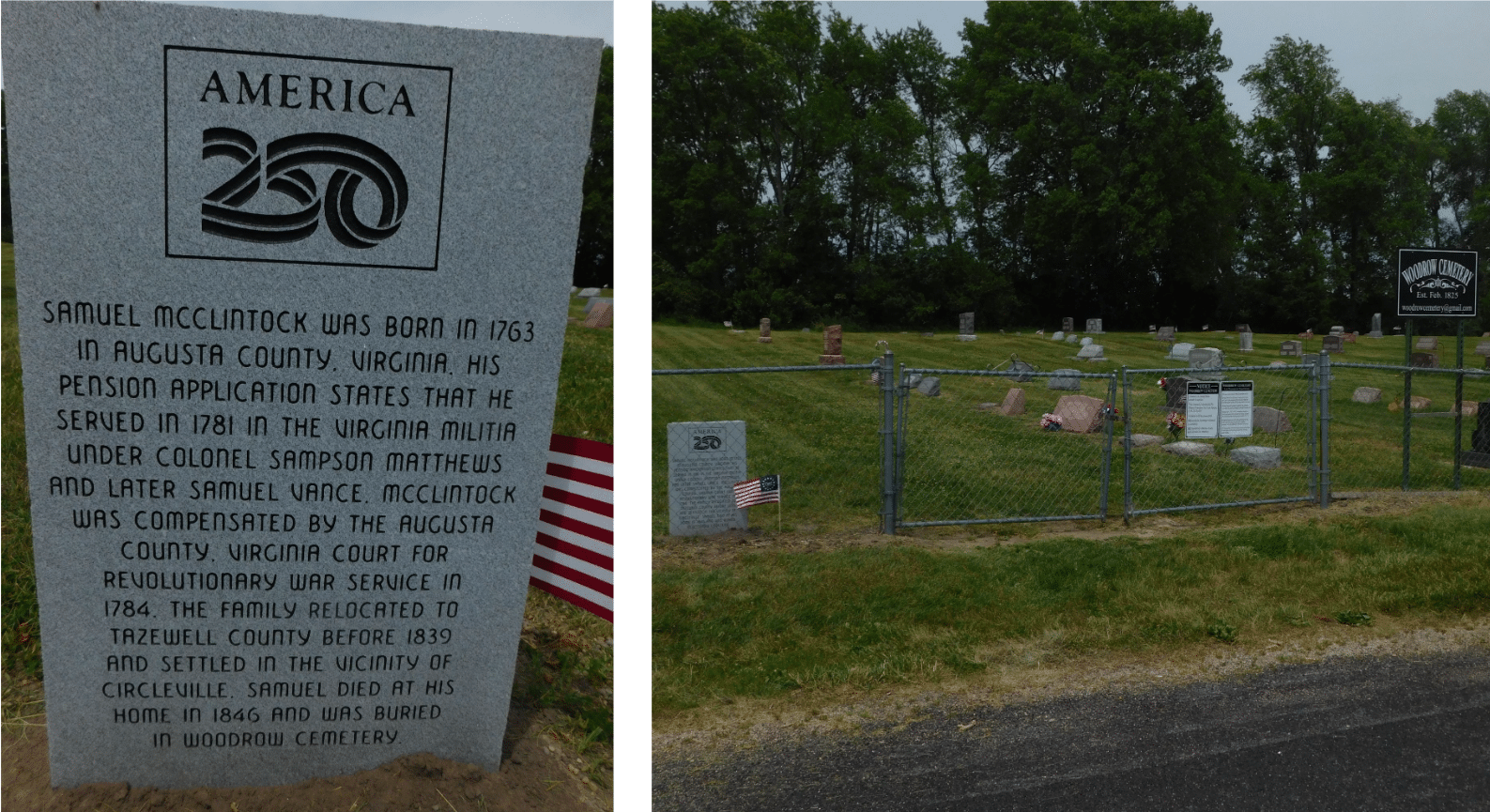
James Broyhill Sr. is one of five Revolutionary War soldiers known to be buried in Tazewell County who were honored last month, May 2026, with new “America 250” cenotaphs — stone memorials created by the Tazewell County Genealogical & Historical Society and Abel Vault & Monument that tell of their Revolutionary War service. In the case of four of those five soldiers, the cenotaphs have been placed at the entrances of the cemeteries where the soldiers are buried. But in the case of James Broyhill, because the Broyhill family cemetery is on private land and is not readily accessible to the public, his cenotaph has been placed at the entrance of Tennessee Point Cemetery.