Here at “From the History Room,” we have often cited and discussed the standard published works on the history of Pekin and Tazewell County, such as William H. Bates’ Pekin history, Charles C. Chapman’s Tazewell County history, the 1949 Pekin Centenary, the 1974 Pekin Sesquicentennial, and the 2024 Pekin Bicentennial Pictorial.
It is probably safe to say that if one wishes to learn about history, one should consult a history book, rather than, say, a cookbook. A perusal of the pages of “The Legendary Illinois Cookbook: Historical and Culinary Lore from the Prairie State” (Leckel, John L., and Feeney, Agnes M., Donning Co., Norfolk, Va., 1982) will reveal how very wise that maxim is. Indeed, that cookbook’s title is more apt than its authors may have realized, as the word “legendary” is perhaps not an inaccurate way to describe some of its “historical lore.” The adjectives “erroneous” and “garbled” would also work.
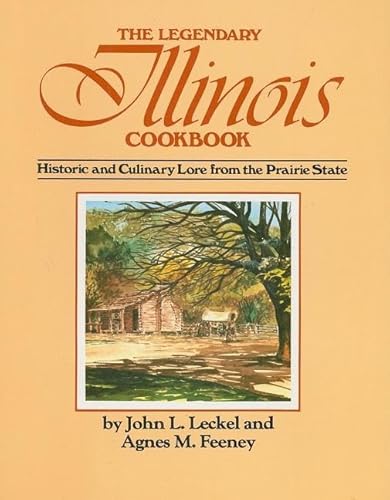
Why do I say that, you ask? Well, turn to page 167 of Leckel’s and Feeney’s cookbook, and you might notice a few, er, problems with what they say about Pekin, Illinois. Toward the top of that page, we find this remarkable paragraph.
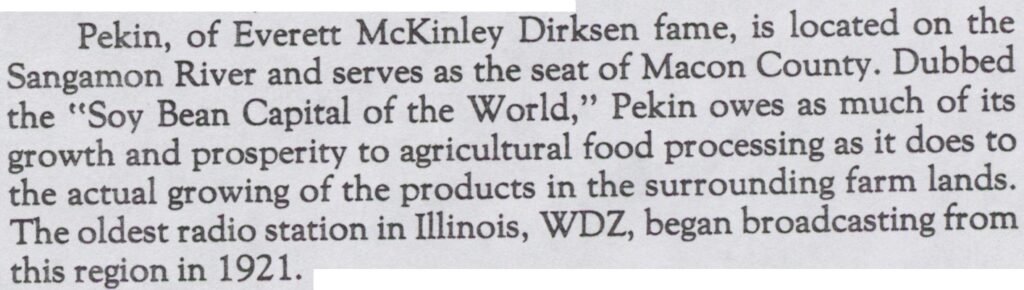
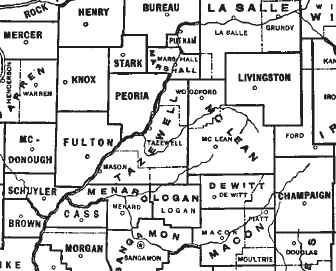
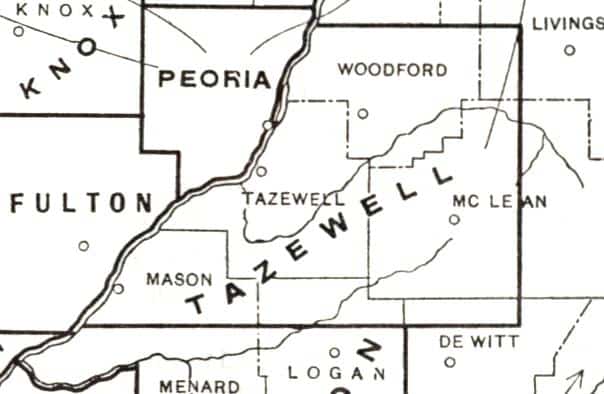
Pekin located on the Sangamon River and the seat of Macon County? That just doesn’t sound right. Let me check a map . . . . Oh. Well, well. Maybe the cookbook is right after all. Perhaps the following map is the one that Leckel and Feeney consulted when researching the “historic lore” of their cookbook:
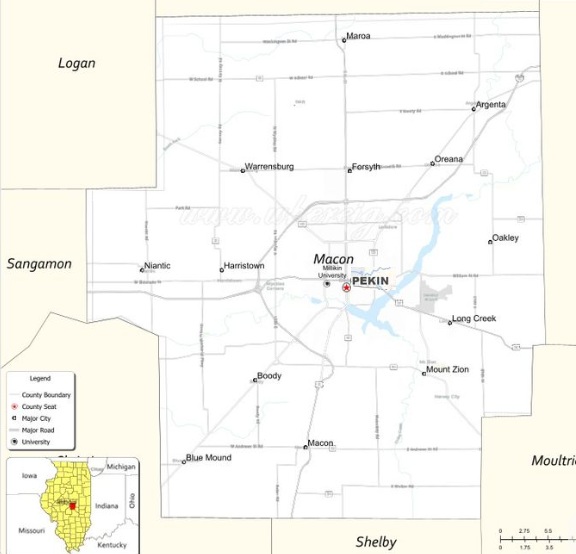
But seriously, folks, you have not been mistaken all your lives. Pekin is not the seat of Macon County, nor is Pekin located on the Sangamon River. We’re the seat of Tazewell County, and that river on our western borders is the Illinois, not the Sangamon. And it is marigolds, not soy beans, for which Pekin is known (though the farms around Pekin have grown quite a lot of soy beans). Our annual autumnal festival is the Marigold Festival, not the Soy Bean Festival. While Pekin’s industrial district has been home to agricultural food processing factories, it would be not entirely accurate to say that Pekin owes much of its growth and prosperity to agricultural food processing.
And no, the oldest radio station in Illinois, WDZ, did not begin broadcasting from the Pekin area in 1921. The historic radio station which started in Pekin was WSIV/WVEL, not WDZ.
Upon closer investigation, almost everything that Leckel and Feeney said about Pekin are facts about the city of Decatur, Illinois. It is Decatur, not Pekin, that is located on the Sangamon River and is the seat of Macon County. It is Decatur, not Pekin, that has been known as the “soy bean capital of the world. As the home of Archer-Daniels-Midland, it is Decatur that owes much of its growth to agricultural food processing.
And Illinois’ oldest radio station, WDZ, got its start in 1921 in Tuscola, in Douglas County, Illinois, then moved to Decatur in 1949.
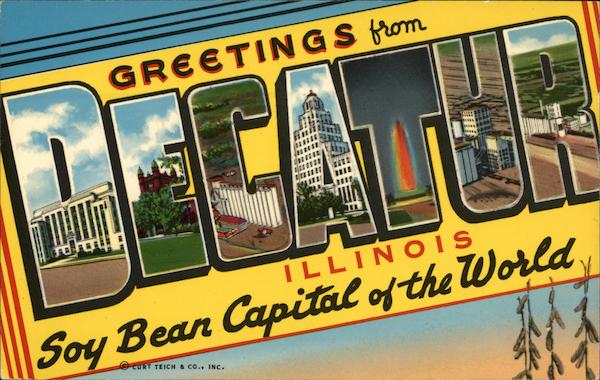

The only thing Leckel and Feeney got right about Pekin is “of Everett McKinley Dirksen fame.” But he is remembered as “Mr. Marigold,” not “Mr. Soy Bean.”
How Leckel and Feeney managed to garble Pekin and Decatur is a mystery to which I have not the solution. But it does prove the wisdom in the maxim proposed above: if you want recipes, look in a cookbook, and if you want history, look in a history book. Don’t consult a cookbook to learn the facts of history.