
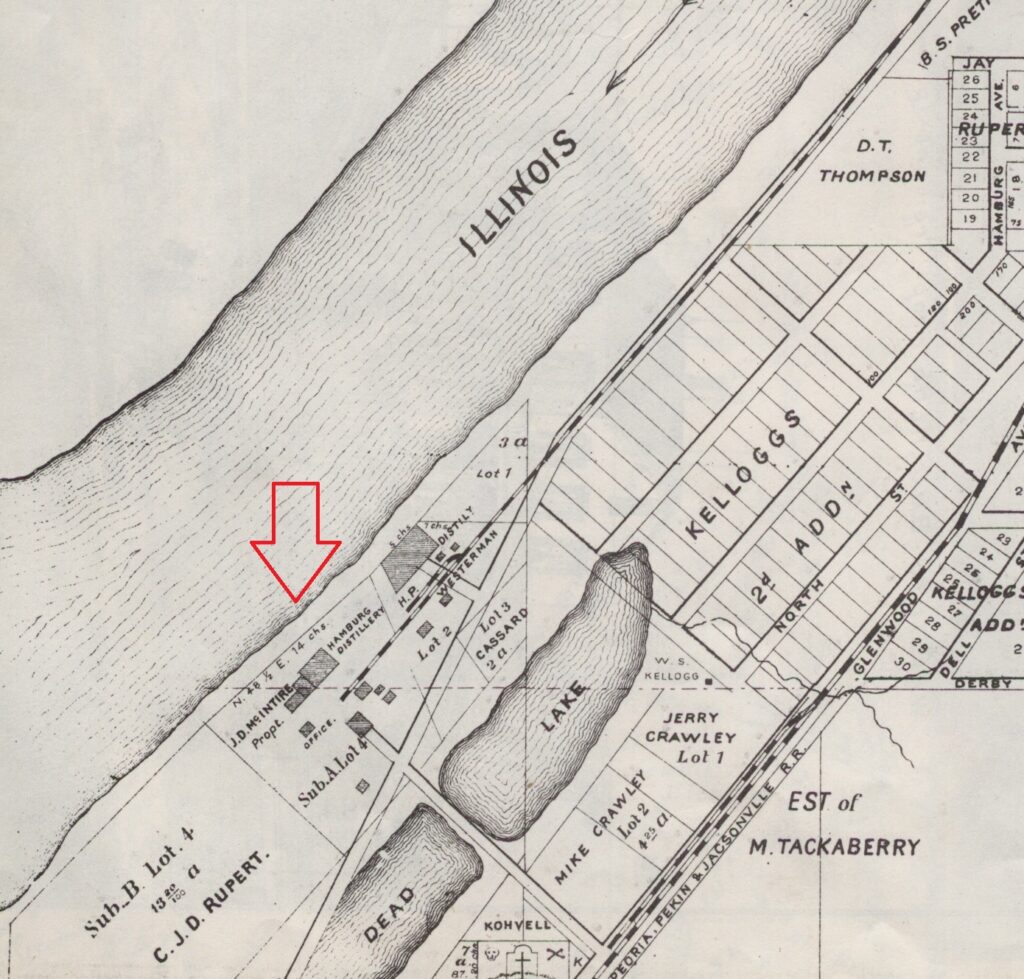
Recently here at “From the History Room,” we recalled the life of Charles L. Wilson (1863-1928), one of the co-founders of the American Distilling Co. in Pekin Wilson had got his start in the distilling business working as a bookkeeper for the Hamburg Distilling Co. in Pekin. The American distillery was built on the former site of the Hamburg, which was was Pekin’s first distillery, founded in 1858 by William A. Callender (1818-1906), one of the early prominent businessmen of both Pekin and Peoria.
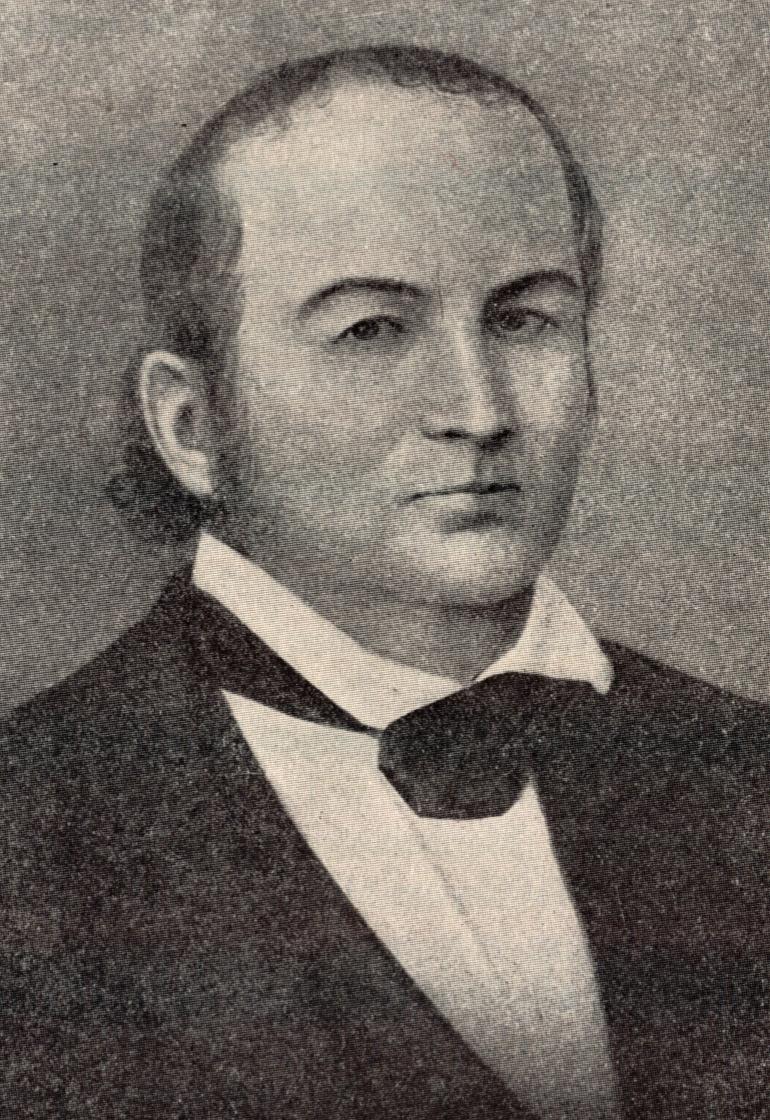
William A. Callender was born 11 Oct. 1818 in Lexington, Kentucky, eldest child of Joseph and Ruth (Runnels) Callender. William’s father Joseph was a veteran of the War of 1812, fighting under future U.S. President Andrew Jackson at the Battle of New Orleans. Joseph’s father was Col. Philip Callender of Virginia, a colonist who had come to America from Scotland, serving as an officer in the Continental Army during the Revolutionary War.
William grew up in Henry County, Kentucky, but at the age of 18, in 1836, he took a machinist apprenticeship in Cincinnati, Ohio. After his apprenticeship, he settled in Covington, Kentucky, where on 1 Dec. 1842 he married Mary Jane Wolfe (1822-1876). William and Mary had eight children together: their eldest, who died in early childhood; Henrietta (Callender) LeVansaler (1848-1875); Emmanuel Callender (1850-c.1860); Louis D. Callender (1853-c.1860); John Warren Callender (1854-1901); Mary Lily (Callender) Chandler (1859-1894); William H. Callender (1863-1934); and their youngest, a daughter thought to be named Ella who died young.
After his marriage, William A. Callender made his first foray into the alcohol distilling business in Lawrenceburg, Indiana, operating a distillery there for a number of years. (He would have learned alcohol distilling from his father Joseph, who was fined several times for operating an unlicensed still.) William later moved to Ohio and built a still there, but before long he had moved back to Covington, Kentucky. Around that time, he served a two-year term in the Kentucky state legislature and attended the 1848 Kentucky constitutional convention. It was apparently in 1848 that William and his family moved to Hamilton, Ohio, where William built a distillery with a 1,200-bushel capacity. Though this venture was successful at first, it ended in ruin, reportedly due to his business partners cheating him out of $500,000.
After that setback, in 1855 William and his family moved to Peoria, Illinois. Three years later, in 1858, he built Pekin’s first distillery, the Hamburg, on South Front Street at the southern Pekin city limits. He was the proprietor of the Hamburg Distilling Co. for only a few years, because by the time of the 1861 Pekin city directory ownership of the Hamburg had passed to Columbus J. Day Rupert (c.1826-c.1882), son of prominent Tazewell County pioneer Gideon H. Rupert. The 1861 directory’s entry for Rupert says, “RUPERT C. J. D., proprietor Hamburg Distillery, southern extension Front; office, southwest cor. Third and St. Mary.“
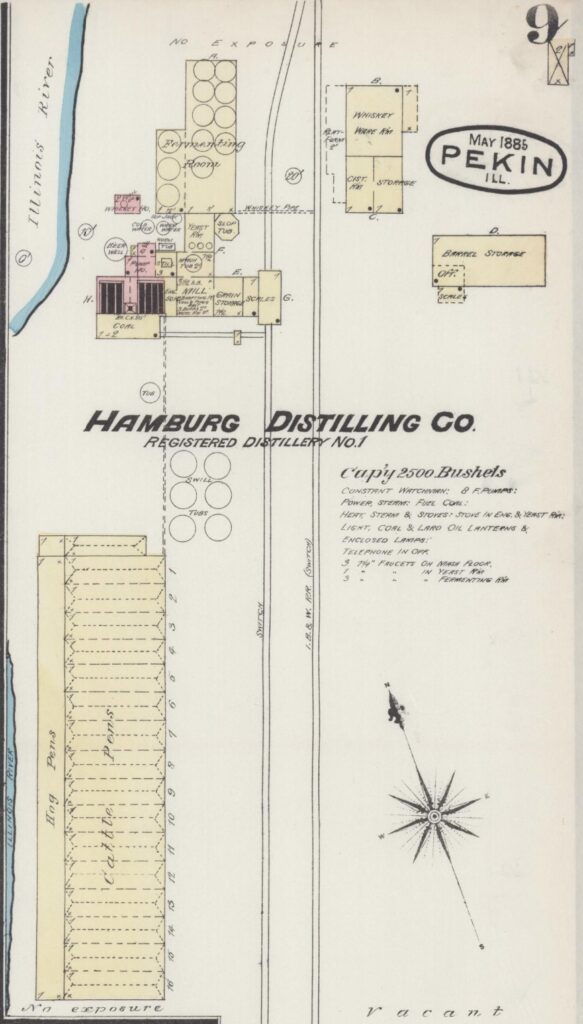
Besides the Hamburg, William Callender also built the Star Distillery in Pekin, as well as another distillery in Wesley City (Creve Coeur), operating them for five years. William then left the distilling business altogether. In her genealogical treatment of the Callender family, “Callender Days,” Joanne Prosser Callender provides a family tradition that she had received from William’s grandson Albert Callender telling of a incident of dreadful sorrow that may have led William to abandon alcohol distilling:
“Years later, William H. (Callender’s) son, Albert, told us of this family story: One of William and Mary’s ‘older boys’ had died young ‘scalded in the slop tubs of the distillery.’ This tragedy must have occurred to either Emanuel or Louis, since each appears just once in a census. We found a headstone for Louis in the Old City Cemetery in Pekin, but it did not show dates of birth or death. I wonder if the shock of this loss may have been what turned William away from the distillery business.”
After giving up his distilling ventures, William engaged in milling until 1872. In that year he sold his milling business and moved back to Peoria. During his years in Peoria, William served 10 years as a Peoria city alderman. While he and his wife Mary were residing in Peoria, Mary died 1 May 1876, and was buried in Springdale Cemetery.
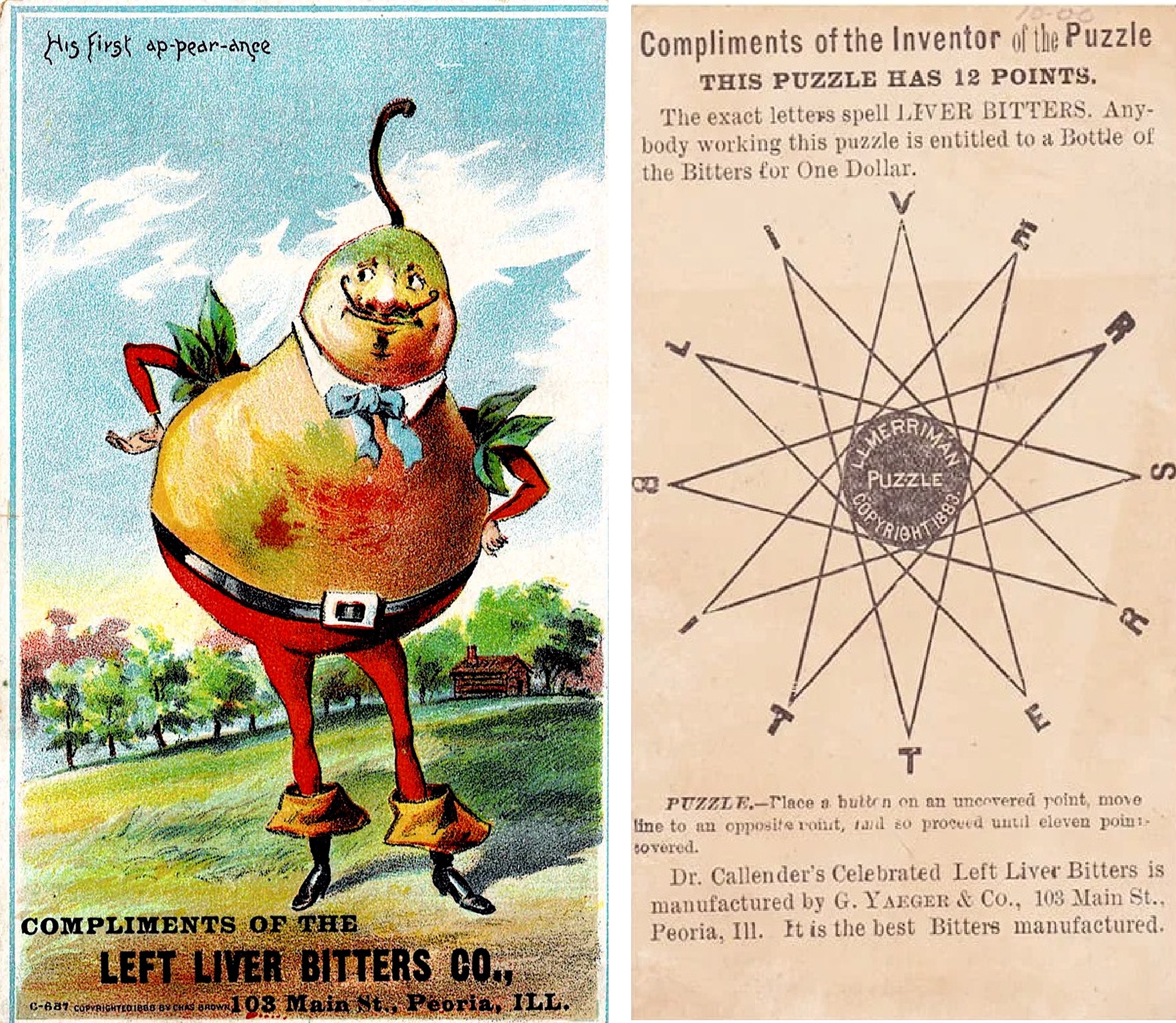
While in Peoria, he patented an alcohol- and vegetable-based tonic that he named the “Callender Left Liver Bitters,” a substance he compounded and peddled in Peoria for the next 20 years. It was also in those days that he became “Dr.” William A. Callender, though it is unclear what medical training, if any, he actually had. According to Dr. Callender, the Callender Left Liver Bitters were “the only bitters that are warranted to cure all diseases of the liver, stomach and blood.” Of course his rivals in the bitters tonics business — which was quite lucrative in the decades from about 1860 to 1905 — made the same claims for their “medicine.” Considering the kinds of purported remedies and cures that were commonly peddled in the 19th century, Dr. William Callender’s Left Liver Bitters were no doubt much more likely to cause, rather than cure, diseases of the liver, stomach and blood.
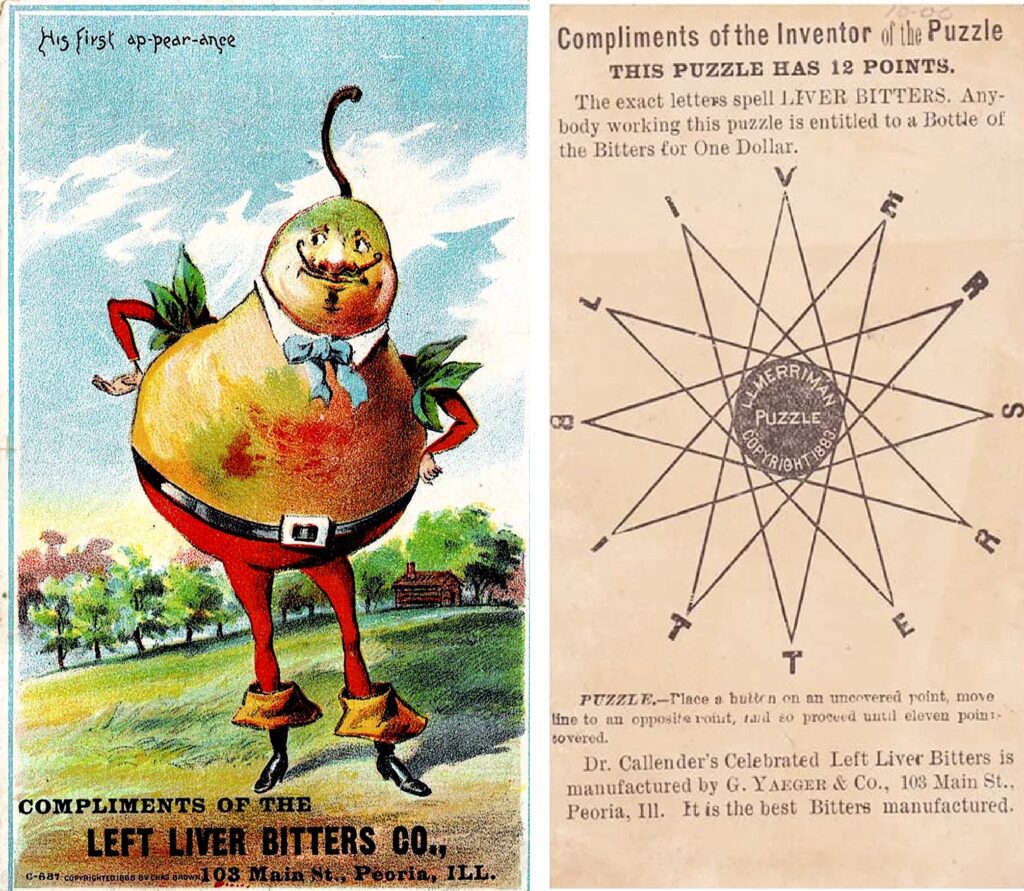
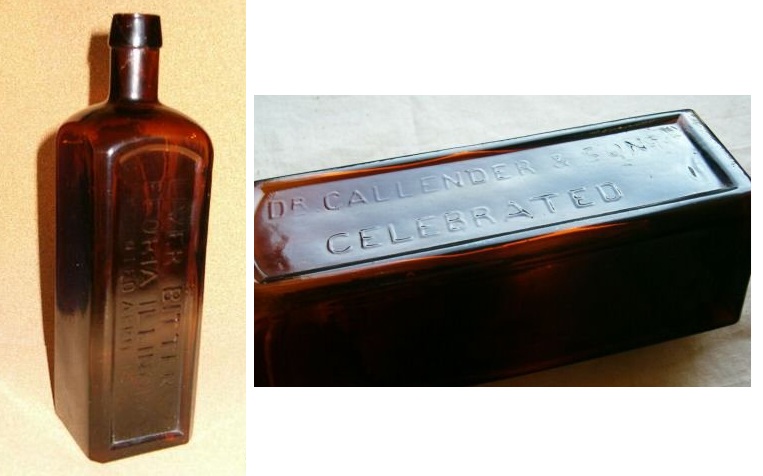
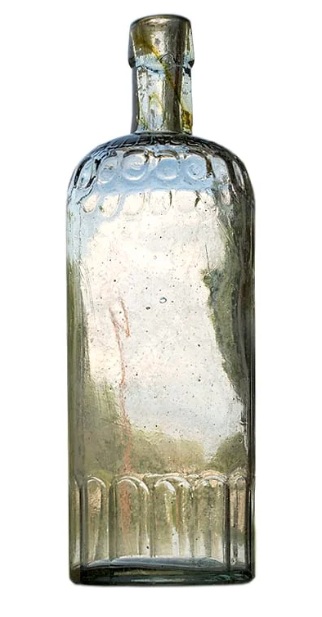
Dr. Callender’s tonic was advertised in newspapers far and wide. One of his ads, from the 16 April 1875 Quad City Times, says, “Callender’s Celebrated Liver Bitters, Prepared for the trade by Dr. Wm. A. Callender & Sons, Peoria, Ill.” Another ad, from the 14 July 1878 Hamilton County Democrat, says, “Dr. Callender’s Celebrated Liver Bitters and Blood Purifier, Patented April 4, 1874. Prepared by the inventor and patentee at his factory at South Adams street, Peoria, Illinois.” A third ad, from the 24 March 1889 Lincoln Evening Call, reads, “Dr. Callender’s Left Liver Bitters, Patent 149,573, Manufactured and for sale at wholesale by Barbero & Callender, Peoria, Ill.“
On 1 Aug. 1892, William moved back to Pekin, bringing the Callender’s Celebrated Left Liver Bitters recipe with him. The 1893 Pekin city directory says that he then resided at the Sherman House hotel at the northeast corner of Second and St. Mary streets. His business partner was Joseph Kemper, and the firm was thus known as Callender & Kemper, located at 229 Court St.
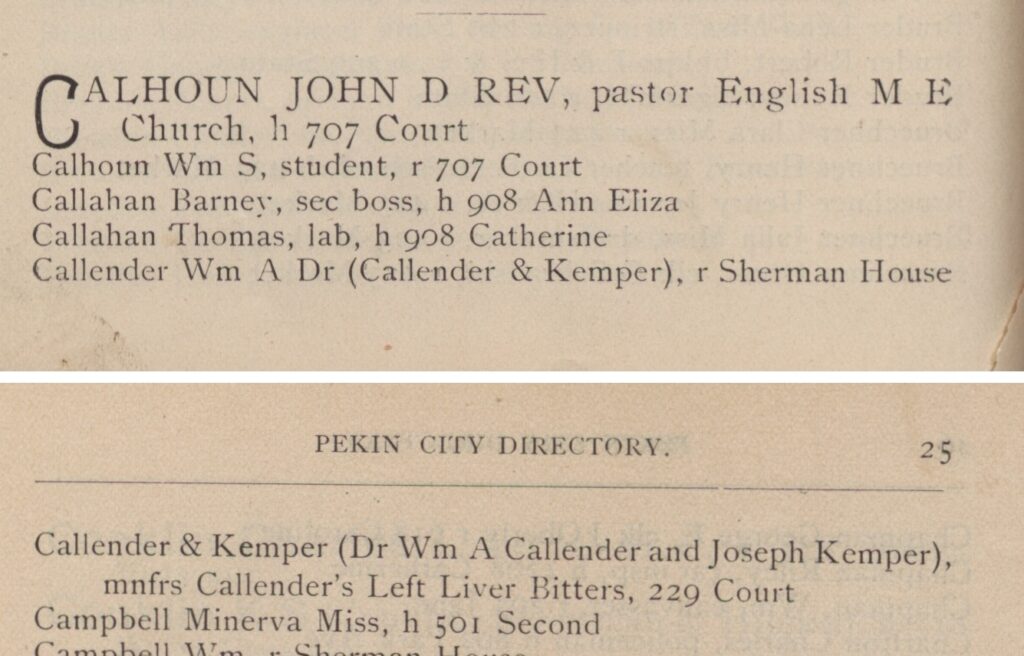
By 1894, the firm was known as William A. Callender & Co. It was in that year that William A. Callender’s biographical sketch was published in “Portrait and Biographical Record of Tazewell and Mason Counties, Illinois” (1894), pages 389-390, as follows —
“HON. WILLIAM A. CALLENDER is a member of the Callender Bitters Company of Pekin, he being the inventor and patentee. This firm is engaged in the manufacture of Left Liver Bitters, and is doing a good business along that line. Our subject was born in Lexington, Ky., October 11, 1818, and is a grandson of Col. Philip Callender, a native of Scotland, who on emigrating to America, settled in Virginia, and when the Revolutionary War broke out, entered the Colonial service and rose to the rank of Colonel. The father, Joseph Callender, was born in Culpeper Court House, Va., and from his native state removed to Kentucky. He engaged in shipping produce down the Mississippi River to New Orleans, and took part in the battle of that city under General Jackson during the War of 1812. Later he returned to Lexington, Ky., and engaged in farming, and afterward followed the same pursuit in New Castle, Ky., where he died at the age of sixty-eight years, his death resulting from injuries caused by a tree falling upon him. He married Ruth Reynolds, who was born in Kentucky of German parentage, and thirteen children graced their union, eleven of whom are yet living.
“William A. Callender is the eldest. He was reared in Henry County, in the heart of the blue grass region of Kentucky, and remained at home until eighteen years of age, when, in 1836, he went to Cincinnati, where he served an apprenticeship to the machinist’s trade. In 1842 he was married in Covington, Ky., to Mary Wolfe, a native of that place. Later he went to Lawrenceburg, Ind., where he built and operated a distillery for several years, after which he built a still house in Ohio. Later his home was in Covington, Ky., but in 1858 [sic – 1848?] he went to Hamilton, Ohio, where he built a distillery with a capacity of twelve hundred bushels. In this line of business he was very successful, but his partners robbed him of $500,000. In 1855 he located in Peoria, and in the year 1858 built the first distillery in Pekin, the Hamburg. He also built the Star Distillery, and erected another in Wesley City, which he carried on for five years. From that time until 1872 he was engaged in the milling business. He then sold out and returned to Peoria, where he invented and engaged in the manufacture of the Callender Liver Bitters, carrying on business at that place until the 1st of August, 1892, when he came to Pekin. He does all the compounding himself, and manufactures the only bitters that are warranted to cure all diseases of the liver, stomach and blood. The firm is now William A. Callender & Co.
“To Mr. and Mrs. Callender were born eight children, but only three are now living: John W., who is now foreman of the A. Lair & Woodward Compounding Company, of Peoria; Lillie, wife of A. Chandler, of Buffalo, N. Y.; and William H., a railroad employee now living in Monticello, Ill. The mother of this family died in Peoria in 1876.
“Mr. Callender has been honored with a number of offices. While in Kentucky he served in the State Legislature for two years, and was a member of the Constitutional Convention of 1848, which framed the present constitution of Kentucky. While in Peoria he served as Alderman for ten years. He has always been a supporter of the Democracy, since 1844 has been a member of the Odd Fellows’ society, since 1850 has been connected with the Masonic fraternity, and since 1868 has been a member of the Universalist Church.”
Though the above biography paints a picture of success, in fact William’s life was on the verge of utter ruin. By the time of the 1900 U.S. Census, he was a boarder at the Tazewell County Alms House east of Pekin in Elm Grove Township. Suffering the physical and psychological effects of many years of alcohol abuse, William was sent to the Alms House in the mid-1890s — around the same time that his 1894 biography was published.
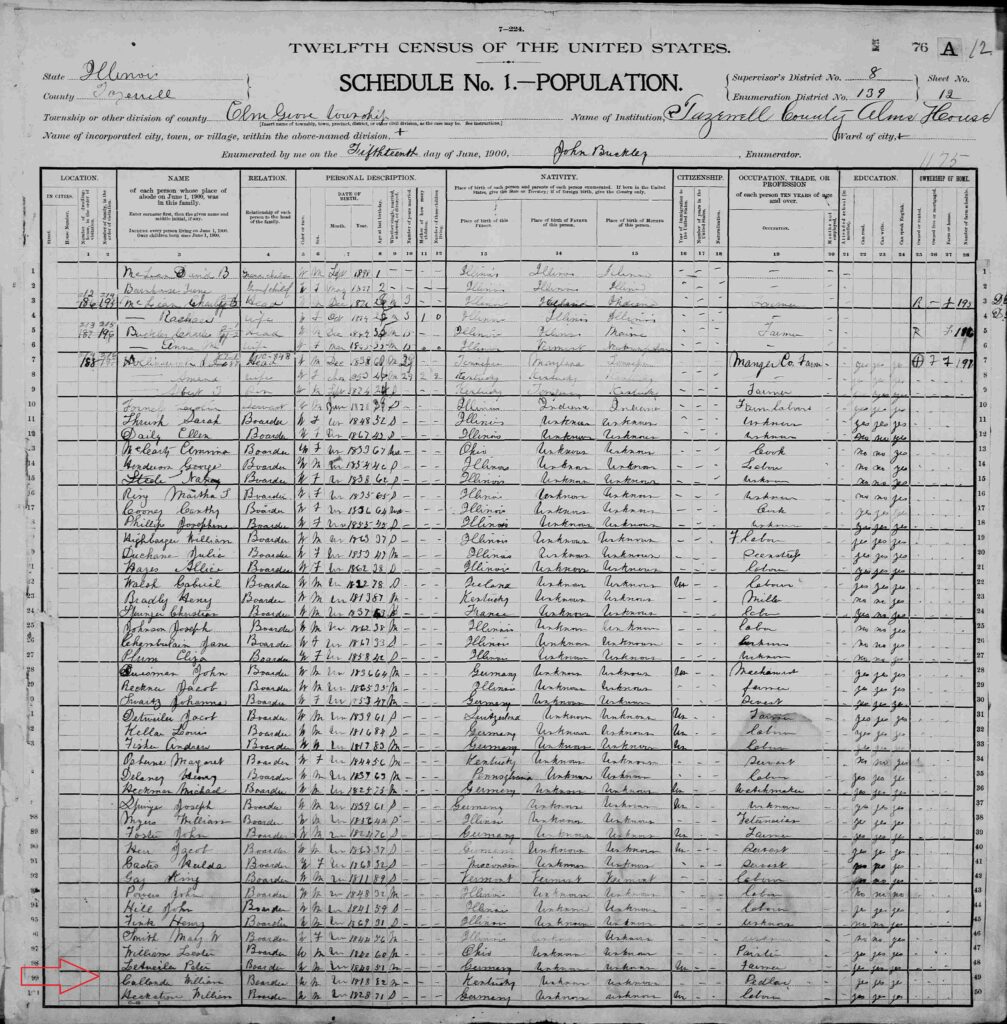
After about a decade at the Tazewell County Alms House, William’s case was brought before a county jury, which determined that he was insane. He was then sent to the Jacksonville State Hospital, where he lived out the rest of his days.
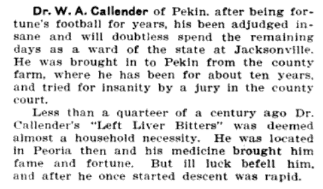
William A. Callender died at the state hospital in Jacksonville, Illinois, on 1 April 1906. Two days later he was buried in the state hospital cemetery, Diamond Grove Cemetery, his grave site marked only by a stone index number.